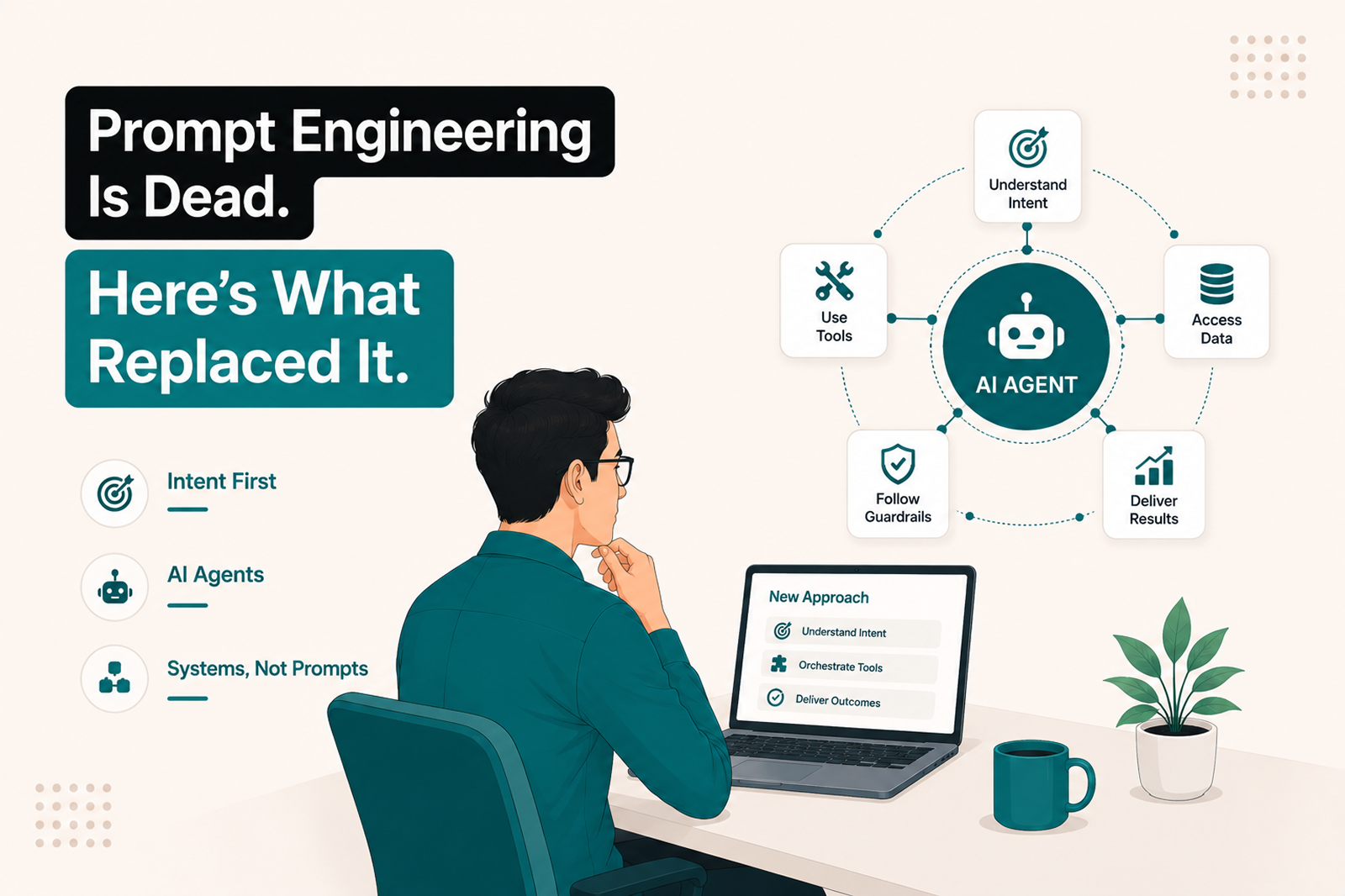
For about two years, prompt engineering was the skill everyone put on a resume. Write the magic words, tell the model it is a world-class expert, maybe promise it a tip, and it would behave. That era is mostly over. Clever phrasing still helps at the edges, but it is not what makes an AI product reliable once real users show up, and the decision-makers I talk to have started to feel the gap between a demo that dazzles and a system that holds. When a company comes to us for AI development now, the hard part is almost never the prompt. It is the context.
Here is the shift in one line. The instruction you type is a tiny slice of what the model actually reads before it answers, often around five percent. The other ninety-five percent is context: the documents you retrieved, the conversation so far, the tool outputs, the data you fed in, and just as much, the noise you chose to leave out. Engineering that ninety-five percent is the real reliability lever, and the discipline now has a name. Context engineering.
of IT and data leaders say prompt engineering alone can no longer power AI at scale
of data teams plan to invest in context-engineering training this year
the share of the model's input that is your actual typed instruction
Is prompt engineering really dead?
The short answer: the buzzword is dead, and the useful part of it got absorbed into something bigger. Writing a clear, unambiguous instruction still matters and always will. But prompt engineering as a standalone craft, the trick lists, the "you are a world-class expert" openers, the one magic system prompt that supposedly fixes everything, no longer carries a serious AI product. It never really did.
Two things killed it. First, the models got better and far less sensitive to phrasing. The gap between an average prompt and a heavily tuned one has narrowed a lot since 2023, so the payoff from wordsmithing shrank. Second, teams shipped these systems to real users and watched them fail in ways no prompt could rescue: wrong facts, stale data, confident nonsense. That is why, in the 2026 State of Context Management Report, 82 percent of IT and data leaders now say prompt engineering alone can no longer power AI at scale. They are not saying prompts do not matter. They are saying prompts are not the bottleneck.
What context engineering actually means
Context engineering is the practice of deciding what information a model sees at the moment it answers, and in what form, order, and quantity. It is four jobs, not one: retrieval (pulling the right facts), compression (fitting them into a limited window), ordering (what the model reads first), and omission (what you deliberately keep out). Get those right and a mid-tier model looks brilliant. Get them wrong and the best model on the market hallucinates.
It helps to think of it as information architecture for the model, not copywriting. You are not persuading the model with a better sentence. You are assembling the right briefing pack so it does not have to guess. That work sits much closer to data engineering and search than to the prompt tinkering that got all the attention. The prompt is the cover note on the pack. The context is the pack, and the pack is what decides whether the answer is right.
Why the shift happened now
Three things changed at roughly the same time, and together they moved the center of gravity from the prompt to the context. None of them is hype. They are just the plumbing of how modern AI products get built.
- Context windows got huge. Models went from a few thousand tokens to hundreds of thousands. Suddenly the question was not "how do I phrase this" but "what do I put in all this space, and what do I keep out."
- Retrieval went mainstream. Grounding answers in your own live data, the pattern behind RAG versus fine-tuning versus prompt engineering, became the default way to make a bot trustworthy. Retrieval quality is a context problem, not a prompt problem.
- Agents arrived. The moment a system takes multiple steps and calls tools, its context fills with history and tool outputs on every turn. Managing that growing pile well is the whole game.
The 95 percent: what really goes into a context window
When people picture "the prompt," they picture the sentence they typed. In a real product, that sentence is maybe five percent of what the model receives on any given call. Here is what actually fills the window before the model writes a single word:
- The system instruction - your rules and role. Important, but small. This is the classic "prompt."
- Retrieved documents - the policy pages, records, and knowledge pulled in to answer this specific question.
- Conversation history - everything said so far in the session, which grows with every turn.
- Tool and function outputs - what the database, API, or search returned, often verbose and messy.
- Examples and schema - formats, sample answers, and the exact shape you want back.
The model reads all of it as one blob and cannot tell your careful instruction from a stale document someone forgot to remove. That is why engineering the whole window matters more than polishing one line. It is also why 95 percent of data teams plan to invest in context-engineering training this year, per the same 2026 report. The skill did not disappear. It moved.
Prompt engineering vs context engineering
They are not opposites, and you still do a little of the first inside the second. But the scope, the skills, and where the reliability comes from are genuinely different. A prompt is a sentence one person can tweak in an afternoon; context is a system that a team designs, tests, and maintains. Here is the side by side we walk clients through.
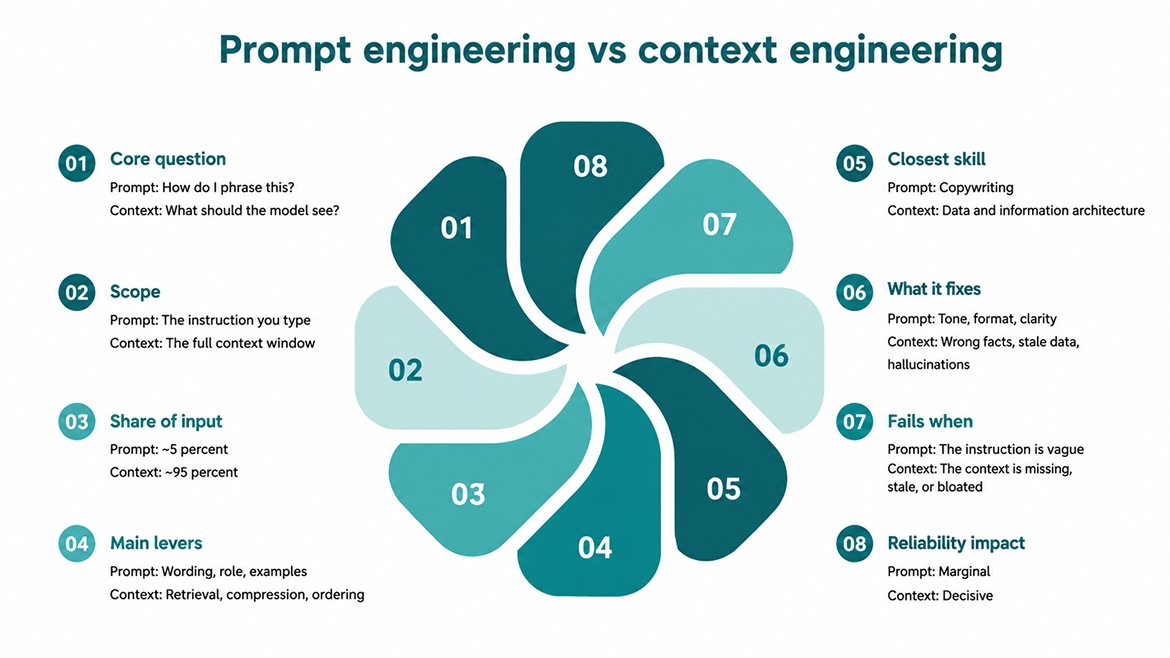
| Dimension | Prompt Engineering | Context Engineering |
|---|---|---|
| Core question | How do I phrase this? | What should the model see? |
| Scope | The instruction you type | The full context window around it |
| Share of the input | ~5 percent | ~95 percent |
| Main levers | Wording, role, examples | Retrieval, compression, ordering, omission |
| Closest skill | Copywriting | Data and information architecture |
| What it fixes | Tone, format, clarity | Wrong facts, stale data, hallucinations |
| Fails when | The instruction is vague | The context is missing, stale, or bloated |
| Reliability impact | Marginal | Decisive |
What this means for teams building on AI
If you are commissioning or running an AI project, the practical takeaway is this: you are building a data and retrieval problem, not a wordsmithing problem. The budget, the talent, and the review time should follow the 95 percent. That reframes a lot of decisions. Which model you pick matters less once your context is solid, and even the question of how to choose an LLM becomes secondary to how well you feed it. It also changes how you evaluate a build: a scripted demo tells you almost nothing, because demos run on clean, hand-picked context. What you want to see is the system answering messy, real questions against your live data.
The context mistakes that cause hallucinations
Most hallucinations I see in production are not model failures. They are context failures. The model was handed a bad briefing pack and did what models do, which is fill the gap with a confident guess. The usual culprits, in rough order of how often they bite:
- Stale data. The retrieved document is months old, so the "fact" the model repeats is simply out of date.
- Missing context. The right answer was never retrieved, so the model improvises one that sounds plausible.
- Too much context. The window is stuffed with marginally relevant text and the one key fact gets lost in the noise.
- Contradictory context. Two retrieved sources disagree and nobody told the model which one wins.
- Bad ordering. The critical fact sits at the bottom of a long dump, where it gets the least attention.
Notice that none of these gets fixed by a better sentence. They get fixed by better retrieval, fresher data, tighter compression, and clear rules for conflicts. That is context engineering, and it is the whole difference between a bot that sounds right and one that is right.
How we build on context, not prompt tricks
Our starting assumption on every build is that the model is good enough and the context is where projects are won or lost. So before anyone argues about wording, we map what the system needs to know, where that knowledge lives, how fresh it has to be, and how we will retrieve exactly the right slice at answer time. The prompt comes last, and it is short. This is the approach we take across our custom AI development work, and it is why our systems tend to hold up long after the demo is over.
We are a CMMI Level 5 team of 80-plus engineers who have delivered for 700-plus companies, and the last two years taught us the same lesson over and over: the teams still chasing the perfect prompt are debugging symptoms, while the teams engineering context are fixing causes. If you are weighing an AI build and are not sure whether your problem is a prompt problem or a context problem, tell us what you are trying to build and we will show you where the reliability is really going to come from. It is almost always the 95 percent.
Frequently Asked Questions
Is prompt engineering dead in 2026?
Mostly, as a standalone skill. A clear instruction still matters, but the trick lists and magic phrasing no longer carry a real AI product. In our 2026 work, reliability comes from context engineering, what the model retrieves and reads around your instruction, not from one clever prompt. The prompt is maybe five percent of the job.
What is context engineering?
Context engineering is the practice of deciding what a model sees when it answers: which facts you retrieve, how you compress them to fit the window, what order they arrive in, and what you deliberately leave out. It is closer to data work and information architecture than to wordsmithing, and it is where production reliability actually comes from.
What is the difference between prompt engineering and context engineering?
Prompt engineering tunes the instruction you type, its phrasing, role, and examples. Context engineering builds everything else the model reads: retrieved documents, history, tool outputs, and the noise you filter out. The prompt is roughly five percent of the input; context is the other ninety-five. One is a sentence. The other is a system.
Does context engineering reduce hallucinations?
Yes, more than any prompt trick. Most hallucinations we see in production are context failures, where the model was handed stale, missing, contradictory, or bloated information and filled the gap with a guess. Fix retrieval, ground answers in current data, and trim irrelevant context, and the made-up answers drop sharply.
Do we need to hire context engineers?
Usually not a new title. You need your existing AI and data people working the context layer instead of chasing prompts, which means retrieval, data pipelines, evaluation, and monitoring. Most teams already have the skills; they just have to point them at the 95 percent. If you are outsourcing, ask a vendor how they handle retrieval and grounding, not what prompts they use.
Have a project in mind? Let's scope it together.
You get a named team, written estimates, full code and IP ownership, and 48-hour response times. CMMI Level 5 certified. 700+ projects delivered across the UK, US, UAE, and Australia.