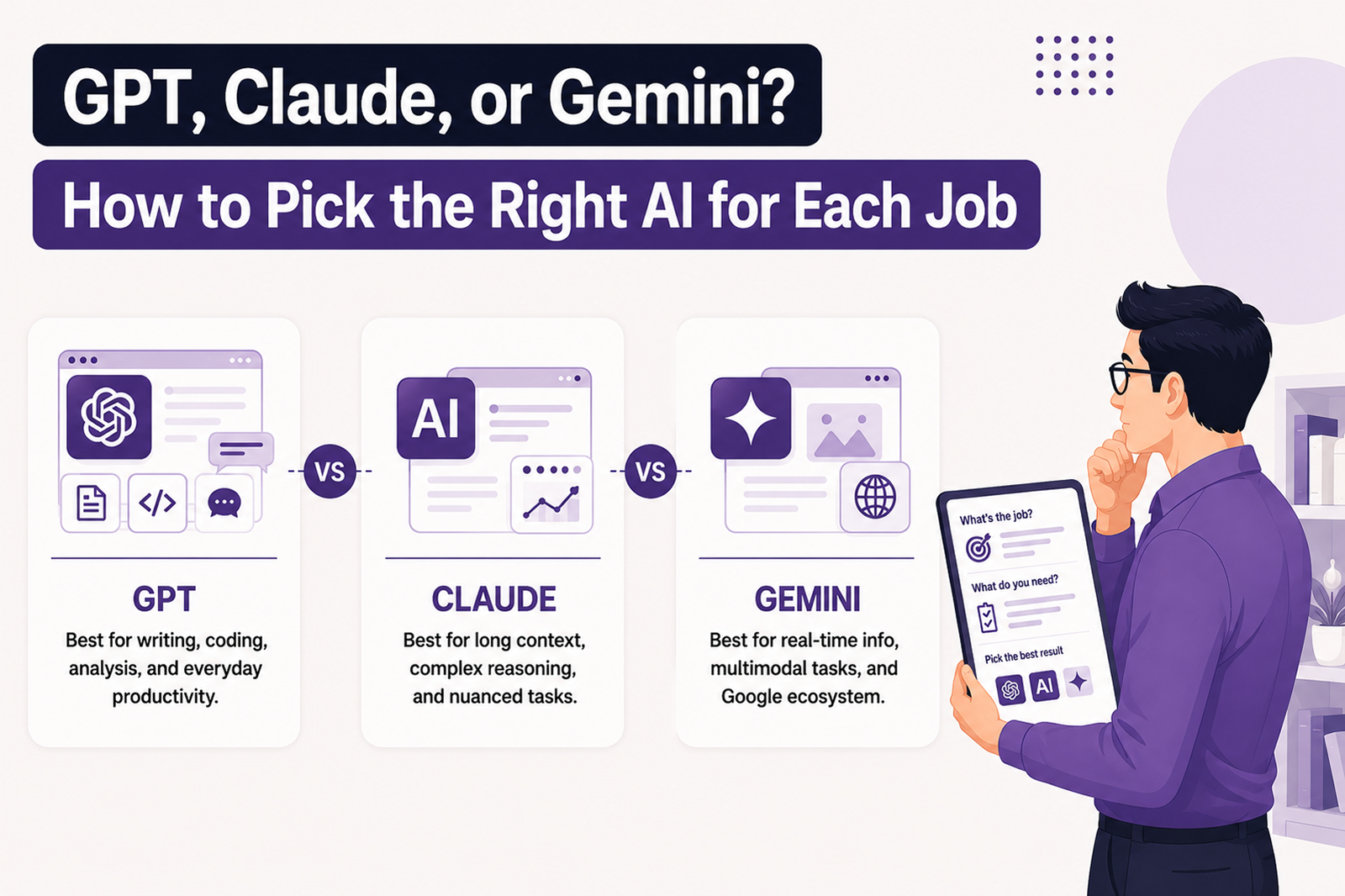
Every week someone asks me the same question: "GPT, Claude, or Gemini - which one should we use?" It is the wrong question, and the honest answer surprises people. You do not pick one. The teams shipping real products in 2026 route work across several models, because the model that wins a benchmark this month is rarely best for every job, and it is often beaten by next month. When a client hires us for AI development, the first thing we kill is the spec-sheet shootout, because it sends you chasing a single "best model" that does not exist.
Here is the frame that actually works: choose by workload, not by brand. Reasoning is one job. High-volume text generation is another. Images and audio are a third. Anything touching regulated or private data is a fourth. Each of those wants a different kind of model, and the smart move is to run a few of them behind one gateway so you can swap, mix, and fall back without rewriting your product. Let me walk through how we make that call.
Share of enterprises now standardizing on more than one AI vendor, not a single model
How fast a "best model" leaderboard ranking tends to go stale
Models a serious product often routes across behind one gateway
The real question when choosing an LLM in 2026
The real question is not "which model is best" but "which model for which job." No single LLM leads on reasoning, cost, speed, multimodal, and privacy all at once, and the rankings reshuffle almost monthly. So the useful decision is not a one-time pick. It is a routing policy that sends each type of work to the model that suits it.
I have watched teams burn a month comparing benchmark scores, sign with the "winner," and then find the model got leapfrogged before they shipped. Benchmarks measure the wrong thing for your product anyway. What matters is how a model does on your prompts, your data, your latency budget, and your bill, and whether you can change your mind cheaply when the field moves. Treat model choice as a reversible decision and most of the anxiety goes away. The stakes on any one pick are lower than the vendor pitch decks want you to believe.
How GPT, Claude, and Gemini actually differ for real work
For real work the three big families cluster into tendencies, not hard rules. Broadly: the GPT line is the flexible generalist with the deepest tooling and ecosystem, Claude is strong on careful reasoning, long-form writing, coding, and following instructions faithfully, and Gemini leans into very large context and native multimodal across text, images, and audio. Every vendor is chasing the others, so these edges narrow constantly.
That is why I refuse to write "Model X is the best coding model" in a blog post. It may be true the week I write it and wrong the week you read it. The durable advice is about categories of strength, so pick based on the shape of your workload: instruction-heavy and reasoning-heavy work, raw generation at volume, or multimodal input. And remember the base model is only half the story. How you adapt it often matters more than which brand you start from, and if you are weighing those options our guide to RAG, fine-tuning, and prompt engineering covers when each one earns its keep.
When an open-source model makes sense
Open-source models - Llama, Mistral, Qwen, and the rest - make sense in three situations: when your data cannot leave your own infrastructure, when you run high enough volume that per-token pricing hurts, or when you need to fine-tune deeply and own the weights. You trade a little frontier reasoning for control, privacy, and cost.
The mistake is treating open versus closed as a loyalty test. It is a workload decision like any other. A frontier hosted model is often the right call for your hardest, lowest-volume reasoning, while a smaller open model quietly handles the millions of easy classification or extraction calls underneath it for a fraction of the price. You do not have to pick a camp. In fact many of the highest-volume jobs never needed a frontier model at all, and our piece on when a small language model does the job gets into where the smaller, cheaper option is not just acceptable but better.
What model routing and an AI gateway actually are
An AI gateway is a single layer your application talks to instead of calling each vendor directly. It takes a request, decides which model should handle it - by job type, cost, latency, or fallback rule - and returns the answer. Model routing is the policy inside that gateway. Together they turn "which model" from a hard-coded dependency into a setting you can change.
Once that layer exists, a lot of good things get easy. You send reasoning-heavy prompts to a strong model and cheap bulk work to a cheap one. You fail over automatically when a provider has an outage or rate-limits you. You get one place for API keys, logging, spend caps, and audit trails instead of credentials scattered through your code. And when a better or cheaper model launches, you point a few requests at it, compare, and roll it out with no rewrite. This is not a fringe practice: more than a third of enterprises now run more than one AI platform, and the share keeps climbing. It is why a serious product often has three or four models live behind one gateway at a time.
A workload-to-model decision matrix
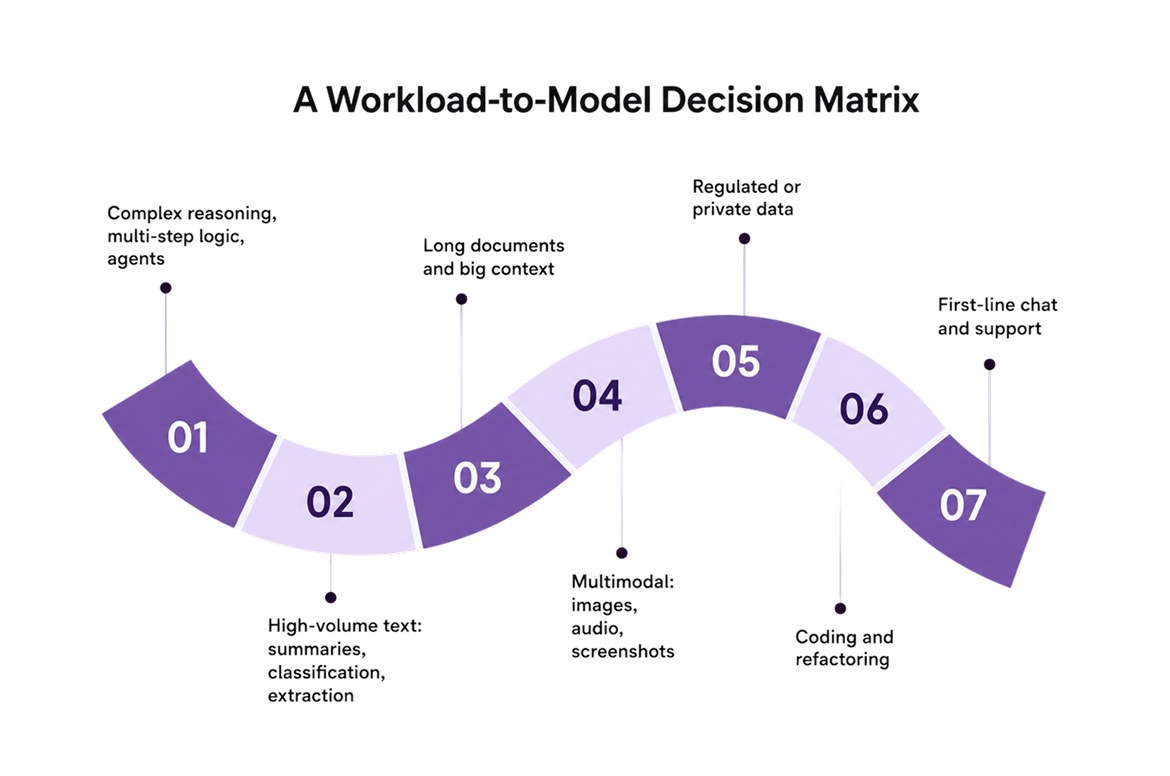
Here is the matrix we actually use to route work. It maps the job to the kind of model that fits, not to a brand name, because the brand that best fills each row will change. Find your workload on the left, and the right two columns tell you what to reach for and why.
| Workload | Model tier to reach for | Why |
|---|---|---|
| Complex reasoning, multi-step logic, agents | Top frontier reasoning model | Accuracy and planning matter more than cost; volume is usually low |
| High-volume text: summaries, classification, extraction | Small, mid, or open model | Cheap and fast wins; the task is well-defined and repetitive |
| Long documents and big context | Large-context model | Fits whole contracts or codebases into a single call |
| Multimodal: images, audio, screenshots | Native multimodal model | Built to read more than plain text |
| Regulated or private data | Open or private-tenant model | Data stays on your infrastructure; residency and audit control |
| Coding and refactoring | Strong coding-tuned model | Instruction-following and code quality carry the work |
| First-line chat and support | Small fast model, escalate hard cases | Most turns are easy; only route the hard ones up |
Notice that not one cell says "always use Model X." The cells describe tiers. Your gateway maps each tier to whichever specific model is winning that category this quarter, and you update the mapping as the field moves. The policy is durable even though the names on it are not.
How much model choice should drive your cost
Less than the marketing implies. The per-token price gap between comparable models is real but small next to the things you actually control: how big your prompts are, how much context you retrieve, how many retries you allow, and how often you call the model at all. Fix those and the vendor's sticker price becomes a rounding error.
The biggest lever is routing itself. Sending easy work to a cheap model and reserving the expensive one for genuinely hard requests routinely cuts spend by more than switching vendors ever would. The second lever is not calling the model when you do not need to, so cache, pre-filter, and short-circuit. I have seen a "we need a cheaper model" problem turn out to be a "we are sending the whole database in every prompt" problem. If you want the full picture of where AI money goes, our breakdown of what an AI build actually costs lays out the line items well beyond the model bill.
How to avoid locking into one vendor
Avoiding lock-in comes down to one rule: never let a single provider's SDK spread through your codebase. Put a gateway or a thin abstraction between your app and the models, keep prompts and evaluation sets provider-neutral, and keep at least one alternative model tested and ready in staging. Then switching is a config change, not a rewrite.
Lock-in is not only about price. A model you depend on can be deprecated, change its behavior in an update, tighten rate limits, or restrict your use case. If your entire product assumes one model's exact quirks, any of those events becomes an emergency. Provider-neutral plumbing turns them into a routine Tuesday. A short checklist we hold clients to:
- Call a gateway or abstraction, never a vendor SDK directly from feature code.
- Keep a versioned eval set so you can score any candidate model on your own tasks.
- Store prompts as data you can re-target, not hard-coded to one model's format.
- Run a second model in shadow or staging so a switch is proven, not hoped for.
How we pick a model per workload at Shanti
Our process is boring on purpose. We list the jobs your product needs an LLM to do, sort each into a tier - reasoning, bulk generation, multimodal, or regulated - and map each tier to a current best-fit model behind a gateway from day one. Then we measure on your prompts and your bill, not on a leaderboard, and we keep a cheaper fallback wired in for every tier.
That is it. No brand loyalty, no betting the product on one vendor, no re-architecture every time a new model trends. We are a CMMI Level 5 team of 80-plus engineers, and across 700-plus projects the pattern holds: the winners treat models as swappable parts and spend their energy on the workload, the data, and the guardrails around it. The model names on the invoice will change. Your routing policy should not have to.
If you are staring at the GPT-versus-Claude-versus-Gemini question and want a straight answer for your specific product, tell us what you are building and we will map your workloads to the right models, gateway and all, and tell you where a cheaper or open model does the job just as well.
Frequently Asked Questions
Which LLM should I use for my product in 2026 - GPT, Claude, Gemini, or open source?
There is no single winner, and picking one is the wrong question. Match the model to the job: a strong reasoning model for complex logic, a fast cheap model for high-volume text, a native multimodal model for images and audio, and an open or private model when data cannot leave your walls. Serious products route across three or four models, not one.
What is an AI gateway or a model router?
An AI gateway is a single layer your app calls instead of calling OpenAI, Anthropic, or Google directly. It routes each request to the right model by job, cost, or fallback rule, and it gives you one place for keys, logging, rate limits, and spend caps. Swapping or adding a model becomes a config change, not a rewrite.
When does an open-source model like Llama, Mistral, or Qwen make sense?
Open models fit in three cases: when data must stay on your own infrastructure, when you run very high volume and want to cut per-token cost, or when you need to fine-tune deeply and own the weights. They trade a little frontier reasoning for control and price. For a lot of narrow, high-volume jobs, a smaller open model is plenty.
Does the choice of LLM really drive my cost?
Less than most people think. Prompt size, how much context you retrieve, retries, and how often you call the model usually swamp the per-token price gap between vendors. Routing cheap models to easy work and reserving expensive models for hard work saves far more than chasing whichever vendor is a few cents cheaper this month.
How do I avoid getting locked into one AI vendor?
Do not hard-wire one provider's SDK across your codebase. Put a gateway or thin abstraction between your app and the models, keep prompts and evals provider-neutral, and keep one alternative model tested in staging. If your only model doubles its price or degrades, switching should be a config change, not a quarter of engineering work.
Have a project in mind? Let's scope it together.
You get a named team, written estimates, full code and IP ownership, and 48-hour response times. CMMI Level 5 certified. 700+ projects delivered across the UK, US, UAE, and Australia.