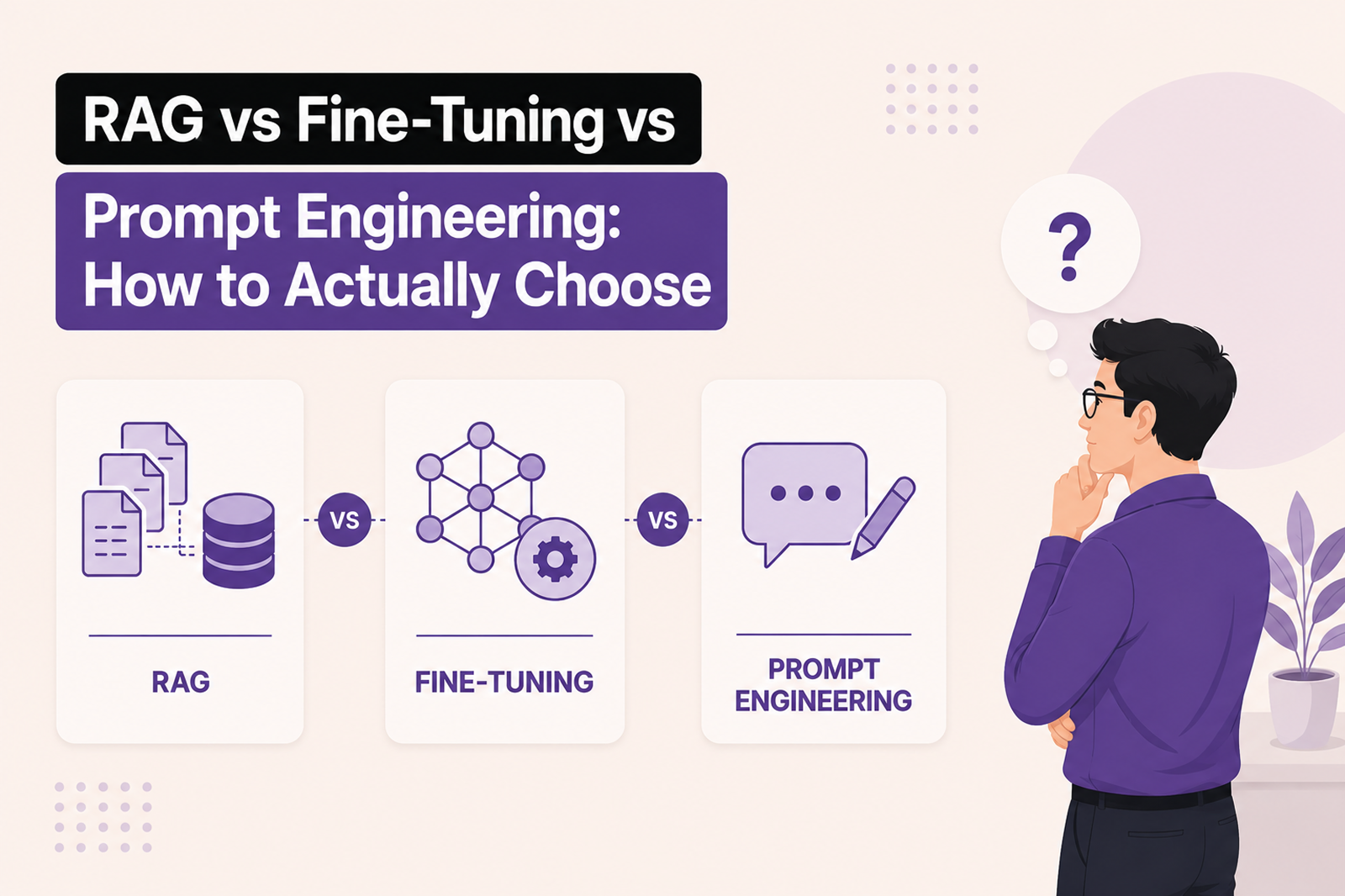
Almost every AI conversation we have with a founder starts the same way. They have a use case, they have heard the words "RAG" and "fine-tuning" thrown around by a vendor or a blog, and they are not sure which one they need. Usually they think they need fine-tuning because it sounds the most serious, and usually they do not. This is the exact question we untangle first on any AI development engagement, before a line of code gets written.
The short answer: Prompt engineering shapes how the model responds and costs almost nothing. RAG feeds the model your private, current data at question-time so it can answer from facts it never saw in training. Fine-tuning changes the model's behavior and style by retraining it on examples. Most business use cases need good prompting plus RAG. Far fewer actually need fine-tuning. They are not competitors; they stack.
of the demo-to-usable gap we close early comes from prompting alone, before any model change
to refresh a RAG answer after a source doc edit, versus a full retrain for fine-tuning
of clean labeled examples is the floor before fine-tuning is worth the cost
What is prompt engineering, in plain terms?
Prompt engineering is writing clear instructions so the model behaves the way you want, without changing the model itself. You are not retraining anything. You are giving better directions, examples, constraints, and structure inside the request. It is the cheapest lever with the biggest early payoff, and people underrate it because it sounds too simple to matter.
In our projects, a well-structured system prompt with two or three worked examples often closes 70 percent of the gap between "the demo is embarrassing" and "this is usable." We have rescued projects that a client thought needed a custom model, purely by rewriting the prompt and adding a few examples. What prompt engineering covers in practice:
- A system prompt that defines role, tone, rules, and what to refuse.
- Few-shot examples that show the exact input-to-output shape you want.
- Output structure (force JSON, force a fixed set of fields, force step-by-step reasoning before the answer).
- Guardrails like "if you are not sure, say you are not sure" instead of inventing an answer.
What it cannot do: it cannot give the model facts it does not have. If you ask about your refund policy and that policy was never in training data or the prompt, no clever wording will produce the right answer. It will produce a confident wrong one. That is the exact problem RAG solves.
What is RAG (retrieval augmented generation)?
RAG means that before the model answers, you search your own data, pull the most relevant pieces, and paste them into the prompt as context. The model then answers using those facts instead of guessing from memory. Retrieval first, generation second. That is the whole idea, and it is why RAG is the right default for most business assistants.
Think of it like an open-book exam. The student (the model) is smart but does not have your company handbook memorized. So right before each question, you slide the three most relevant pages in front of them. They read those pages and answer. Tomorrow you update a page, and the answer updates automatically, because nothing was baked into the student's brain.
This matters because your data changes. Prices change, policies change, inventory changes, support articles get rewritten. With RAG you update the source document and the AI is current within minutes. With fine-tuning you would have to retrain. A real example from our work: a support assistant over a knowledge base of a few thousand articles. The team edits an article in their existing help desk, our pipeline re-indexes it overnight, and the assistant answers from the new version the next morning, with no engineer in the loop.
What is fine-tuning and when do you really need it?
Fine-tuning means taking a base model and continuing its training on a curated set of your own examples, so a behavior, style, or format becomes second nature. You are changing the model's weights. It learns a pattern, not facts. Done well, it makes the model reliably do a narrow thing in a consistent way. The line we hold with clients is simple: fine-tune for behavior and form, not for knowledge.
If you want the model to always answer in your brand voice, always classify tickets into your exact 14 categories, or always produce output in a strict shape that prompting alone keeps drifting from, fine-tuning earns its cost. If you want it to know facts that change, do not fine-tune. Use RAG. When fine-tuning is genuinely worth it:
- A high-volume, narrow, repetitive task (classification, extraction, routing) where you have hundreds to thousands of clean labeled examples.
- A specific output format or tone that prompting keeps getting almost-right but not consistently right.
- A latency or cost target where you want a smaller, cheaper model to behave like a bigger one on your one task.
When it is the wrong tool:
- You have fewer than a few hundred good examples. The result will be unreliable.
- The knowledge changes often. You will be retraining forever.
- You have not tried serious prompting and RAG yet. Reaching for fine-tuning first is the most common expensive mistake we see.
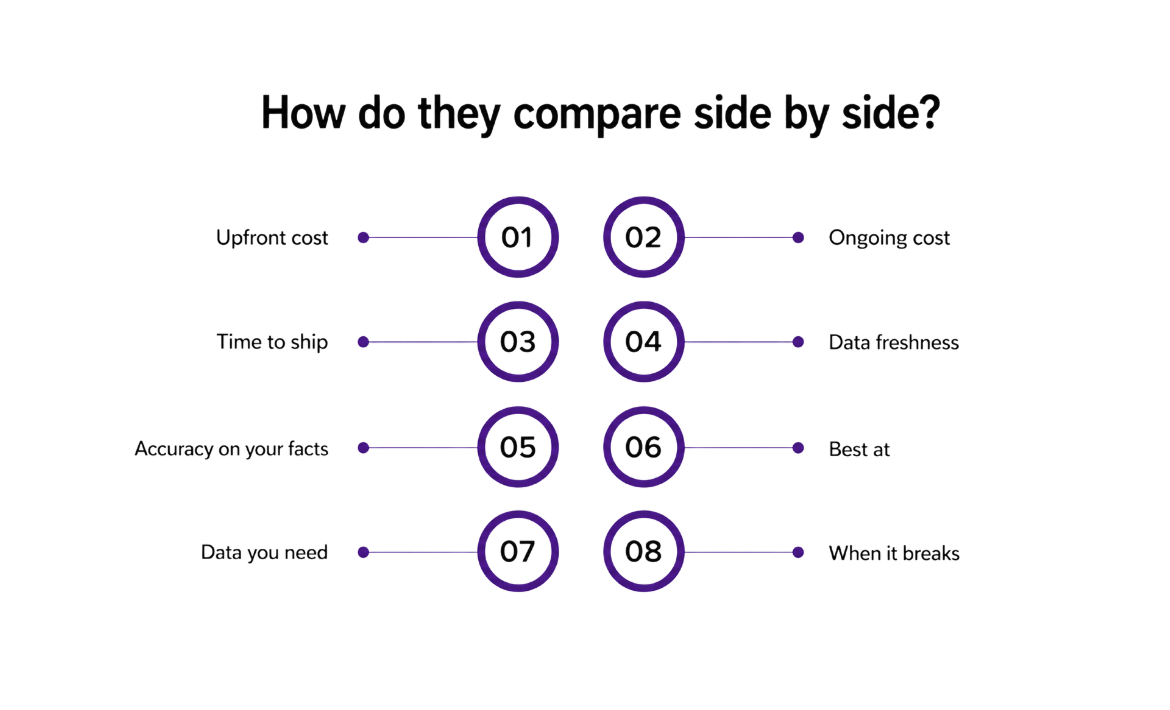
How do they compare side by side?
The three approaches rarely point at the same job, so the honest way to read the table below is by column. These are directional, real-world ranges from how we scope projects, not lab benchmarks. Match the row that hurts most in your use case (cost, freshness, or consistency) to the column that wins it.
| Factor | Prompt Engineering | RAG | Fine-Tuning |
|---|---|---|---|
| Upfront cost | Lowest (hours of work) | Medium (build retrieval + pipeline) | Highest (data prep + training + eval) |
| Ongoing cost | Negligible | Indexing + slightly larger prompts | Retrain when data or behavior changes |
| Time to ship | Days | Weeks | Weeks to months |
| Data freshness | Only as fresh as the prompt | Live: update the source, done | Frozen at training time |
| Accuracy on your facts | Poor for unseen facts | High when retrieval is good | High for the pattern, not new facts |
| Best at | Behavior, format, guardrails | Answering from private, changing data | Consistent narrow behavior at scale |
| Data you need | A few good examples | Clean, searchable documents | Hundreds to thousands of labeled examples |
| When it breaks | Model lacks the facts | Bad retrieval means bad answers | Too little or messy training data |
Notice that the columns almost never overlap. That is the real insight. The question is rarely "which one," it is "which combination, in what order." For a fuller map of the build choices around these techniques, our guide to custom AI development covers how the pieces fit together on a real project.
How do you choose for a business use case?
Start at the cheapest layer and only climb when a real, measured ceiling forces you to. We use this order on almost every engagement, and it keeps budgets honest. Walk these five questions top to bottom and stop at the first "yes" that solves your problem.
- Can a better prompt fix it? Rewrite the system prompt, add examples, constrain the output. Measure. You will be surprised how often you stop right here.
- Does it need facts the model does not have, or facts that change? If yes, you need RAG. This covers most support bots, internal search, document Q-and-A, and policy assistants.
- Is the behavior or format still drifting after good prompting plus RAG? Only now consider fine-tuning, and only for that narrow behavior.
- Do you have the data fine-tuning actually requires? If you cannot point to hundreds of clean labeled examples, the answer is not yet. Go collect them or skip it.
- What does failure cost? Higher stakes justify more investment in evaluation and guardrails across all three layers, not just more model complexity.
How do the three combine in a real build?
They combine in layers, cheapest first. In almost every project the base layer is a strong prompt, the second layer is RAG so answers stay current, and fine-tuning is an optional top layer for one stubborn behavior. You do not pick one and discard the rest; you assemble the smallest stack that hits your quality bar.
A typical path looks like this. Ship a prompted assistant, measure where it fails, then add RAG for the questions that need your private or changing data. If a narrow behavior (a strict output format, a fixed set of categories, a brand voice) still drifts after that, fine-tune a small model for just that slice while RAG keeps feeding it live facts. That combination, a fine-tuned model reading retrieved context, is common and powerful: the model is consistent in form, current in content.
The choice also depends on what you are building. If you are still deciding whether you need something that acts on its own versus something that just answers, our breakdown of an AI chatbot versus an AI agent is the better starting point, because the customization choice follows from what the thing is supposed to do.
How we approach this at Shanti Infosoft
Our bias is to spend your money in the right order. We almost always begin with prompting and a clean RAG layer, because that ships value in weeks and keeps your data current without locking anything in. We reach for fine-tuning when the use case is narrow, the data exists, and we can show that prompting and retrieval have hit a real wall, not before.
The point of all three techniques is the same: a system that gives correct, useful answers your team and customers can trust. It is the same discipline behind getting found by AI systems, which we cover in what answer engine optimization (AEO) is. If you are weighing RAG against fine-tuning for a specific project and want a straight answer about which layers you actually need, tell us your use case and we will map it to your data and budget honestly, even if that means talking you out of the expensive option.
Frequently Asked Questions
Do I need fine-tuning to build an AI assistant for my business?
Usually not. Most business assistants need good prompt engineering plus RAG over your own content, which keeps answers current and ships in weeks. Fine-tuning changes model behavior, not knowledge, so it fits narrow repetitive tasks once you have data and a measured reason. See our note on custom AI development for where each fits.
What is the difference between RAG and fine-tuning?
RAG searches your data at question-time and feeds the relevant pieces into the prompt, so the model answers from live facts it never saw in training. Fine-tuning retrains the model on examples so a behavior, tone, or format becomes second nature. RAG is for changing knowledge; fine-tuning is for consistent narrow behavior.
How much does each approach cost to build?
Prompt engineering is the cheapest, often just hours of work. RAG is medium: you build a retrieval pipeline and index your documents, usually weeks. Fine-tuning is the most expensive because it needs data preparation, training, and evaluation, and you retrain whenever the behavior or data changes.
Can I combine prompt engineering, RAG, and fine-tuning?
Yes, and you usually should. They stack rather than compete. The common default is solid prompting plus RAG over your content. You add fine-tuning later, only for a specific narrow behavior that keeps drifting after good prompting and retrieval. Start at the cheapest layer and climb only when a measured ceiling forces it.
Why do RAG projects fail?
Most failed RAG projects are data and retrieval problems, not model problems. If documents are messy, contradictory, or chunked badly, the model gets bad context and gives bad answers, and people blame the AI. A demo over three hand-picked documents hides how the system behaves over your real, messy corpus. Fix retrieval and data quality first.
Have a project in mind? Let's scope it together.
You get a named team, written estimates, full code and IP ownership, and 48-hour response times. CMMI Level 5 certified. 700+ projects delivered across the UK, US, UAE, and Australia.