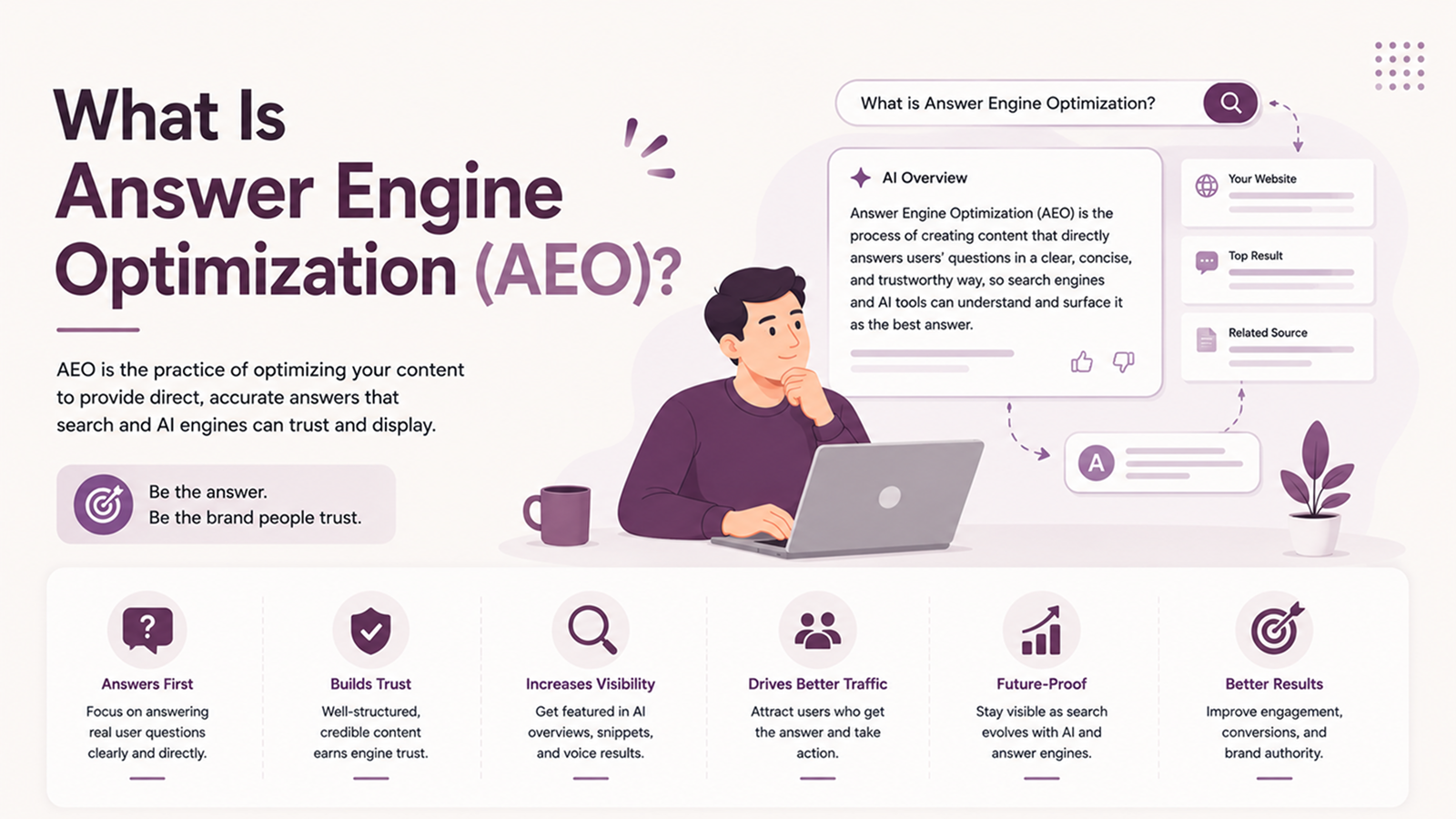
A client called me last quarter genuinely worried. Her organic traffic was flat, but her phone was ringing more than ever. People kept saying "I asked ChatGPT for a vendor and you came up." She had no idea why, and no way to make it happen on purpose. That gap - showing up inside an AI answer without understanding how - is exactly what Answer Engine Optimization closes, and it is why our team now treats it as core to any generative AI content strategy rather than a side experiment.
I run digital marketing at Shanti Infosoft, and over the last two years I have watched buyer behavior split in two. Some people still type a query and scan ten links. A growing number ask a question in plain language and accept the answer they get back. AEO is how you stay visible to that second group. Let me walk through what it really means, why it is not just SEO with a new label, how the engines choose sources, and the exact steps we run on our own site and our clients'.
buyer paths now: some scan ten blue links, a growing share just ask an AI and accept the answer
the direct answer we put under every heading so a model can lift it cleanly
pillars of AEO we run - answer-first structure, proven expertise, machine-readable pages, off-site brand signals
What is Answer Engine Optimization, exactly?
AEO is optimizing your content to be selected, summarized, and cited by AI answer engines rather than only ranked in a list of links. The unit of success shifts from "position 3 on the results page" to "named as a source inside the generated answer." You are optimizing for extraction and trust, not just for clicks.
Here is the practical distinction. A search engine retrieves documents. An answer engine reads documents, writes a response, then sometimes shows you where it got the information. So the question changes from "is my page relevant to this query" to "is my page clear, factual, and quotable enough that a model will lift my words into its answer and attribute them to me."
That sounds subtle. It is not. A page can rank beautifully on Google and never get pulled into a single AI answer because it buries the actual answer under 400 words of preamble. A modest page with one crisp, well-structured definition can get cited constantly because it is easy to extract. The engines reward clarity in a way classic SEO never fully did.
You will also hear the term GEO, or Generative Engine Optimization. People use AEO and GEO almost interchangeably. I treat AEO as the broader discipline of getting picked by any answer surface, and GEO as the slice specifically about generative LLM outputs. If you want the full taxonomy, including how plain SEO fits, we broke it down in our piece on SEO vs AEO vs GEO.
Why does AEO matter so much in 2026?
AEO matters now because a real and growing share of buyer research never reaches your website at all. People ask ChatGPT, Perplexity, Gemini, or Google's AI Overviews, get a synthesized answer, and act on it. If you are not in that answer, you are invisible to that entire journey, even if you rank number one on the traditional results page sitting below it.
Three things changed at once, and together they moved this from interesting to urgent.
- AI Overviews became the default, not the experiment. Google now puts a generated answer above the links for a huge slice of informational queries. That answer pushes the organic results further down the page. The number one blue link is no longer the top of the page - the AI summary is.
- People research entirely inside chat tools. A founder evaluating a development partner might run the whole shortlist through ChatGPT or Perplexity before ever visiting a site. If your brand and your strengths are not legible to those tools, you do not make the list. The same behavior that reshaped how people compare software now shapes how they compare an AI chatbot versus an AI agent before they buy either.
- Zero-click answers got normalized. Users are increasingly satisfied by the answer itself and never click through. That is not a tragedy if you are the cited source - being named builds authority and brand recall even without the visit. It is only a tragedy if your competitor is the cited source.
Here is the part founders miss. AEO is not replacing SEO, it is sitting on top of it. The same content that earns AI citations usually still ranks well. You are not abandoning one for the other, you are making your existing content do a second job. That is a much easier sell internally than "throw out everything and start over," and it happens to be true.
How do AI answer engines actually pick what to cite?
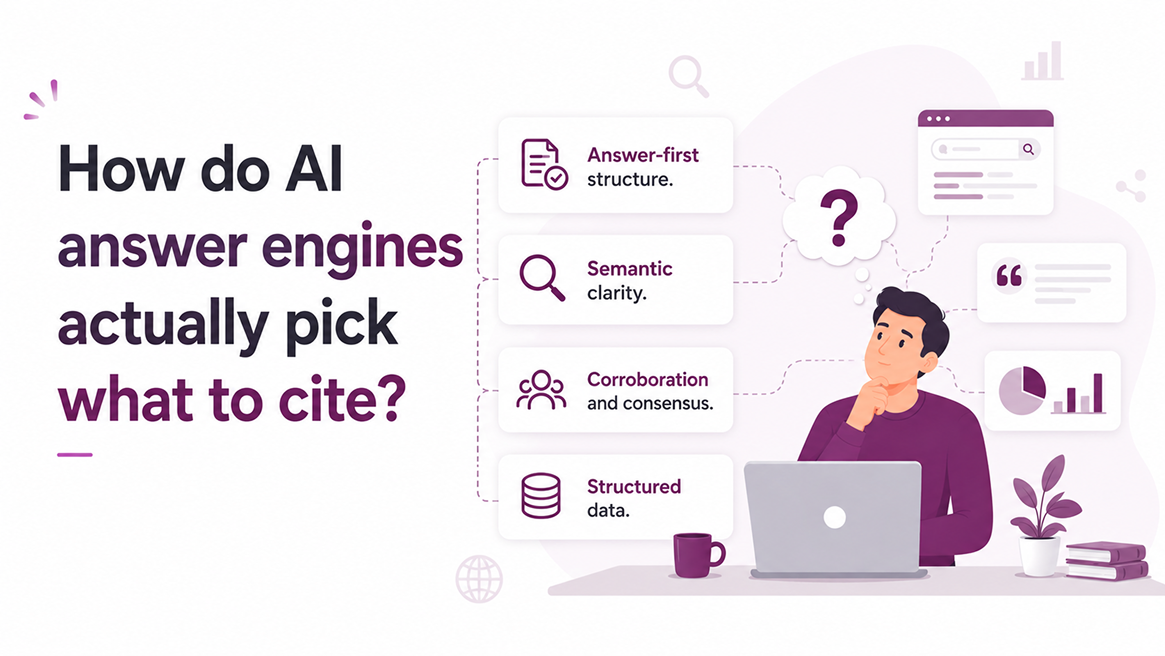
AI answer engines pick sources by retrieving relevant pages, then favoring content that is clear, factually consistent, well structured, and corroborated by other sources. They reward pages that answer the question directly and early, use clean semantic structure, and align with what the rest of the web says. Contradicting the consensus or hiding the answer gets you skipped.
From everything I have observed running campaigns and reading how these systems describe their own behavior, a few signals matter more than the rest:
- Answer-first structure. The engine wants to extract a direct response. If your answer to "what is X" is in the first two sentences under the heading, you are easy to lift. If it is in paragraph six, you lose to the page that put it up front.
- Semantic clarity. Question-shaped headings, short declarative sentences, one idea per paragraph. The model is parsing meaning, and clean structure makes your meaning unambiguous.
- Corroboration and consensus. Models cross-check. If three reputable sources say one thing and your page says another with no evidence, you get treated as the outlier. Being consistent with the broader web is a trust signal, not a lack of originality.
- Entity and brand recognition. The engines build a picture of who you are from mentions across the web - reviews, directories, citations, social, news. A brand mentioned often and consistently is more likely to be surfaced by name. Off-site presence feeds on-site citability.
- Freshness, where it counts. For anything time-sensitive, a recent dated page beats a stale one. "Best practices for 2026" with a real update date outperforms an undated 2022 article on the same topic.
- Structured data. Schema markup does not guarantee a citation, but it removes ambiguity about what your content is - a product, an FAQ, an article, a how-to. Less ambiguity, easier extraction.
Is AEO just SEO with a new name?
No. They share a foundation but optimize for different endpoints. SEO optimizes a page to rank as a clickable link and earn the visit. AEO optimizes content to be quoted and attributed inside a generated answer. The tactics overlap heavily, but the success metric, the formatting priorities, and the role of off-site brand signals are genuinely different.
Here is the tactic-by-tactic side-by-side I use when explaining it to a skeptical marketing lead. Same disciplines, retuned for a different endpoint.
| Dimension | Classic SEO tactic | AEO tactic |
|---|---|---|
| Primary goal | Rank as a clickable link | Get cited inside an AI answer |
| Where you win | The search results page | ChatGPT, Perplexity, AI Overviews, Gemini |
| Unit of success | Position and clicks | Citation, mention, inclusion in the answer |
| Content priority | Depth, keywords, internal links | Direct answers, clarity, extractability |
| Page structure | Keyword-led H2s and long intros | Question-shaped H2s, answer in first two lines |
| Key off-page signal | Backlinks | Brand mentions and consensus across the web |
| How you measure it | Rankings and organic traffic | Citation tracking, AI referral traffic, branded-query lift |
The honest takeaway: if you have neglected SEO, AEO is not a shortcut around that work. Good SEO is the cost of entry. AEO is what you layer on so the same effort also wins the answer box. Anyone selling AEO as a replacement for SEO is selling you something. We are not.
How do you optimize a page for AI answer engines?
You optimize for answer engines by structuring content answer-first, proving your expertise, making pages machine-readable, and building brand presence off-site so the engines recognize you. None of these is exotic. The discipline is in doing all of them consistently rather than one of them occasionally. Here is the exact sequence we run, in order of impact.
- Lead with the answer. Under every question-shaped heading, put a 40 to 60 word direct answer before you expand. Write it so it could stand alone if a model lifted only that sentence.
- Use question-shaped headings. Phrase H2s the way a person asks - "How much does X cost," "Is X worth it." That maps directly to how people prompt AI tools.
- Add structured data. Mark up articles, FAQs, products, and how-tos with schema so engines know exactly what they are reading. Reduce ambiguity at every turn.
- Show real expertise. Name the author, share first-hand experience, cite numbers and examples. Generic content that could have been written by anyone gets treated like noise. Specificity signals trust.
- Keep it fresh. Put a real, visible update date on time-sensitive content and actually update it. Stale pages lose to current ones on anything that moves.
- Build consistent off-site mentions. Get listed in relevant directories, earn reviews, stay active where your audience talks. The engines build their model of your brand from this. A site with no off-site footprint is hard to trust.
- Match your facts to the consensus, or back up your dissent. If you take a contrarian position, support it with evidence. Unsupported claims that contradict everything else get filtered out.
- Make pages fast and crawlable. If a bot cannot reach or render your content cleanly, none of the above matters. Technical hygiene is still table stakes.
How do you measure whether AEO is working?
You measure AEO through a mix of citation tracking, referral traffic from AI tools, and branded-query lift, accepting that the data is messier than classic SEO reporting. There is no single clean dashboard yet. You triangulate: are you being cited, is traffic arriving from AI surfaces, and are more people searching for you by name.
Concretely, here is what we track for our own site and for clients:
- Direct citation checks. Periodically prompt ChatGPT, Perplexity, and Gemini with the questions your buyers ask, and record whether you are named and how accurately. Crude, manual, and genuinely informative.
- Referral traffic from AI sources. Your analytics will show visits referred from chat and answer tools. It is usually a smaller number than search referrals, but it is high-intent - these people already got a recommendation and came to verify.
- Branded search lift. When people encounter your name inside an AI answer, more of them later search for you directly. A rising trend in branded queries is one of the clearest signals that your AEO is landing, even when citations are hard to count.
- Assisted conversions and "how did you hear about us." Do not underrate the survey question at the point of contact. When prospects start saying "an AI tool recommended you," that is your AEO working, full stop.
I will be straight with you: this is less precise than mature SEO tooling has trained us to expect, and anyone promising a perfect AEO attribution dashboard in 2026 is overselling. Watch the trend across these signals and judge direction. Direction is enough to make good decisions.
How we approach this at Shanti Infosoft
We treat AEO and SEO as one connected practice, not two competing budgets. Every piece we publish, on our site and our clients', is written answer-first, structured for both humans and machines, and backed by real expertise rather than filler. We do the unglamorous technical work too: schema, freshness, crawlability, off-site presence. Then we watch the signals and adjust.
What I would not do is let anyone scare you into thinking the old playbook is dead and you need to rip everything out. The fundamentals still hold. AEO mostly asks you to do them more deliberately, with the answer engines in mind. That is a sharpening, not a teardown.
If you are trying to figure out where AEO fits against your existing SEO spend, or you suspect you are ranking but still invisible inside AI answers, that is a conversation we have most weeks. You can read more across our work and writing, or just reach out and tell us what you are seeing. We would rather talk through your actual situation than pitch you a package. Honest read first, plan second.
Frequently Asked Questions
What is Answer Engine Optimization (AEO)?
AEO is the practice of structuring your content so AI answer engines like ChatGPT, Perplexity, and Google AI Overviews quote and cite you directly in their responses. Where SEO fights for a clickable link, AEO fights to be the sentence the AI reads back to the user. The goals differ, but the tactics overlap heavily.
Is AEO the same as SEO?
No. They share a foundation but optimize for different endpoints. SEO gets a page ranked as a clickable link and earns the visit. AEO gets your content quoted and attributed inside a generated answer. The formatting priorities, the success metric, and the weight of off-site brand signals are genuinely different, even though good SEO remains the cost of entry.
How do AI answer engines decide what to cite?
They retrieve relevant pages, then favor content that is clear, factually consistent, well structured, and corroborated by other sources. Pages that answer the question directly and early, use clean semantic headings, carry a real update date, and match the broader consensus get lifted. Hiding the answer or contradicting the consensus without evidence gets you skipped.
Does AEO replace SEO in 2026?
No, it sits on top of it. The same content that earns AI citations usually still ranks well, so you are making existing content do a second job, not throwing it out. Anyone selling AEO as a full replacement for SEO is overselling the split. Treat them as one connected practice.
How do I measure whether AEO is working?
Triangulate three signals, because there is no single clean dashboard yet. Prompt ChatGPT, Perplexity, and Gemini with your buyers' questions and record whether you are named. Watch referral traffic from AI tools in analytics. Track branded-search lift, since people who see you in an answer later search your name. Direction matters more than a precise number.
Have a project in mind? Let's scope it together.
You get a named team, written estimates, full code and IP ownership, and 48-hour response times. CMMI Level 5 certified. 700+ projects delivered across the UK, US, UAE, and Australia.