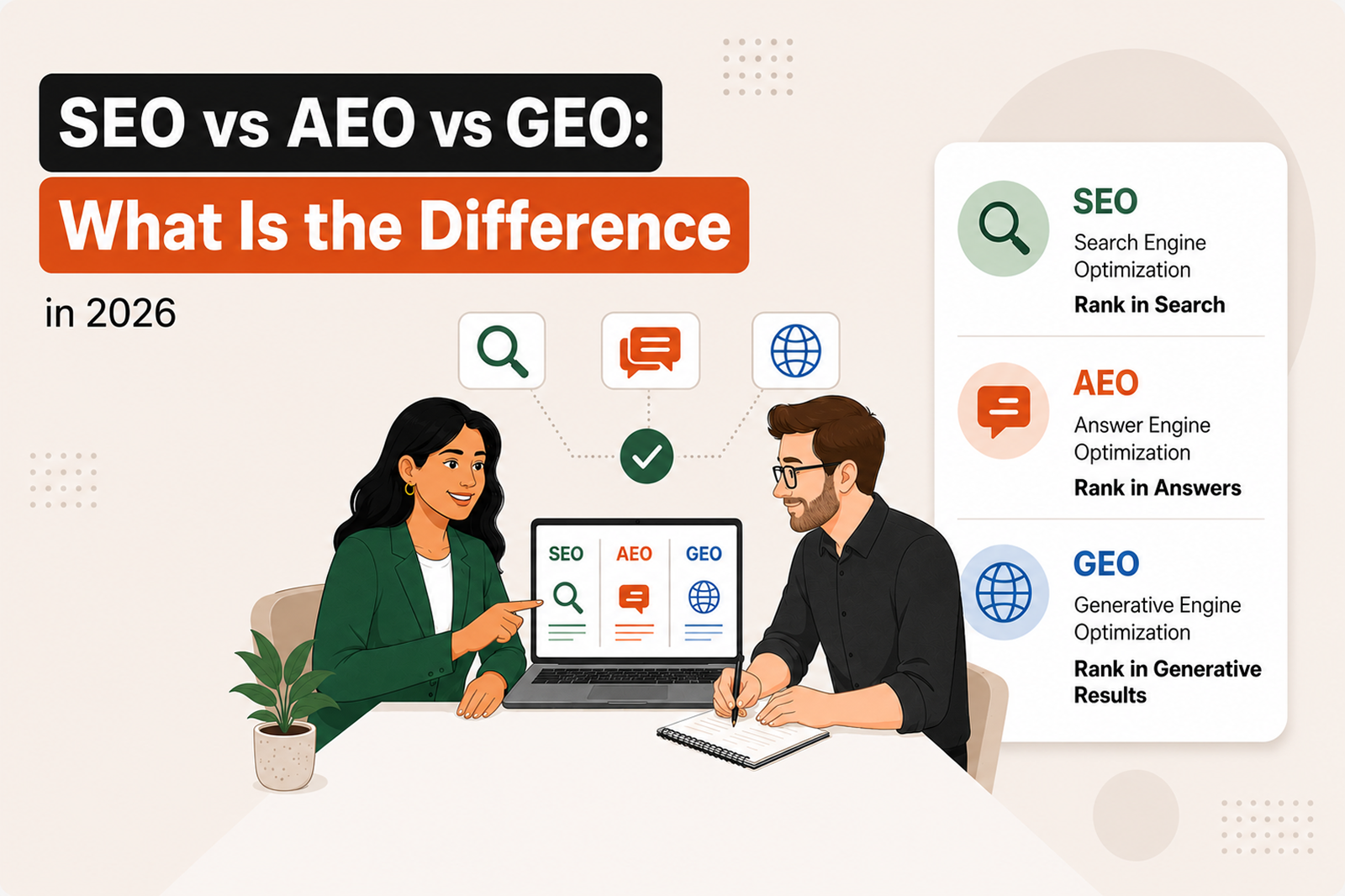
I got an email last month that summed up the whole problem. A founder wrote: "My agency wants to add a GEO retainer on top of SEO, and now someone on LinkedIn says AEO is the real thing. Are these three different services, or is everyone just renaming the same work to bill me more?" Fair question. A sharp one, honestly. Since it lands squarely on how we approach content and generative AI work for clients, let me answer it properly.
The short answer: SEO gets you ranked as a clickable link in search results. AEO gets you cited inside AI answers like ChatGPT and Google AI Overviews. GEO is the slice of AEO focused specifically on generative LLM outputs. They share a foundation and overlap heavily, but they target different surfaces and need different success metrics.
acronyms (SEO, AEO, GEO) that mostly build on one body of work
integrated program beats three overlapping retainers
the year the results page grew an AI answer above the links
I run digital marketing at Shanti Infosoft, and I will not pretend these three terms are cleanly separated in the wild. Marketers use them loosely, and some of the "difference" is genuinely just branding. But underneath the acronym soup there are real distinctions worth understanding before you spend a rupee or a dollar. Here is how I explain it to clients who do not want to be sold three things that are mostly one thing.
What is SEO, and is it still relevant?
SEO, Search Engine Optimization, is the practice of getting your pages to rank highly as clickable links in search results like Google and Bing. It is absolutely still relevant in 2026. AI answers are often built on top of the same content that ranks well, so strong SEO feeds everything else. SEO is the foundation, not the casualty.
The fundamentals have not changed as much as the headlines suggest. You still need relevant content that matches search intent, a technically sound site that loads fast and crawls cleanly, and authority signals like quality backlinks. People declaring "SEO is dead" every year are reliably wrong. What is true is that the search results page looks different now: there is often a generated answer sitting above the links, which changes how much traffic those links capture.
So SEO is necessary but, increasingly, not sufficient on its own. If you only do SEO, you can rank number one and still lose the top of the page to an AI summary that never mentions you. That gap is exactly why the other two acronyms exist.
What is AEO, and how is it different from SEO?
AEO, Answer Engine Optimization, is the practice of structuring content so AI answer engines cite and quote you directly inside their responses. The difference from SEO is the endpoint: SEO wins a clickable position, AEO wins a mention inside the answer itself. The tactics overlap, but AEO prioritizes direct answers, clean structure, and brand recognition over pure ranking.
The mental shift is this. With SEO you ask "will my page rank for this query." With AEO you ask "will an AI read my page and repeat my words as the answer, with my name attached." That pushes you toward answer-first writing - putting the direct response up front so it is easy to extract - and toward building consistent brand mentions across the web so the engines recognize who you are.
AEO is the broader of the two new disciplines. It covers any answer surface: Google's AI Overviews, the answer boxes, ChatGPT, Perplexity, voice assistants. If a machine is reading content and producing a synthesized answer, AEO is about being the source it picks. I went deep on the mechanics - how engines decide what to cite, plus a working checklist - in our guide to what Answer Engine Optimization is. If you only read one of these two posts, read that one.
What is GEO, and is it actually different from AEO?
GEO, Generative Engine Optimization, is the subset of AEO focused specifically on getting your content surfaced and cited by generative AI tools like ChatGPT, Perplexity, Gemini, and Google's generative answers. In practice GEO and AEO overlap so heavily that many teams use them interchangeably. I treat GEO as the LLM-output-specific slice of the wider AEO discipline.
If you want the cleanest way to hold it in your head: AEO is the umbrella, GEO is one panel under it. AEO includes older answer surfaces like featured snippets and voice; GEO is purely about the generative models. The reason GEO got its own name is that optimizing for an LLM that synthesizes an answer from multiple sources feels different from optimizing for a snippet that lifts one passage verbatim. Both reward clarity and structure, but GEO leans harder on consensus, corroboration, and brand authority because the model is blending sources rather than quoting one.
Here is my honest opinion, and you can push back on it: the AEO-versus-GEO distinction matters far more to people who sell these services than to people who buy them. As a buyer, you do not need to litigate which acronym a tactic belongs to. You need to know whether your content shows up in AI answers and what to do if it does not. So I am going to spend the rest of this on the practical comparison, not the terminology fight.
SEO vs AEO vs GEO: the comparison at a glance
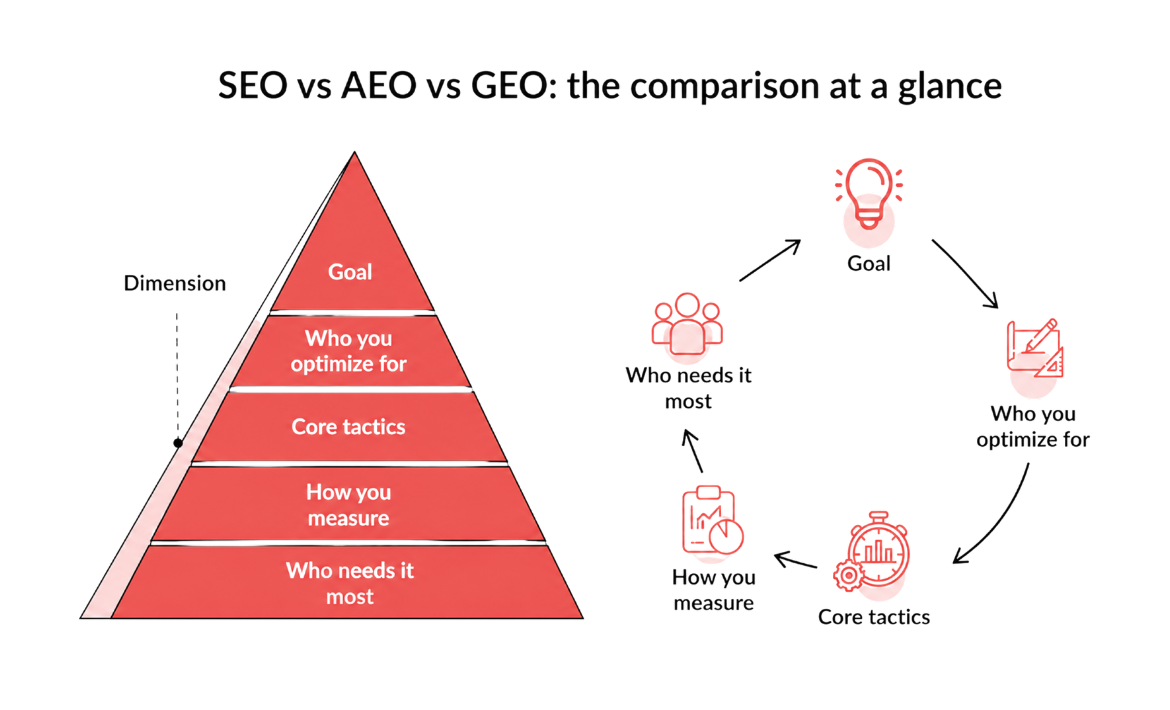
The cleanest way to see the difference is side by side. SEO targets the results page and is measured in rankings and traffic. AEO targets all answer surfaces and is measured in citations. GEO targets generative tools specifically and is measured in mentions inside AI outputs. The tactics overlap, but goals, surfaces, and metrics diverge.
| Dimension | SEO | AEO | GEO |
|---|---|---|---|
| Goal | Rank as a clickable link | Get cited inside answers | Get cited inside generative AI outputs |
| Who you optimize for | Search engines (Google, Bing) | Answer engines and assistants | Generative LLMs (ChatGPT, Perplexity, Gemini) |
| Core tactics | Keywords, content depth, backlinks, technical health | Answer-first content, schema, brand mentions, freshness | Clarity, consensus, corroboration, brand authority |
| How you measure | Rankings, organic traffic | Citations, answer inclusion, referral traffic | Mentions in AI responses, branded-query lift |
| Who needs it most | Everyone with a website | Anyone whose buyers research via AI | Brands competing inside chat-tool recommendations |
Look at the "core tactics" row and you will notice the heavy overlap. Answer-first content helps all three. Schema helps all three. Brand mentions help AEO and GEO and indirectly help SEO. This is why I keep saying these are not three separate budgets - they are three lenses on one connected program. The work compounds.
The "who needs it most" row is the one I would linger on. AEO and GEO matter most when your buyers research through AI before they ever talk to you, and increasingly they do. We watched this shift firsthand while writing about the difference between an AI chatbot and an AI agent: the shortlist often gets built inside a chat tool now, long before a human visits your site. If that is how your market behaves, GEO is not a nice-to-have.
How do SEO, AEO, and GEO reinforce each other?
They reinforce each other because they draw from the same well. A clear, well-structured, authoritative page ranks in search, gets lifted into answer boxes, and gets cited by generative tools - one piece of content paying off on three surfaces. Improve the foundation and all three rise together; neglect it and all three suffer.
Think of it as a stack, not a menu. SEO builds the crawlable, trustworthy page. AEO shapes that same page so a machine can extract a clean answer from it. GEO makes sure your brand shows up enough across the web that a model blending sources reaches for you. Each layer sits on the one below. You cannot skip to GEO and expect it to hold if the SEO underneath is thin, because the generative tools are pulling from pages that ranked in the first place.
This is the part that should relieve your budget anxiety. The tactics that move one surface tend to move the others. Answer-first writing improves featured snippets and AI citations and human readability at the same time. Structured data clarifies your content for every kind of engine. Brand mentions teach both Google and the LLMs who you are. You are not spreading effort thin across three programs - you are compounding it inside one.
Where should you actually invest in 2026?
Invest in SEO first because it is the foundation everything else builds on, then layer AEO and GEO onto the same content rather than running them as separate initiatives. For most businesses the right move is one connected program that produces clear, answer-first, well-structured content - which simultaneously ranks, earns AI citations, and gets surfaced by generative tools.
Here is the order of priority I give clients, and the reasoning behind each step:
- Fix the SEO foundation first. If your site is slow, uncrawlable, or thin on relevant content, nothing downstream works. AI engines often draw from the same well-ranked pages. Skipping this to chase GEO is building the roof before the walls.
- Rewrite your content answer-first. This single change serves all three disciplines at once. Lead every section with a direct, extractable answer. It improves snippets, AI citations, and reader experience together. Highest-leverage move on the list.
- Add structured data. Schema clarifies what your content is for every kind of engine. Low effort, broad benefit, helps SEO and AEO and GEO simultaneously.
- Build off-site brand presence. Directory listings, reviews, consistent mentions. This is where AEO and GEO get most of their lift - the engines learn who you are from your footprint across the web, not just from your own site.
- Keep content fresh and dated. Update time-sensitive pages and show the date. Freshness is a tiebreaker across every surface, and it is cheap insurance against losing to a more recent competitor.
- Then measure across all three. Track rankings and traffic for SEO, citation checks and AI referral traffic for AEO and GEO. Adjust on the trend, not on any single perfect number, because that number does not exist yet.
The practical reassurance: you are not choosing between three things. You are doing one thing well, and it pays off on three surfaces. If a vendor wants to bill you for SEO, AEO, and GEO as three line items doing largely the same underlying work, that is a pricing strategy, not a technical necessity.

What mistakes do teams make with these three?
The most common mistakes are treating AEO and GEO as replacements for SEO, buying them as three separate services that duplicate effort, and obsessing over precise attribution the tooling cannot yet deliver. Teams either ignore the AI surfaces entirely or overcorrect and abandon proven SEO fundamentals. Both extremes cost you.
The specific traps I see most often:
- "SEO is dead, go all-in on GEO." Wrong, and expensive. AI answers are built on content that ranks. Kill your SEO and you starve the source the AI engines draw from. The disciplines are layered, not sequential replacements.
- Paying three times for one body of work. If the SEO, AEO, and GEO deliverables are all "clear answer-first content with schema and brand building," you are buying the same thing under three names. One integrated program is cheaper and more coherent.
- Chasing perfect attribution. There is no clean dashboard that proves "ChatGPT sent you this lead" in 2026. Watch citation checks, AI referral traffic, and branded-search lift as a trend. Demanding precision the ecosystem cannot provide leads to bad decisions and wasted meetings.
- Writing for machines and forgetting humans. Answer-first structure helps engines, but the content still has to be genuinely useful and readable. Keyword-stuffed, robotic pages lose with both audiences now. Clarity serves both; gaming serves neither.
If there is one idea I want you to leave with, it is that the smartest 2026 strategy is not picking a winner among these acronyms. It is producing content so clear and well-structured that it ranks, gets cited, and gets surfaced by AI - all from the same work. The acronyms describe surfaces. Your job is to be the best answer on all of them. If you want the concrete how-to for the answer-engine side of that, the AEO checklist we actually run is the most practical place to start.
How we approach this at Shanti Infosoft
We run SEO, AEO, and GEO as a single integrated program because that is what actually works and what is honest to bill for. We start by fixing the SEO foundation, rewrite content to be answer-first, add the structured data and freshness signals, and build the off-site presence that teaches AI engines who a brand is. One body of work, paying off across the results page and inside the AI answers.
I am wary of the acronym arms race. Every quarter there is a new three-letter discipline that promises to be the thing that finally matters. Most of it is the same fundamentals - clarity, structure, authority, freshness - pointed at a new surface. That is also why we keep our AI development work tied to the same principle: build something genuinely clear and useful, and it performs everywhere, for both machines and people. We would rather teach you that than sell you a stack of overlapping retainers.
If you are trying to sort out whether your current search spend is set up for how people actually research in 2026, that is exactly the kind of audit we do. We will give you a straight read on where SEO ends and AEO and GEO begin for your specific situation, before anyone talks scope or budget.
Frequently Asked Questions
What is the difference between SEO, AEO, and GEO?
SEO gets your page ranked as a clickable link in search results. AEO gets your content cited inside AI answers like Google AI Overviews. GEO is the slice of AEO aimed specifically at generative tools such as ChatGPT and Perplexity. They share a foundation and overlap heavily, but target different surfaces and need different metrics.
Is SEO dead in 2026?
No. SEO is still the foundation. AI answers are usually built from content that already ranks well, so strong SEO feeds every other surface. What changed is the results page: a generated answer often sits above the links now, so ranking number one no longer guarantees the click. SEO is necessary but not always sufficient on its own.
Are AEO and GEO actually different, or just the same thing?
They overlap so much that many teams use the words interchangeably. I treat AEO as the umbrella - any answer surface including snippets and voice - and GEO as one panel under it, focused purely on generative LLM outputs. For buyers, the distinction matters far less than whether your content shows up in AI answers at all.
Should I pay for SEO, AEO, and GEO as three separate services?
Usually no. If all three deliverables are "clear, answer-first content with schema and brand building," you are buying one body of work under three names. One integrated program is cheaper and more coherent. If a vendor bills three overlapping line items, that is a pricing strategy, not a technical necessity. Push on it.
How do I measure whether GEO is working?
Watch citation checks (does the AI quote you), AI referral traffic, and branded-search lift as a trend. There is no clean 2026 dashboard that proves "ChatGPT sent this lead." Demanding precision the ecosystem cannot yet provide leads to bad calls. Track the direction of travel, not a single perfect number that does not exist.
Have a project in mind? Let's scope it together.
You get a named team, written estimates, full code and IP ownership, and 48-hour response times. CMMI Level 5 certified. 700+ projects delivered across the UK, US, UAE, and Australia.