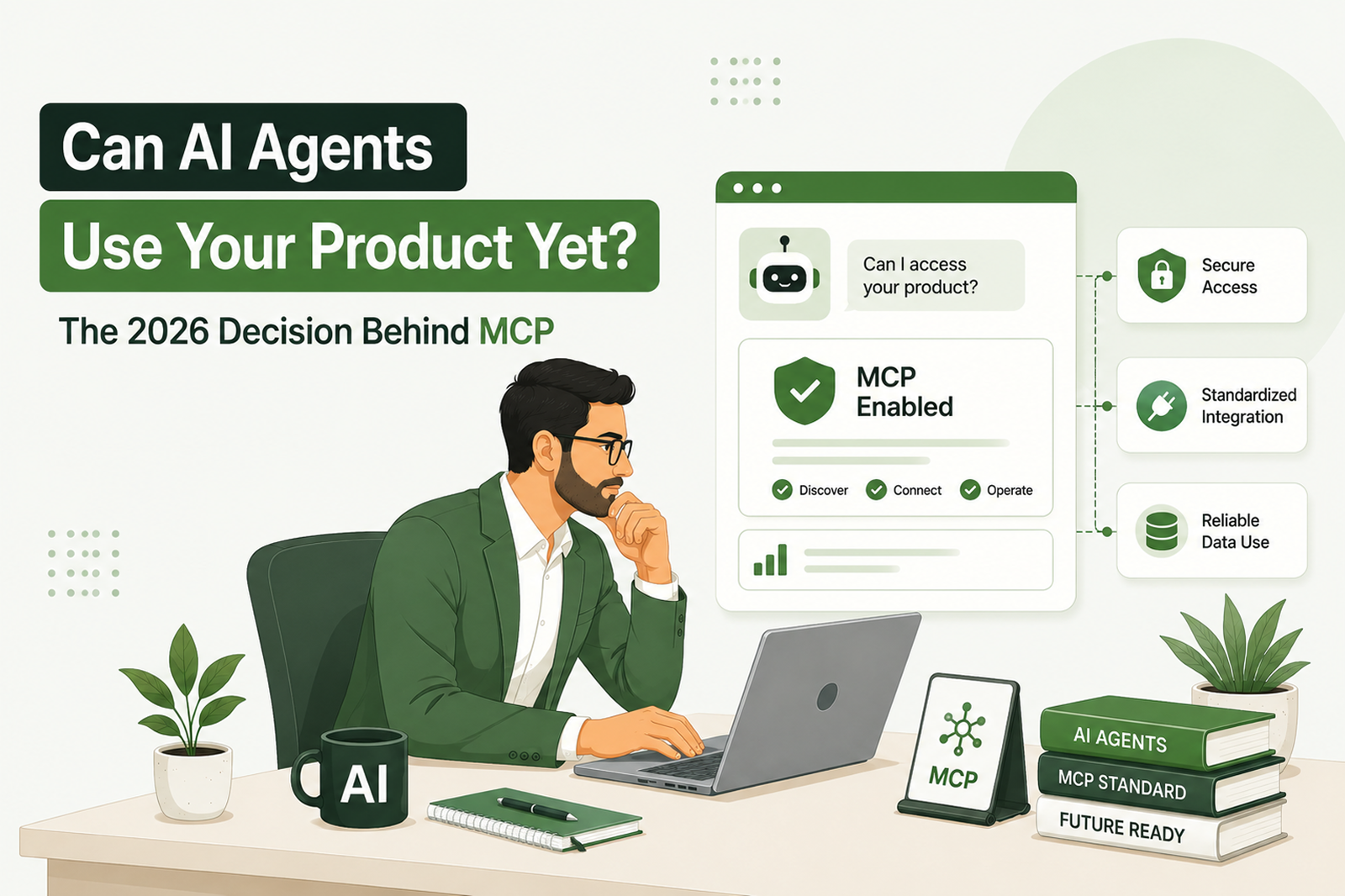
Here is a question that was not on any roadmap two years ago and now lands in enterprise deals: can an AI agent actually use your software? Not read a help doc about it, use it. Pull the right record, start the workflow, file the report. In 2026 the answer runs through one standard, the Model Context Protocol, or MCP, and whether you have shipped an MCP server for your product. This is not a coding topic. It is a product and go-to-market decision, and it is the kind of call our team gets pulled into during AI integration work more often every quarter.
I want to make the decision plain, because most writing on MCP is aimed at engineers wiring it up, not at the people deciding whether it is worth doing. The short version - if your buyers are starting to work through AI assistants, MCP is becoming table stakes, and the safe way in is read-only first.
of the Fortune 500 have already deployed an MCP integration
of enterprise app vendors are expected to ship their own MCP server in 2026, per Forrester
of the biggest AI platforms - OpenAI, Google, Microsoft, Amazon - now share the standard
What an MCP server actually is
An MCP server is a standard adapter that exposes your product's data and actions to AI agents in a format any of them can understand. MCP, the Model Context Protocol, is an open standard first published by Anthropic in late 2024 and now supported across the major AI platforms. Describe what your software can do once, and every compliant agent can use it.
The problem it solves is the messy middle. Before MCP, connecting an AI assistant to your app meant a bespoke integration for each one, with its own quirks. MCP replaces that with one contract. Your server publishes three kinds of things: resources the agent can read (records, documents, reports), tools it can call (create, update, search, trigger), and prompts that guide how it uses them. The agent asks, your server answers or acts, and every agent plays by the same rules.
If the line between an assistant that talks and one that takes action is still fuzzy for you, our explainer on the difference between an AI chatbot and an AI agent is worth a read. MCP is mostly interesting because of the agent side, the part that does things, not just the part that answers.
Why MCP became the default this fast
MCP won because the companies that would normally fight over a standard all adopted the same one inside a single year. Anthropic released it, then OpenAI, Google, Microsoft, and Amazon each added support across their platforms. When the four biggest players agree on a connector, it stops being a bet and becomes the default.
Two things drove it. First, the pain was universal. Every AI platform faced the same problem of building a separate connector for every app, and a shared protocol made it go away for all of them at once. Second, timing. Agents that take actions only became reliable enough to trust in 2025, and the moment they did, everyone needed a safe, standard way to connect them to real systems. MCP was already there, open and working. From there it compounded: every new server made every MCP-capable agent more useful, and every new agent made building one more worthwhile. A meaningful share of the Fortune 500 already run MCP in production today.
Should your product have an MCP server?
The short answer: build one if your users are business users who increasingly work through AI assistants, or if MCP has started showing up in the RFPs and security questionnaires in your market. Wait if your users never touch an agent and no buyer has asked. But "wait" rarely means "wait long" right now, so for most SaaS products the smarter move is to ship a small read-only server early.
Do not build one because the term is hot. Build it when at least one of these signals is real for you.
| Ship an MCP server now if | You can wait if |
|---|---|
| Your buyers are enterprises standardizing on AI agents | Your users are consumers who do not use assistants for your task |
| MCP or "agent access" is appearing in RFPs and questionnaires | No prospect has ever asked how an agent would connect |
| Your value is data or actions an agent would want to use | Your value is a visual or real-time experience an agent cannot use |
| You already have a clean, documented API to build on | Your API is unstable and changing week to week |
| A competitor has shipped one, or is about to | Your market has shown zero agent demand so far |
If your product predates all of this, an MCP server is usually part of a wider question about adding AI to an existing SaaS product. The server is the doorway, but you still decide what is worth putting behind it.
What you expose, and the read-only-first rule
Expose the smallest useful set of reads first, and add actions only once you trust the pattern. The read-only-first rule is the single most important design choice in an MCP rollout: let agents look before you let them touch. A read that returns the wrong record is an annoyance. A write that changes the wrong record is an incident.
In practice we stage it:
- Stage one, read-only. Search, fetch records, pull reports and status. The agent can answer questions about the customer's data, and nothing it does is destructive.
- Stage two, safe writes. Create drafts, add notes, open tickets. Actions that are reversible and low-stakes, each behind the user's real permissions.
- Stage three, consequential actions. Anything that moves money, deletes data, or contacts a customer, gated with hard limits and a human approval step above a threshold.
Most of the value shows up in stage one, which is also the cheapest and safest to ship. That is the point of leading with it: you get the enterprise checkbox and real usage while the blast radius is near zero, then earn your way up to actions.
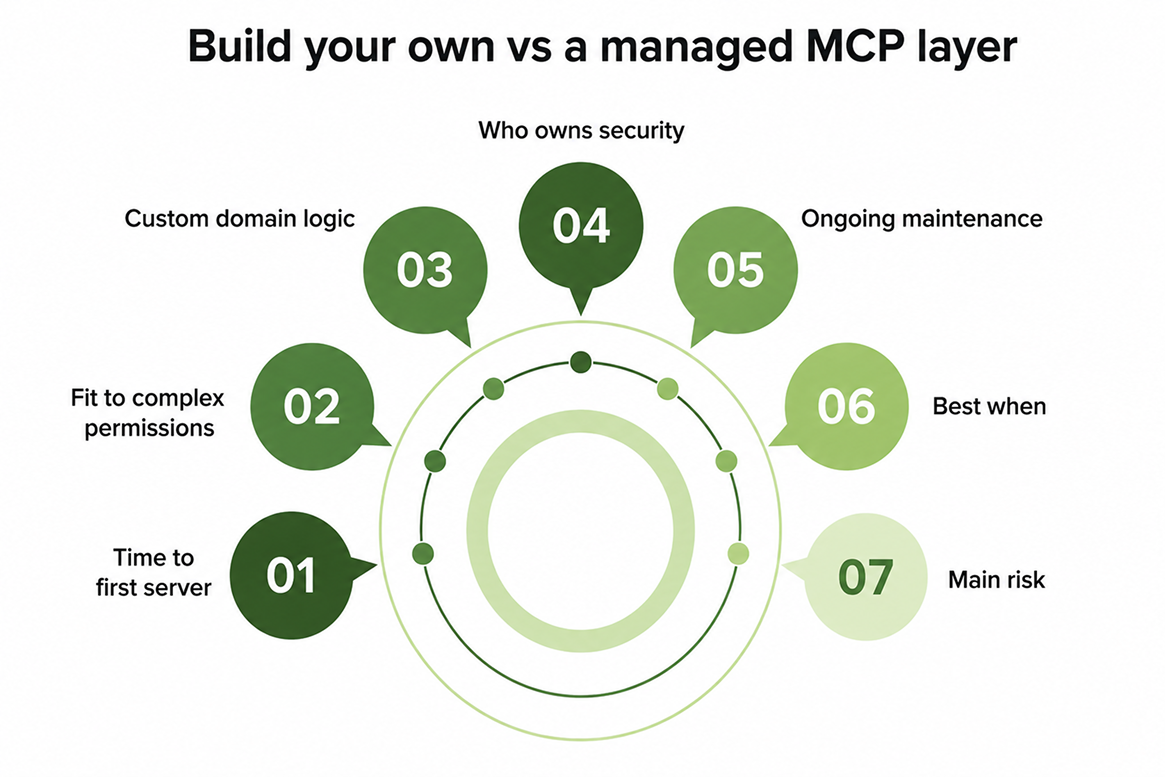
Build your own vs a managed MCP layer
Build your own when your data model and permissions are complex and central to your product. Use a managed MCP layer, a gateway or a service that wraps your existing API, when you mainly need to get a clean API in front of agents quickly and do not want to own the plumbing. Plenty of teams start managed to learn, then bring it in-house once they see what agents actually use.
| Dimension | Build your own | Managed MCP layer / gateway |
|---|---|---|
| Time to first server | Weeks | Days |
| Fit to complex permissions | Full, you control every rule | Limited to what the layer supports |
| Custom domain logic | Anything you can code | Mostly straight API-to-tool mapping |
| Who owns security | You, end to end | Shared with the vendor |
| Ongoing maintenance | Your team tracks the spec | Vendor tracks the spec |
| Best when | MCP is core to your product | You have a clean API and want speed |
| Main risk | Engineering time and upkeep | Vendor lock-in and a ceiling on control |
What it means for winning enterprise deals
An MCP server is starting to function like a sales requirement, not just a feature. As enterprise buyers standardize on AI agents internally, "does this vendor expose an MCP server" is turning into a line item in evaluations, the same way "do you have an API" or "do you support SSO" became non-negotiable a decade ago. Miss it and you can drop off a shortlist without ever hearing why.
The logic is simple. If a company has committed to running work through Copilot, Claude, or an in-house agent, a tool their agents can use is worth more than one they cannot, even if yours is better in isolation. MCP support is how you stay usable inside the workflow they have already chosen. This is part of a broader shift in how buyers shop for AI agents in 2026, where "does it fit our agent stack" is quietly outranking older checklist items.
The security risks, and how to limit blast radius
The core risk is that you are giving a non-deterministic system permission to act on live data, and it can be steered by the text it reads. Two failure modes matter most: over-broad permissions, where the agent can do more than it should, and prompt injection, where a hidden instruction in the data it reads convinces it to misuse a tool it legitimately has. Both are manageable if you design for them from the start.
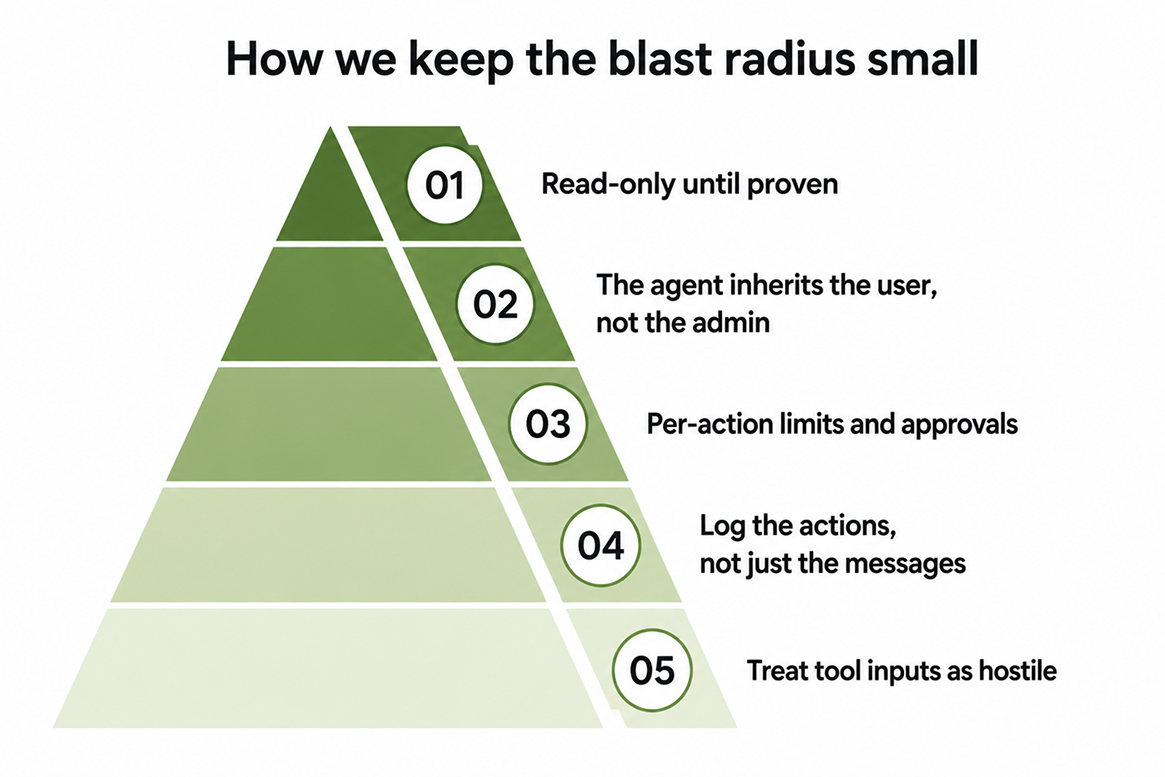
How we keep the blast radius small:
- Read-only until proven. The fastest way to cap damage is to not expose destructive actions yet. It is the biggest single lever you have.
- The agent inherits the user, not the admin. Every MCP call runs under the requesting user's real permissions, so an agent can never reach data or actions that user could not.
- Per-action limits and approvals. Hard caps on anything consequential - amounts, record counts, rate - with a human approval step above a threshold.
- Log the actions, not just the messages. You need to see what the agent did, not only what it said, so a bad pattern gets caught in minutes.
- Treat tool inputs as hostile. Validate and sanitize everything an agent passes, the same way you would a request from the open internet, because effectively it is one.
None of this is exotic. It is the security discipline you already apply to a public API, plus respect for the fact that the caller can be talked into things. Get it right and MCP is no scarier than any other integration. Get it wrong and you have handed an over-eager assistant write access to production.
How we approach MCP for clients
We start with the decision, not the code. Is there real agent demand or an RFP pattern that justifies a server, or is this fear of missing out? If it is justified, we scope the smallest read-only server that answers the actual buyer question, ship it, and instrument it so usage tells us what to build next. Actions come later, narrow and gated.
Our team has shipped software for 700-plus companies across the UK, US, UAE, and Australia, and the MCP conversations follow a familiar shape: a sound API underneath, a nervous security team, and a sales org that wants to check the box on the next deal. The job is to satisfy all three without pretending the risk is zero. We are CMMI Level 5, so the boring parts - permissions, logging, approvals - are exactly where we spend the care.
If you are trying to work out whether your product needs an MCP server this year, or how to expose one without losing sleep over it, tell us what your product does and who is asking, and we will give you a straight read on whether to ship now, ship read-only, or wait.
Frequently Asked Questions
What is an MCP server in plain terms?
An MCP server is a standard adapter that lets any AI agent use your software. MCP (Model Context Protocol) is an open standard. Think of it as a USB-C port for AI. You expose your data and actions once through an MCP server, and ChatGPT, Claude, Copilot, or any compliant agent can call them without a custom integration each time.
Should we build an MCP server for our SaaS product in 2026?
Build one if your customers are business users who increasingly work through AI assistants, or if MCP support is starting to show up in RFPs and security questionnaires in your market. If your users never touch an agent and no buyer has asked, you can wait. But ship read-only access early, because the ask tends to arrive fast.
Is it safe to expose our product to AI agents through MCP?
It is safe if you scope it. The real risk is write access, an agent taking a wrong action on live data. Start read-only, put every action behind the same permissions your API already enforces, add per-action limits and human approval for anything destructive, and log every call. Treat the agent as an untrusted user, not a trusted admin.
Should we build our own MCP server or use a managed layer?
Build your own when your data model and permissions are complex and central to your product. Use a managed MCP layer or gateway when you mainly want to wrap an existing, well-structured API quickly. Many teams start managed to learn what agents actually call, then bring it in-house once the usage pattern is clear.
Does an MCP server help us win enterprise deals?
Increasingly, yes. As enterprise buyers standardize on AI agents, whether you expose an MCP server is becoming a line item in vendor evaluations, the way an API or SSO once did. Not having one can quietly drop you from a shortlist before you ever get to a demo.
Have a project in mind? Let's scope it together.
You get a named team, written estimates, full code and IP ownership, and 48-hour response times. CMMI Level 5 certified. 700+ projects delivered across the UK, US, UAE, and Australia.