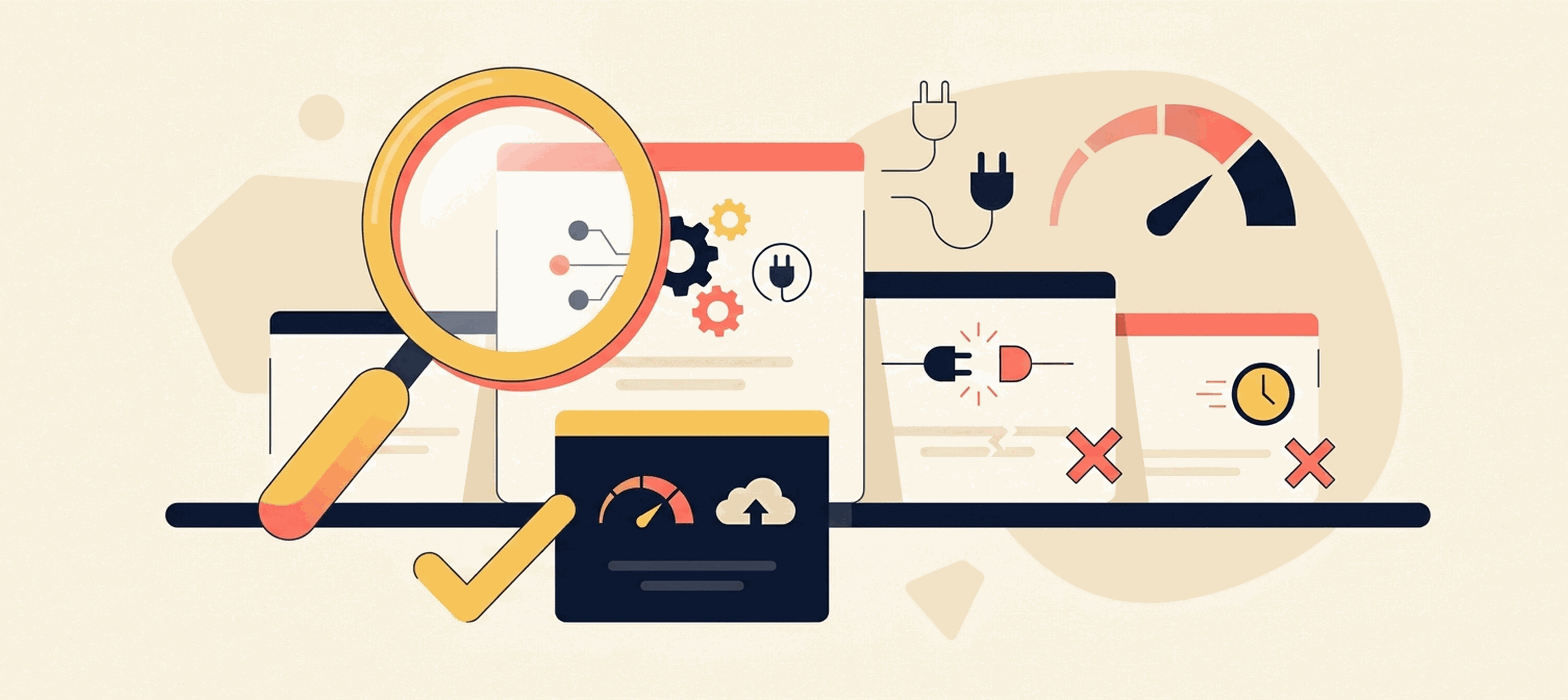
Watch a real buyer evaluate an AI agent and you'll notice something the demo videos never show you: they're not impressed by the magic. They're hunting for the seam where it breaks.
Two years ago, "it uses AI" was enough to win a meeting. In 2026 it's the price of entry — and a buyer who has already been burned by one over-promised agent walks into your demo looking for reasons to say no. The good news for anyone building or buying in this space: the way serious buyers actually shop has become remarkably consistent. They reject the same things and reward the same things. If you know the pattern, you can be on the right side of it.
Things that decide most AI-agent deals — and they're rarely the model
Vendors Gartner considers real "agentic AI" out of thousands marketing the term
Of agentic AI projects Gartner expects to be cancelled by 2027
Why Buying an Agent Is Not Like Buying Software
Traditional software is judged on features. You can list them, tick them off, and compare two products column by column. An AI agent resists that kind of evaluation, because the thing you're buying isn't a fixed set of features — it's a behaviour. It makes decisions. It takes actions on your behalf. And the same agent that looks flawless in a five-minute demo can quietly make a wrong call on the three-hundredth conversation, when nobody is watching.
That's why experienced buyers have stopped shopping for agents the way they shop for a CRM. They've learned — often the expensive way — that the impressive part is cheap and the reliable part is hard. So they spend their evaluation energy on the reliable part. Gartner's widely-cited 2025 forecast that over 40% of agentic AI projects will be cancelled by the end of 2027 — driven by escalating costs, unclear business value, and weak risk controls — is exactly the fear sitting in the back of every buyer's mind. They are not trying to find the smartest agent. They are trying to avoid becoming a statistic.
The 4 Things That Actually Win (and Lose) Agent Deals
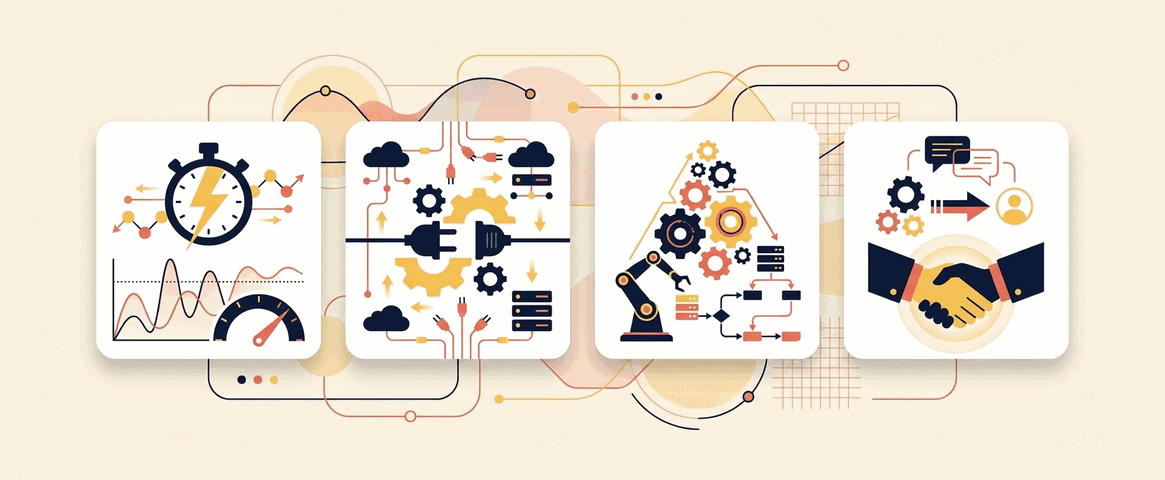
Across product launches, buyer forums, and the criteria teams now publish in their own evaluations, four themes come up again and again. None of them is "has the biggest model." They are the practical questions of someone who has to live with this thing in production.
1. Latency — does it feel instant, or does it make me wait?
An agent that takes nine seconds to answer feels broken, no matter how good the answer is. Buyers test this immediately and viscerally: they fire a question and watch the clock. A customer-facing agent that stalls will be switched off within a week because real users abandon it. This is why "low latency" has quietly become one of the first filters buyers apply — it's the easiest signal that a product was built for production and not just for a launch video.
2. Integrations — does it actually plug into my stack?
An agent that can't reach your data is a very expensive chatbot. The buyers who get value are ruthless here: can it read from our CRM, write back to our ticketing system, call our internal API, respect our permissions? A product with deep, well-documented integrations beats a "smarter" product that lives in its own walled garden. The question behind the question is always the same — how much custom plumbing will my team have to build before this delivers anything?
3. Automation depth — does it finish the job or just start it?
There's a world of difference between an agent that drafts a reply and one that drafts it, checks it against policy, sends it, logs the outcome, and escalates the edge case. Buyers increasingly probe for that depth: how many steps can it own end-to-end before a human has to step in? Shallow automation that hands work back to you on every other turn doesn't reduce headcount-hours — it just relocates them.
4. Human handoff — what happens when it can't, or shouldn't?
This is the one that separates the toys from the tools, and it's the criterion the best buyers weight most heavily. A production-grade agent knows the boundary of its own competence. It recognises when it's uncertain, when the stakes are high, or when policy says a human must decide — and it hands off cleanly, with full context, to the right person. An agent with no graceful handoff isn't autonomous; it's just unsupervised.
| What buyers check | Wins the deal | Loses the deal |
|---|---|---|
| Latency | Feels instant; sub-second to a few seconds on real queries | Long pauses; "thinking" spinners that kill the UX |
| Integrations | Reads and writes to the buyer's real systems, respects permissions | Walled garden; demands heavy custom plumbing first |
| Automation depth | Owns a full workflow end-to-end, logs every action | Drafts only; hands work back on every turn |
| Human handoff | Knows its limits; escalates cleanly with context | No off-ramp; fails silently or guesses |
| Proof | Live reference customer, real metrics, audit trail | Demo-only; "trust us, it works" |
What Buyers Reject on Sight
Just as telling as what wins is what gets a product eliminated in the first ten minutes. If you're building an agent — or evaluating one — these are the patterns that now read as instant red flags.
"Agent washing." Gartner has been blunt about this: of the thousands of vendors marketing "agentic AI," only a small fraction — on the order of around 130 by their count — are doing anything that genuinely qualifies. The rest are chatbots, rule-based RPA, or last year's assistant with a new label. Buyers have caught on, and a re-skinned chatbot dressed up as an "autonomous agent" now damages trust faster than no AI at all.
Demo-only proof. A controlled demo is where every input is clean and every output is rehearsed. Buyers who've been burned ask, immediately, to see the agent running for a real customer, on real data, with real volume — and to talk to that customer. A vendor who can't produce a single reference in production is telling you something.
No audit trail. If the agent acts on your behalf, you need to know what it did and why. "It's a black box" is an answer that ends conversations in any regulated or high-stakes context.
Vague accountability. When the buyer asks "who is responsible when it makes a costly mistake?" and the answer is a shrug, the deal is effectively over.
The One Question That Reveals Everything
If you only have time to ask a vendor one thing, make it this: "Show me the worst real conversation this agent has had in production, and tell me what happened next."
It's a deceptively powerful question because of how it's constructed. It assumes — correctly — that the agent has failed at least once, which signals to the vendor that you're not naive. It demands a real example, not a hypothetical, so it can't be answered with marketing. And it asks about the aftermath, which is where all the things that actually matter live: did anyone notice? Was it logged? Did it escalate to a human? Did the customer get hurt? Did the system learn from it?
A vendor with a production-grade product will have a good answer ready, often a slightly proud one, because handling failure gracefully is the hard engineering they're most pleased with. A vendor selling demo-ware will stall, deflect, or insist the situation doesn't really come up — and that hesitation tells you everything the glossy deck was designed to hide. You can learn more from how a vendor talks about their agent's worst day than from a hundred slides about its best.
A Buyer's Checklist Before You Commit
If you're shopping for an AI agent in 2026, run any contender through this before you sign. If more than two boxes stay empty, slow down.
- You tested latency yourself on real questions — not just watched a recorded demo
- It integrates with your actual systems, and you've confirmed read and write paths
- You know exactly how many workflow steps it owns before a human is needed
- The human-handoff path is clean, contextual, and you've seen it trigger
- There is a complete audit log of every action the agent takes
- You spoke to at least one reference customer running it in production
- Accountability for mistakes is named in writing, not implied
- The first deployment is scoped to one narrow, measurable task
The Buyers Who Win Are the Ones Who Shop Like Skeptics
The pattern is clear once you've seen it a few times: the buyers who get real value from AI agents are not the most enthusiastic ones. They're the most skeptical. They assume the demo is the best the product will ever look, they test the seams, they demand proof in production, and they refuse to buy autonomy without accountability.
That's not cynicism — it's how you end up in the 60% of projects that survive instead of the 40% that get quietly cancelled. Whether you're building an agent or buying one, the discipline is the same: be honest about where it breaks, design for the handoff, and prove it on real data before you bet your operations on it.
If you're evaluating an agent for your business and want a straight answer about what will actually hold up in production — not a pitch — that's the conversation we have every week with founders and operators. You can tell us the task you're trying to automate and we'll tell you honestly whether an agent is the right tool, and what it would take to ship one you can trust. You can also see how we approach production-grade AI agent development across regulated and high-stakes use cases.
Frequently Asked Questions
Evaluating an AI Agent? Get a Straight Answer, Not a Pitch.
Tell us the task you're trying to automate and we'll tell you honestly whether an agent is the right tool — and what it would take to ship one that survives production. Named team, written estimates, full IP ownership, CMMI Level 5.