Every few weeks a founder or a CTO asks me some version of the same question: our core system is old, slow, and expensive to change, so do we fix it or throw it out and start over? It is one of the most expensive decisions a business makes, and the reflex answer is almost always wrong. "Rewrite everything" feels decisive, but it is usually the costliest and riskiest option on the board. The honest truth is that aging software is not one problem with one fix; it is a spectrum, and the job of good software development is to match the lightest fix to the real problem. Spend more than the problem needs and you have burned money. Spend less and you are back here in a year.
So instead of a fix-or-rebuild coin flip, we walk clients through a ladder of five modernization paths, from simply documenting and stabilizing a system all the way up to rebuilding it piece by piece. Each rung has a clear when-to-use, a realistic effort, and a payback window. This piece lays out all five, shows you how to diagnose which one you need before you spend anything, and puts a number on the option everyone forgets to price: doing nothing.
modernization paths, from stabilize to full rebuild
12-month TCO reduction from a well-scoped modernization
typical payback window on a rebuild
Should you fix or rebuild your legacy app?
The short answer: refactor when the architecture is still sound and only the code has decayed, and rebuild only when the system no longer fits the business or the underlying stack is dead. Almost everything real sits between those two extremes, which is exactly why a straight fix-or-rebuild choice leads teams astray. The better question is not "fix or replace" but "what is actually broken here - the infrastructure, the code, the platform, or the fit with the business?" Answer that, and the right path usually names itself.
The reason this matters is money and risk. A full rebuild is the most expensive and highest-risk option on the table, and it is the one people jump to first because it feels like progress. Most aging systems do not need it. They need a smaller, cheaper intervention aimed at the one thing that is genuinely hurting. If you want to see how fast a from-scratch build adds up, our guide to custom software development cost lays out the ranges, and they are exactly why "rewrite everything" should be the last resort and not the first instinct.
The five modernization paths
Modernization is a ladder, not a switch. Each rung does more, costs more, and takes longer than the one below it, so the discipline is to climb only as high as the problem requires. Here are the five paths, what each one is for, the effort it takes, and when it starts paying back.
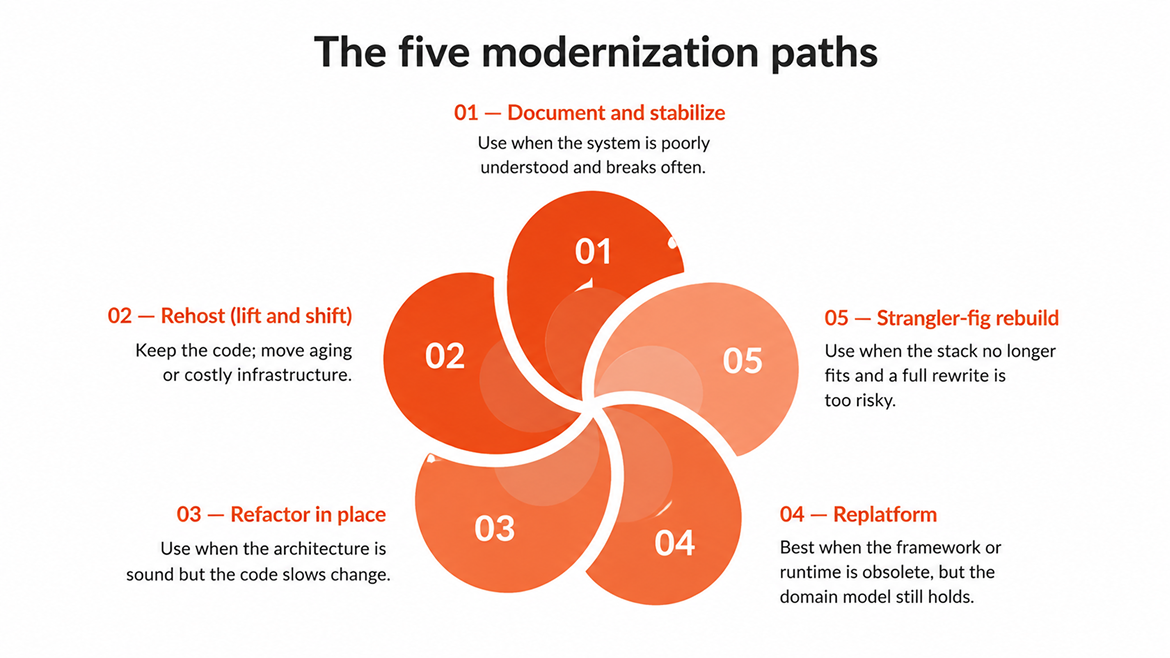
| Path | When to use it | Effort | Payback |
|---|---|---|---|
| Document and stabilize | You do not fully understand the system, it breaks often, and the knowledge lives in a few people's heads | Low, a few weeks | Immediate risk cut, near-zero spend |
| Rehost (lift and shift) | The code is fine; the infrastructure is the cost and the risk, such as aging servers or an expensive data center | Low to medium, weeks to a few months | Fast, roughly 3 to 9 months |
| Refactor in place | The architecture is sound but the code is a drag on every change, and you keep the same platform | Medium, months | Faster delivery within 2 to 4 quarters |
| Replatform | The framework, language version, or runtime is obsolete or unsupported, but the domain model still holds | Medium to high, months | Roughly 9 to 18 months |
| Strangler-fig rebuild | The system no longer fits the business or the stack is dead, and a stop-the-world rewrite is too risky | High, incremental over quarters | Long but safe, about 14 to 26 months |
Read that table as a menu of lightest-first options. You start at the bottom and stop at the first rung that genuinely solves your problem. A tired data center does not need a rebuild; it needs a rehost. A dead framework does not need documentation; it needs a replatform or a strangler-fig rebuild. The skill is honest diagnosis, which is the next section.
How to diagnose which path you need
Diagnosis comes down to naming the layer that is actually hurting. Ask four questions in order and stop at the first yes. Is the infrastructure the problem, meaning old hardware, a costly data center, or scaling limits, while the code runs fine? Then rehost. Is the platform dead, meaning an unsupported framework, an end-of-life language version, or a runtime nobody patches? Then replatform or rebuild. Is the code the problem, meaning the logic is right but every change is slow and scary? Then refactor. Is the business fit gone, meaning the system models a company you no longer are? Then rebuild the pieces that matter.
Before any of that, one rule holds: if you cannot answer these questions confidently, you are not ready to spend. That is what the first rung, document and stabilize, is for. This is also where an outside read pays off; a short IT consulting engagement to inventory and score the system usually costs a fraction of the first wrong build. Guessing is the expensive option.
The real cost of doing nothing
Doing nothing is not free. It is a payment plan with rising interest. The trap is that the cost is invisible on any single day, so it never makes the quarterly agenda until something breaks badly. Priced honestly, inaction usually costs more than the modernization people keep postponing to avoid the bill. Here is where the money actually leaks:
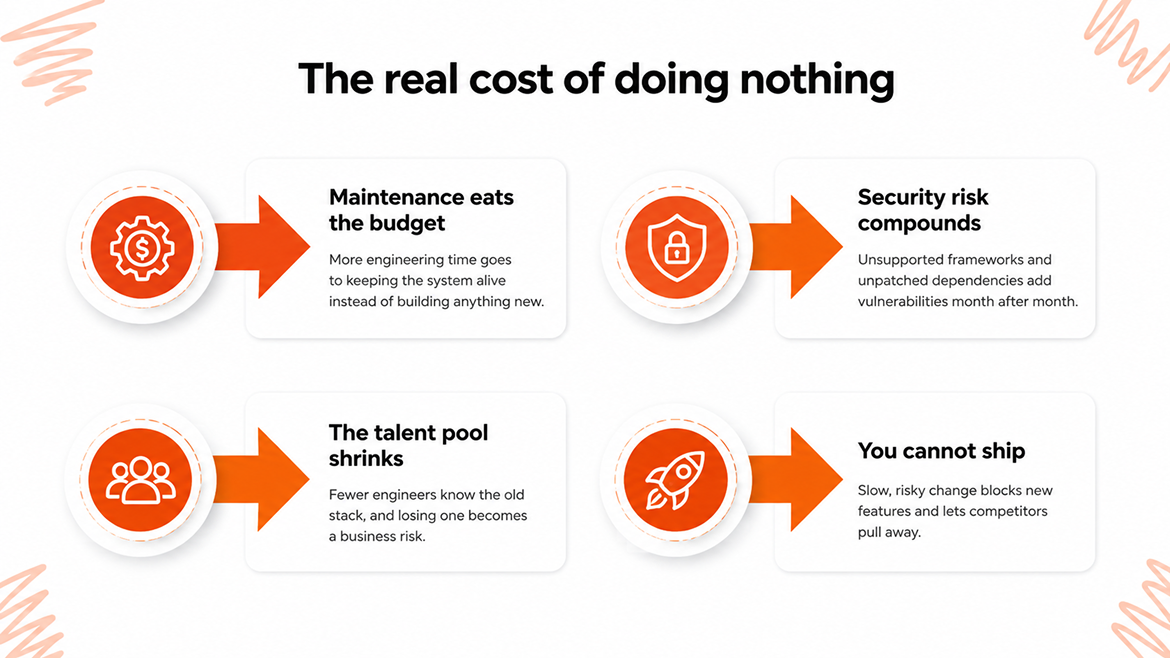
- Maintenance eats the budget. The older and more fragile the system, the more of your engineering time goes to keeping it alive instead of building anything new. In many organizations the majority of the IT budget, often quoted at well over half, goes to keeping the lights on, and legacy systems are the reason.
- Security risk compounds. Unsupported frameworks and unpatched dependencies stop getting fixes. Every month that passes adds known vulnerabilities you cannot close without touching the system you are avoiding.
- The talent pool shrinks. Fewer engineers know the old stack every year, so the ones who do cost more, and losing one of them quietly becomes a business risk.
- You cannot ship. When every change is slow and risky, you stop shipping the features that win customers, and competitors on modern stacks pull away. That opportunity cost rarely shows up on a spreadsheet, yet it is often the biggest number of all.
- Compliance catches up. New data and security rules assume systems you can actually change. A frozen legacy app turns each new regulation into an emergency.
Put those together and the "cheap" option of waiting is usually the most expensive line in the whole decision. A well-scoped modernization, by contrast, commonly takes 25 to 45 percent off the 12-month total cost of ownership, meaning the maintenance, the incidents, and the wasted time, which is what makes even a large rebuild pencil out.
Refactor in place: when the bones are good
Refactoring is the right call when the architecture is sound but the code has rotted around it. The system does the right things; it is just slow and frightening to change. You keep the platform and the behavior, and you pay down the tech debt that taxes every new feature: untangle the worst modules, add the tests that were never written, and cut the dead code. Nothing the user sees changes, and everything the developer touches gets easier.
The trap to avoid is refactoring as a hobby, meaning endless cleanup with no business goal. Tie every refactor to a payback: faster delivery in a specific area, fewer incidents in a specific module, a dependency upgrade you actually need. If a refactor cannot name the money it saves or the speed it buys, it is polishing, not modernizing. Done with that discipline, refactor-in-place is the highest-return rung on the ladder for systems whose bones are still good.
The strangler-fig rebuild: replace piece by piece
When a system genuinely has to be replaced, you almost never want to replace it all at once. The strangler-fig pattern, named after the vine that grows around a tree and gradually takes its place, rebuilds a legacy system incrementally behind a facade. You put a routing layer in front of the old application, then rebuild one capability at a time and point that capability's traffic at the new code. The old system keeps running for everything you have not migrated yet. Over time, more and more routes to the new build, until nothing routes to the old one and you retire it.
The reason this beats a clean-slate rewrite is risk. At every step you have a working system in production, you can stop or reverse if a slice goes wrong, and you deliver value the whole way instead of after a two-year blackout. It is how we approach most serious rebuilds, and it pairs naturally with a move to a modern architecture. If you are rethinking the whole shape of the system, it is worth reading how a multi-tenant SaaS architecture is structured before you commit the first new module. The migration and the redesign then happen together, one slice at a time.
Avoiding the big-bang-rewrite trap
The big-bang rewrite, meaning freeze the old system, build the replacement in full, then flip a switch, is the single most seductive and most dangerous path in this whole space. It fails for reasons that are entirely predictable. You spend months or years reproducing features you already had, delivering zero new value the entire time. The old system keeps changing underneath you, so the target moves. And the day of the switch is a cliff: everything has to work at once, and if it does not, there is no halfway to fall back to.
The honest cost of a rewrite is not just the build. It is the frozen roadmap, the doubled maintenance while you run two systems in parallel, and the very real chance the project is cancelled before it ever ships, which is where a lot of them end up. A big-bang rewrite makes sense only for genuinely small systems, or when the old stack is so dead that keeping it alive through a migration is not an option. For everything else, the strangler-fig approach reaches the same destination at a fraction of the risk.
How we modernize legacy systems
Our process starts with diagnosis, not code. Before we quote a build, we inventory the system, score each part against the five paths, and put a number on both the modernization and the cost of leaving it alone. Often the answer is smaller than the client feared: a rehost plus some targeted refactoring rather than the rebuild they braced for. When a rebuild is genuinely warranted, we run it as a strangler-fig migration so the business keeps running and the spend is staged. If the trigger is aging infrastructure, that work usually folds into a broader move to the cloud, and our cloud migration checklist is the same one we run on our own projects.
We are a CMMI Level 5 team of 80-plus engineers who have delivered for 700-plus companies across the UK, US, UAE, and Australia, and the pattern holds almost everywhere: the lightest path that fixes the real problem beats the dramatic one. The number that decides it is always the payback, not the newest technology. If you are staring at an aging system and are not sure whether it needs a tune-up or a teardown, tell us what you are running and we will diagnose the lightest path that actually solves it, before anyone writes a line of code.
Frequently Asked Questions
Should I refactor or rebuild my legacy application?
Refactor when the architecture is still sound and only the code has decayed; rebuild only when the system no longer fits the business or the underlying stack is dead. Most real cases sit between those poles, which is why we use a five-path ladder from stabilize to strangler-fig rebuild rather than a straight fix-or-replace choice. Diagnose the real problem first, then pick the lightest path that solves it.
What is the difference between rehosting, replatforming, and refactoring?
Rehosting, or lift and shift, moves the same code to new infrastructure without changing it. Replatforming moves it to a modern framework or runtime with some rework. Refactoring improves the code itself while keeping the platform. Rehosting fixes an infrastructure problem, replatforming fixes an obsolete-stack problem, and refactoring fixes a code-quality problem. Naming the real problem tells you which one you need.
How much does legacy application modernization cost?
It ranges from near-zero for documenting and stabilizing to a full rebuild that can run into six figures, depending on scope. The useful number is not the sticker price but the payback: a well-scoped modernization commonly cuts 12-month total cost of ownership by 25 to 45 percent, and a rebuild typically pays back in 14 to 26 months. Price the cost of doing nothing before you compare.
What is the strangler fig pattern?
The strangler fig pattern rebuilds a legacy system piece by piece behind a facade that routes each request to either the old system or its new replacement. You migrate one capability at a time, in production, until nothing routes to the old system and you retire it. It avoids the all-or-nothing risk of a big-bang rewrite and keeps the business running throughout.
Is a big-bang rewrite ever a good idea?
Rarely. A stop-the-world rewrite freezes new features for months or years while you rebuild what you already had, and the old system keeps changing underneath you. It works only for very small systems or when the old stack is truly unmaintainable. For anything sizable, an incremental strangler-fig migration is safer, cheaper to course-correct, and delivers value along the way.
Have a project in mind? Let's scope it together.
You get a named team, written estimates, full code and IP ownership, and 48-hour response times. CMMI Level 5 certified. 700+ projects delivered across the UK, US, UAE, and Australia.