"How much does custom software cost" is the question we get most, and it is genuinely hard to answer well, because the honest reply is a range wide enough to feel useless. The same sentence from two founders can mean a four-week internal tool or an eighteen-month platform, so before we quote anything we lean on our software consulting work to pin down what the one-line brief left out. The number lives entirely in those details.
So instead of a single figure, this is the set of ranges we actually see, the things that move a quote up or down, the difference between fixed-price and time-and-materials, and the levers that keep a budget sane. We have estimated and built enough of these to tell you where the money really goes, and it is rarely where first-time buyers expect.
Typical 2026 range from a small MVP to a large custom platform
Share of a healthy budget that goes to hands-on development, the rest to design, QA, and PM
How much more onshore-only US or Western Europe teams can cost for the same scope
What does custom software cost by project size?
Cost scales with scope and complexity, not with how the idea sounds in a meeting. A small internal tool or MVP typically runs $15,000 to $50,000, a mid-size product $60,000 to $250,000, and a large multi-system platform from $250,000 into seven figures. Each tier roughly multiplies the one below it.
These are directional 2026 ranges for blended offshore and nearshore teams. Onshore-only US or Western Europe rates can run two to four times higher for the same scope, so read the table as the shape of the cost, not a quote.
| Tier | Typical scope | Timeline | Indicative cost (2026) |
|---|---|---|---|
| Small / MVP | One core workflow, a handful of screens, one or two integrations, limited users | 1-3 months | ~$15,000 - $50,000 |
| Mid-size product | Several modules, real user base, roles and permissions, a few integrations, dashboards | 4-9 months | ~$60,000 - $250,000 |
| Large platform | Multiple connected systems, heavy scale, strong security or compliance, ongoing roadmap | 9-24+ months | ~$250,000 - $1,000,000+ |
If your idea sounds like a small build but you keep adding "and it should also," you are quietly walking up a tier. That is fine, but name it early, because the gap between tiers is where budgets get blown by surprise. If your starting point is genuinely a first version, our piece on what an MVP is and what it costs is the better place to anchor your number.
What actually drives the cost up?
The biggest cost drivers are almost never the choice of programming language or framework. They are the things buyers wave past in the first call: how clear the requirements are, how many other systems you have to talk to, and the invisible non-functional requirements like security, performance, and uptime. Those quietly double a quote far more often than any single feature does.
Here is where the money concentrates, roughly in order of impact:
- Scope clarity. Vague requirements are the single most expensive thing in software. Every unanswered question becomes a guess, a rework, or a change order. A tight spec can cost less than half of a fuzzy one for the "same" product.
- Integrations. Every external system you connect to (payments, CRMs, ERPs, legacy APIs) adds work and risk. Third-party systems behave in undocumented ways, and you pay for the surprises. A build with five integrations is a different animal from one with none.
- Non-functional requirements. "It works" is cheap. "It works for 100,000 concurrent users, stays up 99.9% of the time, and passes a security audit" is expensive, and it is mostly invisible until you specify it. Compliance like HIPAA or PCI adds real cost on top.
- User roles and workflows. Each distinct user type and permission set multiplies the screens, the logic, and the testing. Three roles is not three times one role; it is more.
- Design polish. A functional UI and a beautifully crafted one are different budgets. Both can be right; just decide which you are paying for.
- Data migration. Moving messy existing data into a new system is routinely underestimated and routinely painful.
- Change rate. How often you change your mind mid-build is a cost driver you control entirely, and it is a big one.
Notice what is not on that list: the language. React versus Vue, Node versus Python, these rarely move the total meaningfully for typical business software. People burn weeks debating the stack and then lose far more to a vague spec. The picture shifts for things like cross-platform mobile, where the framework choice genuinely affects cost, but for most web and backend work the stack is a rounding error next to scope.
Where does the money actually go?
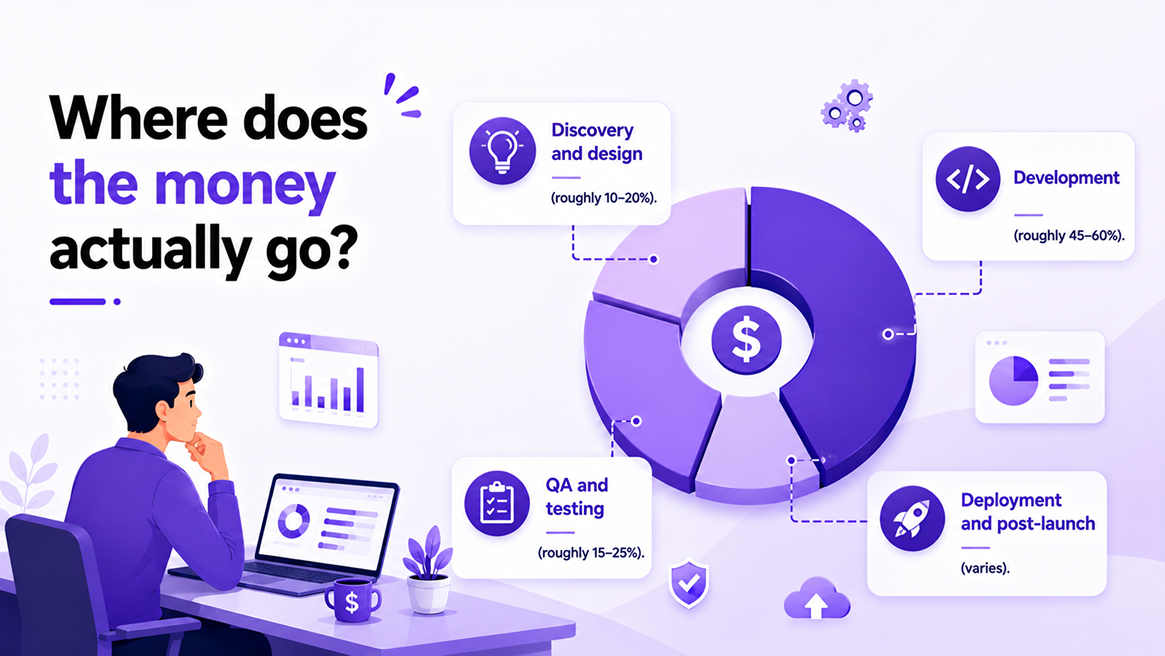
Most of a software budget is not raw coding. On a typical project, hands-on-keyboard development is often only 45 to 60 percent of the total, and the rest goes to the work that makes the code usable and durable. Buyers who only price "the coding" are the ones who get blindsided.
A rough sense of where a healthy project's effort lands:
- Discovery and design (roughly 10-20%). Figuring out what to build and how it should work and look. Skimped here, it costs triple later.
- Development (roughly 45-60%). The actual building. The visible part, but not the whole iceberg.
- QA and testing (roughly 15-25%). Catching defects before your users do. Cutting this does not save money; it moves the cost to production, where it is far higher.
- Project management and communication (roughly 10-15%). Coordination, planning, keeping everyone aligned. Real work, not overhead to be optimized away.
- Deployment and post-launch (varies). Getting it live and keeping it healthy. Software is not done at launch; it is just born.
When a quote looks suspiciously cheap, it is almost always because one of these was quietly dropped, usually QA, documentation, or project management. You do not save that money. You pay it later, with interest, when the thing breaks and nobody wrote down how it works.
Fixed-price or time-and-materials?
Neither model is inherently cheaper; they price risk differently. Fixed-price suits small, tightly defined scopes and shifts risk to the vendor, who bakes a buffer into the number. Time-and-materials suits evolving products and usually costs less over a real build, because you are not paying for padded estimates, but it asks more of you as a client. For most mid-size and larger work, milestone-based billing gives you the best of both.
Here is the honest trade-off between the two:
| Aspect | Fixed-price | Time-and-materials |
|---|---|---|
| Best for | Small, well-defined scope; clear spec | Evolving products; unclear or changing scope |
| Who holds the risk | Vendor (so a buffer is priced in) | Client (you pay for actual work done) |
| Flexibility to change | Low; changes mean change orders | High; reprioritize sprint to sprint |
| Typical net cost | Higher if scope is fuzzy (buffer + change orders) | Lower on a real build, but needs your attention |
How do you keep the budget under control?
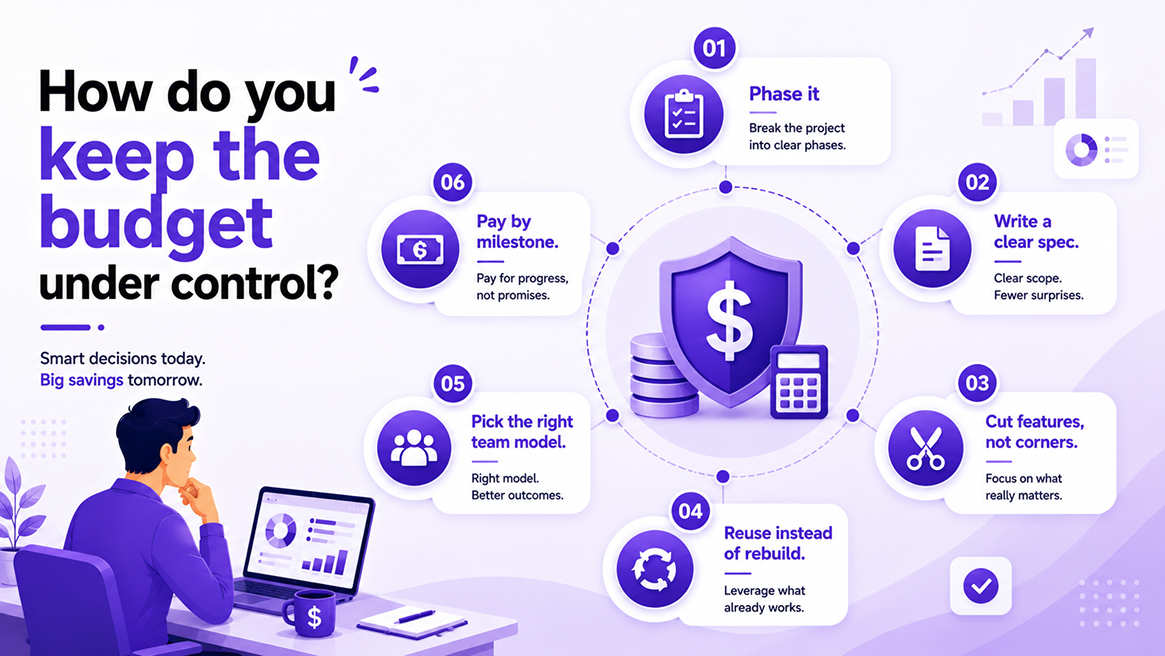
You control a software budget mostly before any code is written, by controlling scope and sequencing ruthlessly. The single highest-leverage move is to build the smallest version that delivers real value, get it in front of users, and let what you learn fund the next phase, instead of trying to specify everything up front and paying for guesses.
The levers that actually work, in rough order of impact:
- Phase it. Do not build everything at once. Ship a core version, learn from real use, then invest in what proves out. Most of the original wishlist turns out to be optional.
- Write a clear spec. Time spent pinning down requirements is the cheapest money in the project. Every question answered before coding is a change order avoided.
- Cut features, not corners. If the budget is tight, remove scope. Do not keep the scope and remove testing or documentation; that just defers the bill and inflates it.
- Reuse instead of rebuild. Proven libraries, existing components, and managed services beat building from scratch for anything that is not your differentiator.
- Pick the right team model. An in-house team, an outsourced partner, and a dedicated team each carry different cost curves; our take on in-house versus outsourced versus a dedicated team walks through when each one is cheapest.
- Pay by milestone. Tie payments to delivered, working software. It aligns incentives and gives you a natural checkpoint to reassess before spending more.
The same scope discipline applies whether you are pricing a platform or a storefront. If it is the latter, our breakdown of what an ecommerce website costs walks through the same tiering logic for a more specific case.
How we approach this at Shanti Infosoft
When someone asks us for a number, our honest first move is to slow down and ask questions, because a fast quote on a vague brief helps nobody. It is a guess dressed up as a commitment, and everyone pays for it later. We would rather spend a call understanding what you actually need and then give you a range we can stand behind, including the parts you might be able to skip or defer.
We scope it honestly, name the assumptions, and tell you when the smart move is to buy something off the shelf or build less than you planned. If you want a grounded estimate for something you are considering, or just a sanity check on a quote you already have, reach out. We are happy to walk through the numbers with you before anyone commits to anything.
Frequently Asked Questions
How much does custom software cost in 2026?
In 2026, a small custom build or MVP typically runs about $15,000 to $50,000, a mid-size product $60,000 to $250,000, and a large platform from $250,000 into seven figures. These reflect blended offshore and nearshore teams. Onshore-only US or Western Europe rates can run two to four times higher for the same scope.
What drives custom software cost up the most?
The biggest drivers are scope clarity, the number of integrations, and non-functional requirements like security, scale, and uptime. Vague requirements are the single most expensive thing in software. The programming language or framework almost never moves the total meaningfully for typical business software.
Fixed-price or time-and-materials, which is cheaper?
Neither is inherently cheaper. Fixed-price fits small, well-defined scopes and puts risk on the vendor, who prices a buffer in. Time-and-materials fits evolving products and usually costs less over a real build because you do not pay for padded estimates, but it needs your attention. Milestone-based billing gives you much of both.
Why are two quotes for the "same" software so different?
Usually because the cheaper quote quietly dropped something: QA, project management, documentation, security, or post-launch support. It can also reflect a different team region or a more junior team. Compare what is included, not just the bottom line, or you pay the difference later with interest.
How can I reduce cost without wrecking quality?
Phase the build and ship a small core first, write a clear spec before coding, and cut features rather than corners. Reuse proven libraries and managed services, lock your requirements before you lock the price, and choose the right team model. Never save money by removing testing.
Have a project in mind? Let's scope it together.
You get a named team, written estimates, full code and IP ownership, and 48-hour response times. CMMI Level 5 certified. 700+ projects delivered across the UK, US, UAE, and Australia.