Almost every founder who calls us has already half-decided how to staff the build. They want to hire two engineers, or they want to just outsource the whole thing, or a friend told them a dedicated team is the smart middle path. Then the first roadmap slips, or a contractor ghosts mid-sprint, and the model they picked starts to feel like the actual problem. Getting this choice right is really a software development staffing decision, and it deserves more thought than an hourly rate.
It usually is not the model itself. The model was probably wrong for the stage they were in. We have shipped products all three ways, sometimes for the same client across two years, and the differences are real and predictable once you stop arguing about hourly rates and start thinking about who owns the outcome.
Typical time to hire and onboard the first in-house engineer
How much a fixed-bid project can overrun once real requirements shift
Roadmap length where a dedicated team usually beats one-off outsourcing
What do in-house, outsourced, and dedicated team actually mean?
These three words get used loosely, so let us pin them down. In-house means full-time employees you recruit, pay, and manage directly. Project outsourcing means you hand a defined scope to an agency for a fixed price or fixed timeline. A dedicated team is engineers from a vendor who work only on your product, full-time, under your direction, billed monthly per person.
The honest difference is not the headcount or the invoice. It is where the management and the risk sit. With in-house, you own everything: hiring, retention, payroll, the bad weeks. With fixed-bid outsourcing, the vendor owns delivery risk but you lose day-to-day control and flexibility. A dedicated team splits it down the middle. You direct the work and own the roadmap; the vendor owns recruiting, benefits, replacements, and the desk the person sits at. We wrote more about picking that vendor in our guide on how to hire a software development company, because the model only works if the partner is solid.
How do the three models compare on cost, control, and risk?
No single model wins on everything. In-house gives maximum control and the lowest long-run cost per hour, but it is slow to stand up and you carry all the risk. Outsourcing is fastest to start and caps your downside on a fixed scope, but flexibility and code ownership suffer. Dedicated teams sit in the middle on almost every axis, which is exactly why so many growth-stage companies land there.
Here is how we actually weigh them when a client asks. Treat these as directional, because the numbers move with geography, seniority, and how messy your requirements are.
| Factor | In-house team | Project outsourcing | Dedicated team |
|---|---|---|---|
| Cost to start | High (recruiting, salary, benefits, equipment, office) | Lowest (pay per project) | Medium (monthly per person, no hiring or HR overhead) |
| Long-run cost per hour | Lowest once retained | Highest if scope keeps changing (each change is a re-quote) | Medium and predictable |
| Control over people and process | Total | Low (vendor runs delivery their way) | High (you set priorities, sprints, and standards) |
| Speed to first line of code | Slow (1-3 months to hire and onboard) | Fast (days to weeks) | Fast (days to weeks; vendor has the bench) |
| Scaling up or down | Slow and painful (hire or lay off) | Per project only | Fast (add or release people with notice) |
| IP and code ownership | Cleanest (work-for-hire by default) | Yours only if the contract and handoff say so | Yours with an IP clause and a repo you control |
| Knowledge retention | Strongest (stays in the building) | Weakest (walks out the door at handoff) | Strong if the team is stable and documents well |
| Main risk | You carry hiring, retention, and idle-time risk | Scope creep, quality at handoff, lock-in | Vendor churn and weak management on your side |
| Best for | Core product you will evolve for years | Fixed scope, one-off builds, clear specs | Sustained roadmap, fast scaling, founder-led control |
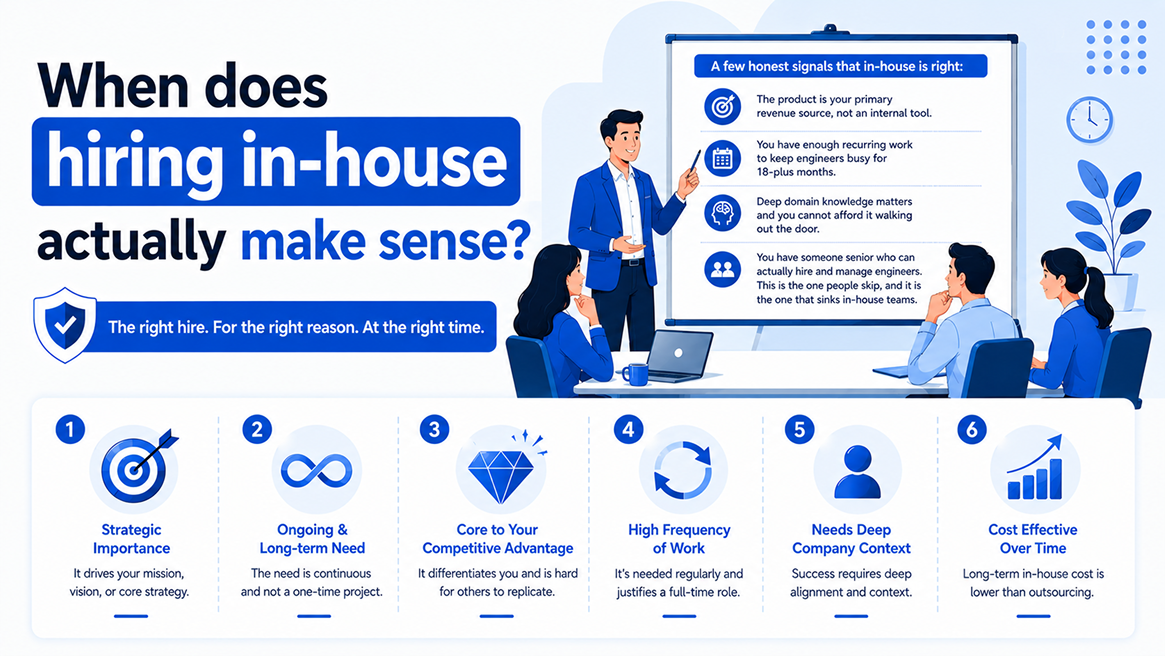
When does hiring in-house actually make sense?
Go in-house when the software is the business, not a supporting tool, and when you expect to keep changing it indefinitely. If your engineers will live in the same codebase for three years, the slow start and the payroll pay for themselves through retained knowledge and full control. This is the right call for funded product companies and for any team where the code is the moat.
The cost most founders underestimate is not the salary. It is everything around it. A senior engineer in many markets costs far more than their pay packet once you add benefits, equipment, recruiter fees, management time, and the months they sit half-productive while onboarding. Then there is bench risk: if the roadmap goes quiet for a quarter, you are still paying full freight. In-house is the lowest cost per hour only when you keep that person genuinely busy for years.
A few honest signals that in-house is right:
- The product is your primary revenue source, not an internal tool.
- You have enough recurring work to keep engineers busy for 18-plus months.
- Deep domain knowledge matters and you cannot afford it walking out the door.
- You have someone senior who can actually hire and manage engineers. This is the one people skip, and it is the one that sinks in-house teams.
When is project outsourcing the right call?
Outsource a project when the scope is genuinely fixed and your main need is to get it built without building a team. A redesign, a defined integration, a v1 with a clear spec, a migration with a known end state: these are great fits because the vendor can quote a price, own delivery, and hand you a finished thing. You pay for an outcome, not for headcount.
The trap is pretending a fuzzy project is a fixed one. Fixed-bid contracts punish change. The moment your requirements shift, and on real software they always shift, every change becomes a re-negotiation, and the per-hour cost quietly becomes the highest of the three models. We have walked into rescue projects where a fixed price build ended up costing 30 to 40 percent more through change orders, plus a month lost arguing about what was in scope.
Outsourcing also hands the codebase to people who leave when the invoice is paid. If nobody on your side understands what was built, you have bought a black box. That is fine for a marketing site. It is dangerous for anything you plan to keep evolving. If you go this route, insist on documentation and a real handoff as line items, and budget honestly using something like our breakdown of custom software development cost in 2026 so the quote you compare against is grounded in reality.
Why do so many growth-stage companies choose a dedicated team?
A dedicated team wins when you have a real, ongoing roadmap and you want to move fast while keeping control, but you are not ready to take on permanent hiring and HR. You get engineers working only on your product, in your sprints, to your standards, and the vendor absorbs recruiting, benefits, equipment, and the headache of finding a replacement when someone leaves. You scale the team up or down with notice instead of running a hiring loop or a layoff.
This is the model we run most often, so I will be honest about both sides. The upside is speed and flexibility with control that fixed-bid outsourcing simply cannot give you. You are not waiting three months to hire; the vendor already has the bench. You are not stuck with a black box; the people are yours to direct and they stay on the product long enough to build real context.
The risks are specific and manageable. First, vendor churn: if the partner rotates people constantly, you lose the knowledge advantage that justified the model. Ask about average tenure and whether the same engineers stay on an account. Second, weak management on your side. A dedicated team is not a vending machine. Someone on your end has to own priorities and feedback, the same way they would for employees. Teams that treat a dedicated team like fire-and-forget outsourcing get fire-and-forget results.
Good fit signals for a dedicated team:
- You have 6-plus months of roadmap and the work keeps coming.
- You want to set direction yourself but skip recruiting and HR.
- You need to scale capacity in weeks, not quarters.
- You have a product owner or technical lead who can give the team clear direction.
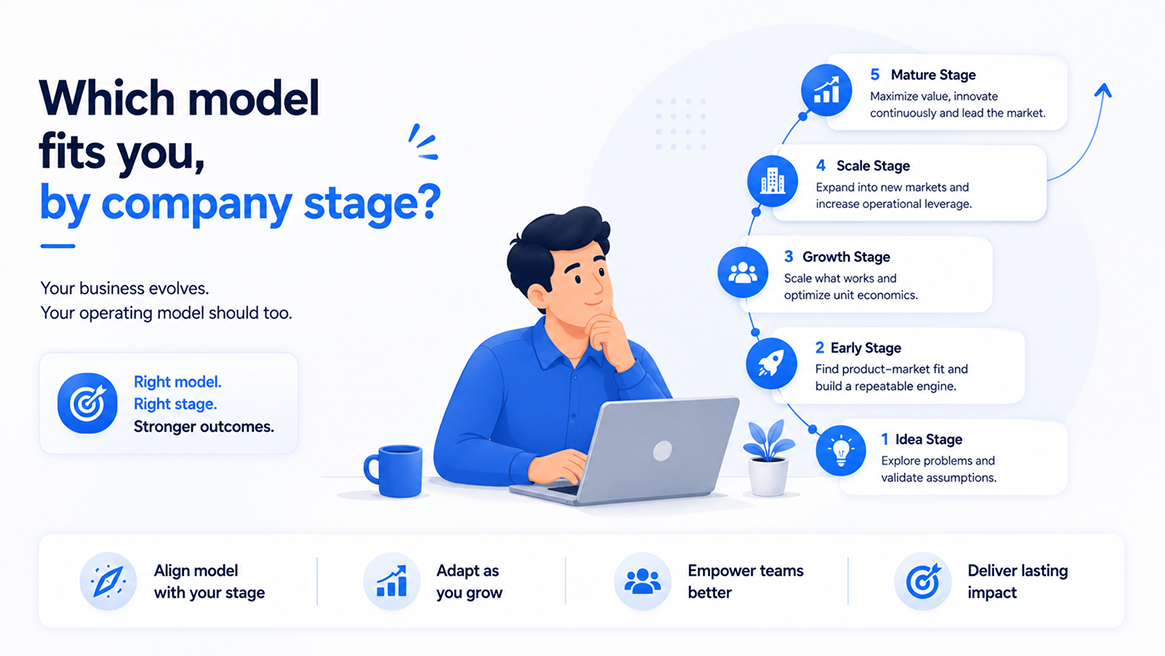
Which model fits you, by company stage?
Match the model to where you are, not to whichever option sounds cheapest this month. As a rule: pre-product and cash-tight leans outsourcing or a tiny dedicated team, growth-stage with a live roadmap leans dedicated team, and a funded product company whose code is the moat leans in-house with a dedicated team for surge work. Below is the shortcut we give founders.
| Your stage | Best-fit model | Why |
|---|---|---|
| Idea to first MVP, tight budget | Project outsourcing (fixed v1) or small dedicated team | Get to market without payroll; validate before you commit |
| Post-launch, roadmap growing fast | Dedicated team | Velocity and control without the hiring loop |
| Funded, software is the core product | In-house core, dedicated team for surge | Retain knowledge and control; flex capacity when needed |
| One-off need (site, integration, migration) | Project outsourcing | Fixed scope, clean handoff, no standing team required |
Can you mix models or switch between them?
Yes, and the smartest teams do exactly that as they grow. The models are stages on a path far more often than they are a permanent identity. The mistake is treating the first choice as forever and gritting your teeth through a mismatch instead of changing the staffing to fit the moment.
The pattern we see most: start with project outsourcing or a small dedicated team to get a v1 live without committing to payroll, then bring the core in-house once the product proves out and the roadmap is undeniably long, while keeping a dedicated team for surge work and specialized skills you do not need full-time. One client of ours ran exactly this arc over two years, and the part that made it work was a clean codebase and real documentation at every handoff, so nothing was a black box when ownership moved. The same logic applies to AI work, which we broke down in our take on AI development outsourcing versus in-house.
A simple way to choose right now:
- Is the scope fixed and the spec clear, with little change expected? Lean outsourcing.
- Is there a long, evolving roadmap and is this software your core product? Start moving toward in-house, with a dedicated team to get going fast.
- Do you need velocity and control now but cannot absorb hiring and HR yet? Dedicated team, and reassess in two quarters.
How we approach this at Shanti Infosoft
We do not have a favorite model, because we have watched the same product need different ones at different stages. When a founder asks us to just build it, our first question is usually how long they expect to keep changing it, because that one answer reshuffles the whole recommendation. A fixed v1 and a five-year platform are not the same problem, and pretending otherwise is how budgets get burned.
In practice we run dedicated teams for clients with live, evolving roadmaps, take on fixed-scope projects where the spec is genuinely settled, and we will tell you honestly when the right move is to hire your own people and we step back to advisory. The thing we care about is that whatever model you choose actually fits the stage you are in, and that the work stays clean enough to hand off without pain. If you want a second opinion on which way to staff a build, or just a sanity check on a quote, we are happy to talk it through. Start at Shanti Infosoft, and if you are still deciding whether to build at all, our team can walk you through the trade-offs before you commit a rupee or a hire.
Frequently Asked Questions
What is the difference between outsourcing and a dedicated team?
Project outsourcing hands a fixed scope to a vendor who owns delivery and gives you a finished result. A dedicated team is engineers who work only on your product, in your sprints, under your direction, billed monthly per person. Outsourcing buys an outcome; a dedicated team buys ongoing capacity you control.
Is a dedicated team cheaper than hiring in-house?
On monthly rate, in-house often looks cheaper, but that ignores recruiter fees, benefits, equipment, management time, and idle weeks. A dedicated team costs more per hour yet removes hiring and HR overhead and scales down when work slows. In-house wins on cost only when you keep people genuinely busy for years.
Who owns the IP and source code in each model?
In all three you should own the IP and code, but only if the contract says so. In-house is cleanest since employees assign work-for-hire by default in most places. With outsourcing and dedicated teams, insist on a written IP-assignment clause, a private repository you control, and full source handover. Never let the vendor host the only copy.
When should a startup outsource instead of building a team?
Outsource when the scope is genuinely fixed, the spec is clear, and you mainly need it built without standing up a team. A defined v1, a redesign, or a known integration are good fits. Avoid fixed-bid outsourcing for fuzzy, fast-changing products, since every change becomes a re-quote. See our guide on how to hire a software development company.
Can I switch between these models as I grow?
Yes, and most companies should. A common arc is to start with outsourcing or a small dedicated team for v1, then bring the core in-house once the roadmap is undeniably long, while keeping a dedicated team for surge work. The switch only stays painless if every handoff ships clean code and real documentation, so nothing becomes a black box.
Have a project in mind? Let's scope it together.
You get a named team, written estimates, full code and IP ownership, and 48-hour response times. CMMI Level 5 certified. 700+ projects delivered across the UK, US, UAE, and Australia.