
Most AI ROI advice hands you a calculator and wishes you luck. Plug in a few numbers, read off a percentage, show it to your CFO. The trouble is that the numbers feeding that calculator are usually guesses in a nice font, because nobody measured the "before." I run AI consulting engagements for a living, and the most common reason a company cannot prove its AI is working is not that the AI failed. It is that no one set up the measurement before the build started.
So this is not another ROI formula post, though you will get a formula. It is about instrumenting the initiative from day one, so that when the board asks whether the AI spend is actually paying off, you hand over one clean, defensible number instead of a shrug and a story. Build the metric in. Do not bolt it on later.
of enterprise generative AI pilots show no measurable P&L impact yet (2025 MIT study)
of executives say they can confidently measure the return on their AI spend
of finance chiefs report a clear, quantified ROI from AI so far
The honest way to measure AI ROI, in one paragraph
The short answer: capture a baseline before you build, track the specific hard and soft metrics the initiative is meant to move, then report the change as one number the board can defend. The formula is simple - ROI equals value gained minus total cost, divided by total cost. The hard part is never the arithmetic. It is measuring "value gained" honestly against what would have happened anyway, and being disciplined about counting the full cost, not just the license fee.
Everything else here is how to do those three things without fooling yourself. Baseline first. Separate what you can bank from what you can only feel. Ship one number per initiative, with the assumptions shown.
Why most AI ROI numbers are fiction
Most reported AI ROI numbers are fiction because they compare a polished pilot to a fuzzy memory of the past, count activity instead of outcomes, and never subtract what would have happened without the AI. The demo looked great, someone estimated "this saves us 40 percent," and that estimate hardened into a fact nobody can trace. That is not measurement. It is a vibe with a percent sign.
The evidence that this is widespread is not subtle. A widely cited 2025 MIT study found that roughly 95 percent of enterprise generative AI pilots showed no measurable impact on the P&L. In recent executive surveys, well under a third say they can confidently measure the return on their AI, and only about one in seven finance chiefs report a clear, quantified ROI. Read those together and the picture is plain: plenty of AI is being deployed, and almost nobody can prove what it did.
The gap usually traces to three habits. First, measuring the demo instead of the deployed system - a great demo is the easiest thing in AI to produce and the least predictive of production value, a trap I get into in why a working AI demo is the problem. Second, counting activity - messages handled, documents parsed - rather than outcomes anyone would pay for. Third, forgetting the counterfactual: some of that "gain" was going to arrive anyway from a process change or a good quarter.
Set the baseline before you build
The most valuable thing you can do for AI ROI takes an afternoon and happens before a single line of code: write down the current state. How long the task takes now, what it costs, how often it goes wrong, how customers rate it. Without that snapshot, every future number is an argument. With it, ROI is just subtraction.
A usable baseline is boring and specific. Pick the workflow the AI will touch and record the few numbers that actually matter for it:
- Volume. How many times a week does this happen - tickets, invoices, calls, reports?
- Time. Minutes per instance, start to finish, including the waiting and the rework.
- Cost. Loaded hourly cost of the people doing it, plus any tooling it needs today.
- Quality. Error rate, rework rate, or a satisfaction score - whatever "good" means here.
Capture it for two to four weeks so a bad Monday does not become your benchmark. This is the step almost everyone skips, and skipping it is exactly why AI ROI turns into a debate later. You cannot prove you improved something you never measured.
Hard ROI vs soft ROI, and how to report each
Split every AI benefit into two buckets. Hard ROI is money you can bank - cost removed or revenue added, in currency, that a CFO will accept. Soft ROI is real value that is harder to price - speed, quality, risk reduction, experience. Both matter. The mistake is blending them into one inflated figure, or dismissing soft ROI because it is awkward to quantify. Report them separately and honestly, and your number survives scrutiny.
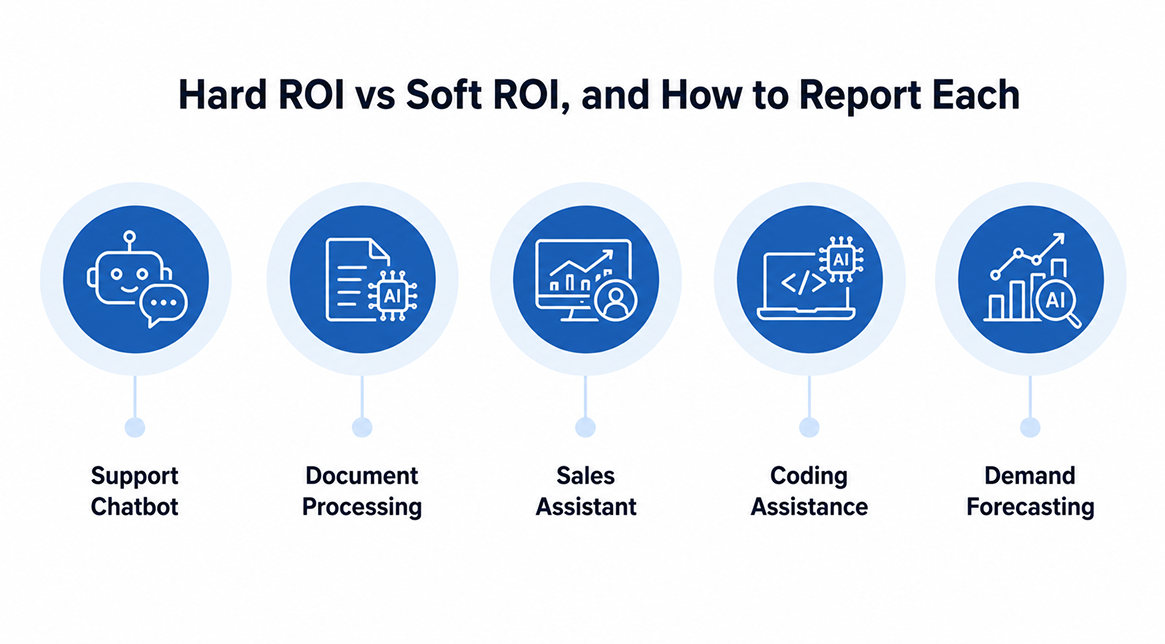
Here is how the two split across common AI initiatives:
| AI initiative | Hard ROI (bank it in money) | Soft ROI (track it, value it carefully) |
|---|---|---|
| Support chatbot | Tickets deflected x loaded cost per ticket | Faster first response, higher CSAT, round-the-clock cover |
| Document processing | Hours removed x loaded hourly cost | Fewer keying errors, lower compliance risk |
| Sales assistant | Revenue from faster follow-up and more qualified meetings | Rep ramp time, less busywork, morale |
| Coding assistance | Rework hours saved, more shipped per sprint | Developer flow, retention, faster onboarding |
| Demand forecasting | Carrying cost cut, fewer stockouts | Planner confidence, faster decisions |
Report hard ROI as a single money figure with the baseline and assumptions attached, so anyone can check your working. Report soft ROI as the raw metric first - cycle time down 30 percent, error rate halved - and only convert it to money when the link is honest and you can state the assumption out loud. A CSAT lift that plausibly cuts churn can carry a money estimate, clearly labeled as an estimate. A vague "better experience" cannot, and you should not pretend it can. The cost side deserves the same rigor: count licenses, build, integration, monitoring, and the human review the system still needs, which is the full bill I break down in the real bill of automation.
Ship one board-ready number per initiative
For each AI initiative, decide up front on the single number that defines success, and report that. Not a dashboard with forty metrics - one headline figure the board can hold in their head, backed by the detail underneath. "This support AI saves 1.2 million a year net of run cost, and here is the baseline and the math" beats a wall of charts every time. One initiative, one number, one owner.
That number should be net, not gross - net of the license, the build amortized over its useful life, the integration, and the ongoing human oversight. A gross saving that ignores a heavy run cost is exactly the kind of fiction that gets a program cancelled the moment finance looks closely. Pick the primary metric before you build, so the whole team aims at the same target instead of hunting for a flattering statistic after the fact.
A simple AI-ROI formula you can defend
Use the plainest version and show your working: ROI percent equals (annual value gained minus annual total cost) divided by annual total cost, times 100. Payback period is total upfront cost divided by monthly net value. Neither is clever. The credibility comes entirely from the inputs being real and conservative, not from the equation.
Walk it through with round numbers. Say a document workflow takes 2,000 hours a year at a loaded 30 per hour, so 60,000 of baseline cost. The AI cuts it by 70 percent, saving 42,000 a year in hard ROI. The system costs 12,000 a year to run and was 20,000 to build, amortized at about 6,600 a year over three years. Net annual value is 42,000 minus 12,000 minus 6,600, or 23,400. Against roughly 18,600 of annual cost, that is about a 126 percent ROI, with the build paying back in well under a year. The soft ROI - fewer errors, lower risk - then sits on top as clearly labeled upside, not as padding inside the headline.
What to do when the ROI is soft or strategic
Some AI work will not produce a clean dollar figure, and that is fine as long as you are honest about it. When the value is soft or strategic - protecting a customer experience, reducing a hard-to-price risk, building a capability you will need in two years - report it as exactly that, with a measurable proxy attached, rather than forcing a fake precise number that collapses under one good question.
The move is to make the soft thing measurable even when it is not monetary. Risk becomes incidents avoided or exposure reduced. Experience becomes CSAT, retention, or response time. Capability becomes a milestone: "we can now do X, which we could not before." You are still measuring, just not in currency, and a board can weigh a well-framed strategic bet far better than a suspicious precise ROI. Strategic value compounds, which is the larger point in our piece on the real impact of AI on business growth - some of the biggest returns show up as position and capability well before they show up in a quarter.
What you must not do is let "it is strategic" become the excuse that dodges measurement entirely. Strategic and unmeasured are not the same thing. If you genuinely cannot find any proxy - hard number, soft metric, or milestone - that is a signal the initiative may not be worth funding yet.
How we instrument ROI on delivery
Our approach is simple to say and rare to see: we build the measurement into the system, not around it. Before the build, we agree the baseline and the one success metric. During the build, we instrument the workflow so the numbers - volume, time, cost, quality - are captured automatically, not reconstructed from memory when a board meeting looms. That is "build the metric in, don't bolt it on" made concrete.
In practice that means logging every task the AI handles and what it would have taken before, tagging outcomes so we can separate the AI's effect from everything else, and putting the net number - after run cost and oversight - on a dashboard the sponsor can open any day. When the review comes, nobody scrambles. The number is already there, already net, already defensible. If you are adding AI to something you already run, this instinct matters even more, because you are measuring a change against a live system rather than a greenfield build.
If you want your next AI initiative to reach the board with one clean number instead of a hopeful story, that is the discipline to insist on from day one. Tell us the outcome you are chasing and we will help you set the baseline, pick the number that matters, and build the measurement in from the start - so proving it worked becomes the easy part.
Frequently Asked Questions
How do you measure ROI on an AI project?
Capture a baseline before you build - today's volume, time, cost, and quality for the workflow the AI will touch. Then track the same numbers once the AI is live, subtract the total cost (license, build, integration, oversight), and report the net change as one figure. ROI is value gained minus cost, divided by cost. The discipline, not the math, is the hard part.
Why can't most companies prove their AI ROI?
Because they never measured the "before." Without a baseline, every after-the-fact number is an argument, not a measurement. Most reported ROI also counts activity instead of outcomes and ignores the counterfactual - the share of the gain that would have happened anyway. A widely cited 2025 MIT study found roughly 95 percent of enterprise GenAI pilots showed no measurable P&L impact for exactly these reasons.
What is the difference between hard ROI and soft ROI in AI?
Hard ROI is money you can bank - cost removed or revenue added, in currency a CFO will accept. Soft ROI is real value that is harder to price - speed, quality, risk reduction, better experience. Report them separately. Bank the hard number, track the soft metric as its raw value, and only convert soft to money when the link is honest and you state the assumption out loud.
What is a good ROI for an AI project, and how fast should it show up?
A well-scoped operational AI project - support deflection, document processing, workflow automation - often lands a net ROI in the double to low triple digits within the first year, with payback under a year once run costs are counted. Strategic or platform work pays back slower and shows up first as capability and position. Be suspicious of any number over a few hundred percent; honest inputs rarely produce it.
How do you present AI ROI to the board or CFO?
Bring one net number per initiative, not a forty-metric dashboard. State the baseline, the value gained, the full cost subtracted, and the assumptions, so anyone can check your working. Report soft and strategic value separately as clearly labeled upside. A defensible 90 percent survives scrutiny; an unbelievable 400 percent invites the question that unravels the whole program.
Have a project in mind? Let's scope it together.
You get a named team, written estimates, full code and IP ownership, and 48-hour response times. CMMI Level 5 certified. 700+ projects delivered across the UK, US, UAE, and Australia.