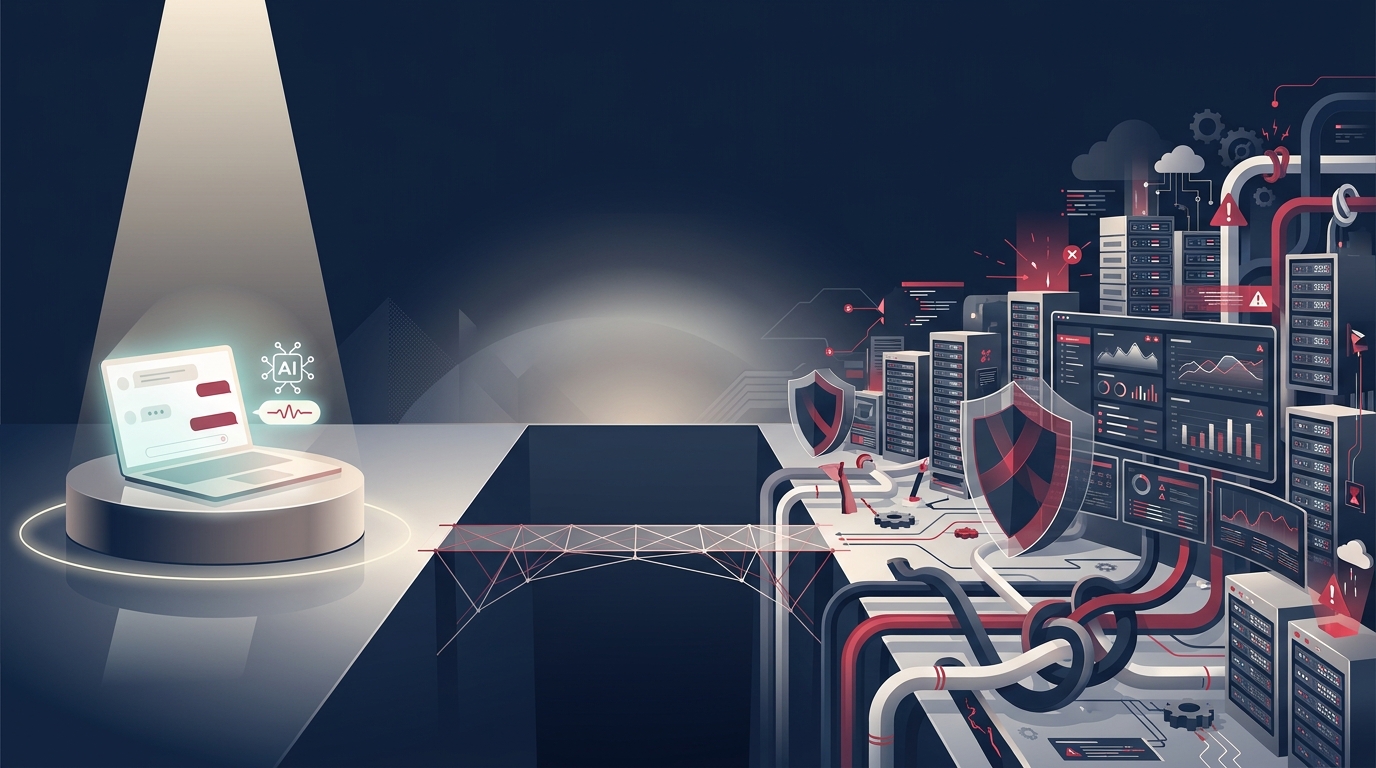
The demo always works. That is precisely why it should worry you.
You have sat in the meeting. Someone shares their screen, types a question, and an AI assistant answers it perfectly. It pulls the right number, drafts the right email, summarises the right document. The room nods. A budget gets approved. And then, somewhere between that flawless thirty-second demo and a system your customers actually rely on, the project goes quiet — slips, balloons in cost, or never ships at all. This is the most expensive pattern in enterprise software right now, and the demo is what sets the trap.
Here is the uncomfortable truth almost no vendor will say out loud during a pitch: a working demo proves the easiest twenty percent of the problem. The hard eighty percent — the part that decides whether you get value or a write-off — is everything the demo carefully avoided. This article is about that gap: why it exists, why it kills projects, and exactly what the minority of teams who cross it do differently.
Sources: RAND Corporation analysis of why AI projects fail; the 20/80 split is the production gap pattern Shanti sees across delivery.
Why a Demo That Works Tells You Almost Nothing
A demo is a performance, and like any performance, it is staged. None of that is dishonest — it is simply what a demo is for. The problem is the conclusion you draw from it. When you watch a flawless demo, your brain quietly fills in: "if it can do that, it can do the real thing." It usually cannot, not yet, because the demo removed every condition that makes the real thing hard.
Think about what a demo silently controls for. The input is hand-picked — the question the presenter typed is one they know the system handles well. The data is clean and curated, not the decade of inconsistent, half-empty, contradictory records sitting in your actual systems. There is a human in the loop steering it, ready to rephrase a prompt if the first attempt wobbles. There is no real load, no concurrent users, no malicious input, no compliance requirement, no integration with the seven other tools your business depends on, and no question of what it costs when ten thousand people use it instead of one. Strip those conditions away and you have a magic trick. Add them back and you have engineering.
The 80% Nobody Puts in the Demo
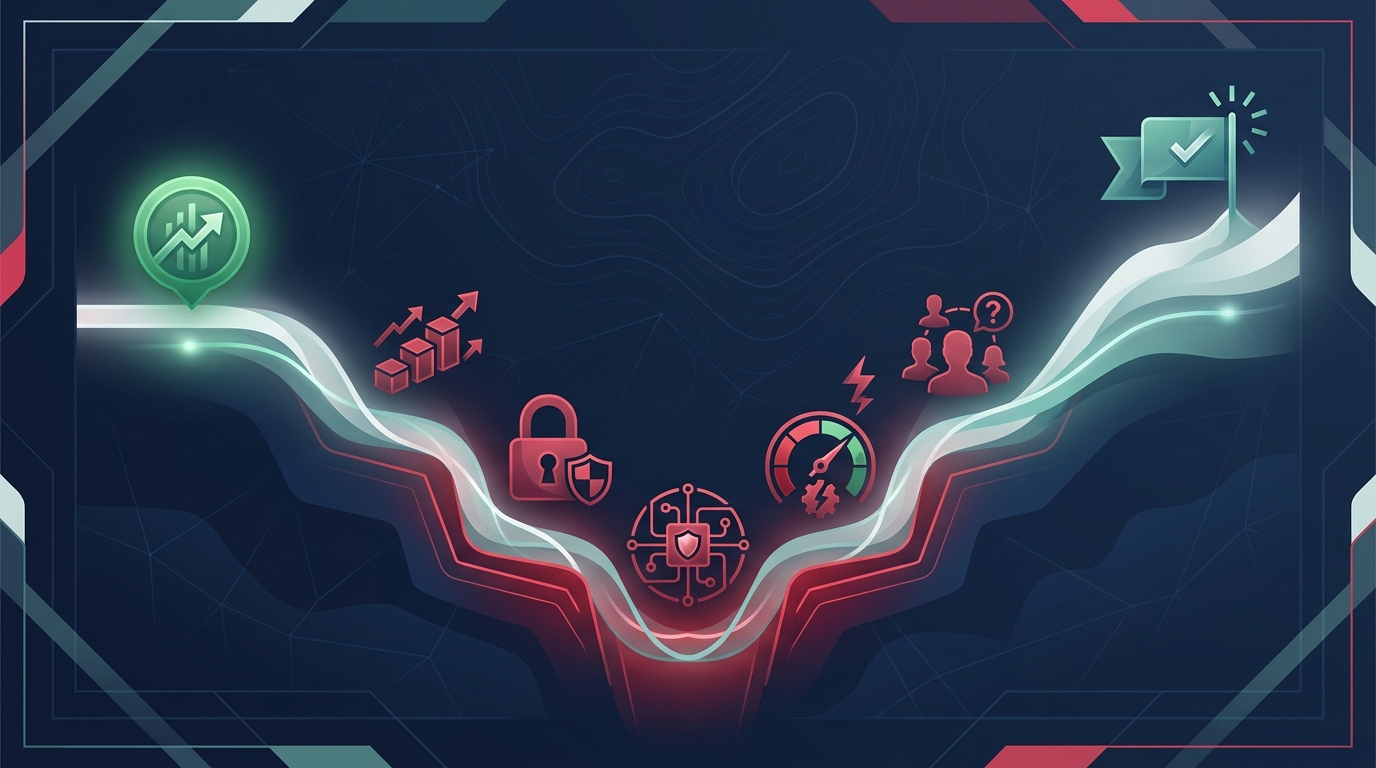
If the demo is the visible tip, here is the mass under the water — the work that turns a prototype into something a business can actually depend on. None of it is glamorous, and that is exactly why it gets skipped in the sales cycle and discovered in the budget overrun.
| In the demo | In production (the real work) |
|---|---|
| One clean, hand-picked input | Messy real-world inputs, missing fields, contradictory records, and inputs nobody anticipated |
| It answered correctly | Defined behaviour for when it is wrong: how it flags uncertainty, escalates, and fails safely |
| A person steering the prompt | Unattended operation with guardrails, so a non-expert user cannot break it |
| Runs on a laptop | Scales to real concurrency without latency collapse or runaway cost |
| Standalone screen | Integrated with your CRM, billing, auth, and the tools your team already lives in |
| No one is watching the data | Security, access control, a data-processing agreement, and audit trails for compliance |
| It worked today | Monitoring, evaluation, and maintenance so it still works in three months as data and models drift |
Look down that right-hand column and notice something: almost none of it is about the AI model. It is data engineering, error handling, integration, security, observability, and operations. The model — the bit everyone obsesses over in the demo — is one component in a system that is mostly plumbing. That is not a criticism of the technology; it is a description of what software has always been. AI did not change it. AI just made the demo so convincing that people forgot the plumbing exists.
The Failures Are Organizational, Not Technical
The instinct, when an AI project stalls, is to blame the model — it is not smart enough, the prompt needs work, maybe a newer model will fix it. That is almost never the real reason. RAND's analysis of why AI initiatives fail puts more than eighty percent of failures down to organizational and operational causes, not the underlying technology. In plain language: the model was usually capable enough. The project failed for human and structural reasons.
Those reasons rhyme across almost every stalled project we have been called in to rescue. The problem was framed around a technology rather than a measurable business outcome, so nobody could say what "done" or "working" actually meant. The data the system needed was not ready — scattered, dirty, or locked in systems no one could integrate with. The team mistook the prototype for the product and tried to ship the demo, then watched it crumble on contact with real users. And there was no plan for the long tail: monitoring, retraining, and maintenance, the unglamorous work that keeps an AI system alive after launch. The technology was the easy part. The discipline around it was missing.
This is genuinely good news, even though it does not sound like it. It means success is not gated behind some breakthrough you cannot control. It is gated behind decisions and engineering practices you absolutely can — if you and your partner take the eighty percent as seriously as the twenty.
Set the Production Bar Before You Build the Demo
The single highest-leverage move you can make is also the cheapest: define what "production-ready" means before anyone builds a prototype. Most teams do this backwards. They build the demo, get excited, and only then discover what real use demands. By then the demo's shortcuts are baked into expectations and the budget. Flip the order. Decide the bar first, then build a prototype that tests the hardest part of clearing it — not the easiest part of looking impressive.
Writing the bar down is not bureaucracy; it is the contract that protects you. It turns "the demo worked" into something you can actually hold a vendor to. Here is the minimum it should pin down:
- The outcome, in business terms. Not "use AI for support" but "resolve 40% of tier-1 tickets end to end without a human, measured weekly." If you cannot measure it, you cannot tell success from theatre.
- The accuracy and failure bar. What level of correctness is acceptable, and exactly what must happen when the system is unsure or wrong — escalate, flag, refuse? Wrong-answer behaviour is a product requirement, not an afterthought.
- Latency and cost at real scale. How fast must it respond, and what is the cost per request when usage is ten or a hundred times the demo? Get a written estimate for "what happens when this doubles."
- The integration surface. Which existing systems it must talk to, and who owns that work. Integration is where timelines quietly go to die.
- Security, data, and compliance. Where data lives, who can see it, whether it trains anyone else's model, and what regulation applies. In regulated industries this is the wall most pilots hit.
- The operating plan. Who monitors it, how it is evaluated over time, and what maintenance is budgeted. Launch is the start of the work, not the end.
How to Be in the Winning Minority
If most AI projects fail to deliver and most of those failures are self-inflicted, then crossing the gap is not luck — it is a method. The teams who land in the minority that actually ships value tend to do the same handful of things, and none of them require a bigger model.
They treat the proof of concept as a test of the riskiest assumption, not a sales artefact — they point the prototype straight at the messiest data and the nastiest edge case, because that is what they are actually unsure about. They pilot against real users and real inputs early, in a contained way, so reality corrects the plan while it is still cheap to change. They scope to a measurable outcome and write it into the contract, so "working" has a definition both sides agreed to. They budget for the eighty percent — the integration, the security, the monitoring, the maintenance — from day one, instead of discovering it as a series of unwelcome surprises. And they pick a partner who shows them production systems used by real people, not a reel of demos, and who is comfortable demonstrating failure as confidently as success.
That last one is the quiet differentiator. Anyone can show you a demo that works. Far fewer can point to something live, handling real load, that has survived contact with real users for a year. When you are evaluating a partner, ask to see the boring parts: the monitoring dashboard, the error-handling, the thing that broke once and how they caught it. The willingness to show you the unglamorous eighty percent is the single best signal that they know it exists — and that they will build it for you instead of handing you a demo and an invoice.
We Build for the 80% the Demo Skips
Shanti Infosoft is a CMMI Level 5 software engineering firm. We take AI from a working prototype to a hardened production system — with the integration, security review, human QA, and monitoring that decide whether you get value or a write-off. You get a named senior team, written fixed-scope estimates, and full IP and source ownership.
Frequently Asked Questions
Why do so many AI projects fail after a successful demo?
Because the demo only proves the easiest part. It runs on clean, hand-picked data, in a controlled setting, with a human steering it. Production brings messy inputs, edge cases, security and compliance requirements, integration with existing systems, monitoring, and cost at scale. RAND's analysis finds that the majority of AI project failures are organizational and operational, not down to the model's raw capability.
What is the difference between an AI proof of concept and a production system?
A proof of concept answers "can this work at all?" on a narrow, favourable example. A production system answers "will this work reliably, safely, and affordably for real users, every day, when things go wrong?" The PoC is roughly the first 20% of the effort; the remaining 80% is data pipelines, error handling, evaluation, security, integration, monitoring, and maintenance.
How long does it take to move an AI prototype into production?
For a well-scoped use case, expect roughly 2 to 5 months from a working prototype to a hardened production system, depending on data quality, integration complexity, and compliance needs. Be sceptical of anyone promising "production-ready" in a couple of weeks — that usually means shipping the demo as if it were the product.
How do I avoid building an AI demo that never reaches production?
Define the production bar before you build the demo: the accuracy, latency, cost, and failure behaviour real use requires, plus how integration, security, and monitoring will be handled. Then build a prototype that tests the hardest part of clearing that bar, pilot it against real data and real users early, and treat the demo as a probe of the riskiest assumption rather than a finished product.
Is the AI model usually the reason a project fails?
Rarely. In most stalled projects the model was capable enough; the project failed because the outcome was never defined in measurable terms, the data was not ready, the prototype was mistaken for the product, or no one owned the ongoing operation. Those are fixable, controllable problems — which is why the gap is crossable with the right discipline and partner.
Written by
Rishabh Jain
AI Consultant & Founder, Shanti Infosoft LLP
Shanti Infosoft is a CMMI Level 5 software engineering firm. We deliver every project with written, fixed-scope estimates, full IP and source-code ownership for the client, and a named team of senior engineers. We specialise in taking AI from prototype to production: 700+ projects delivered across web and mobile development, AI integration, and offshore engineering.
700+ Projects Delivered | CMMI Level 5 | 4.9★ on Clutch | 38,000+ hrs on Upwork