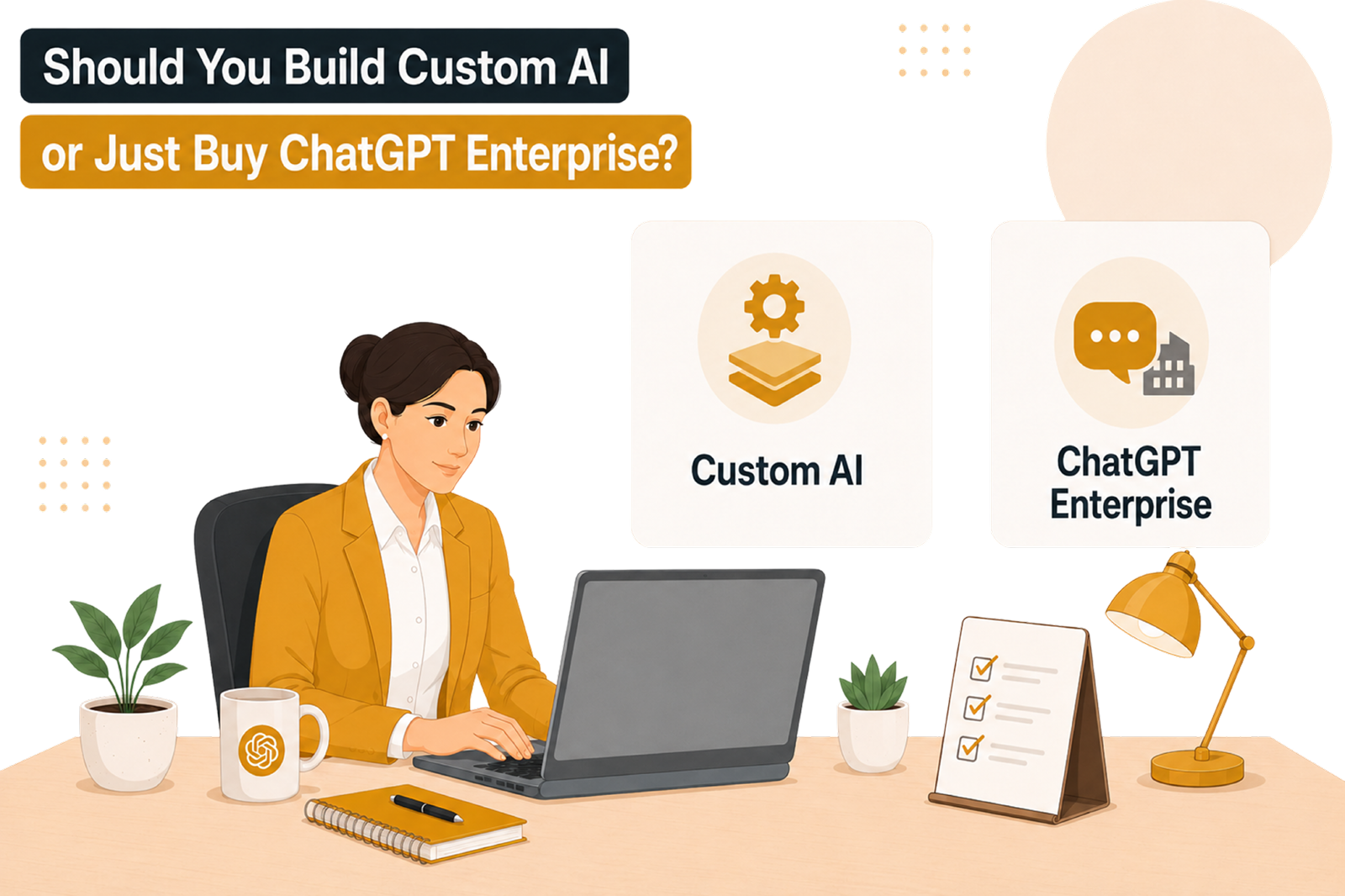
I get this question in almost every scoping call now: "Should we just buy ChatGPT Enterprise, or does this actually need a custom build?" It is the right question, and most of the articles answering it are useless - endless feature grids comparing seat prices and context windows. That is not the decision. As a project manager who runs these builds and rollouts, what I care about, and what our AI consulting conversations always come back to, is one line: where does the suite you can buy stop, and where does the thing you have to build begin?
Here is the honest version. AI suites - ChatGPT Enterprise, Microsoft Copilot, Google Gemini - are genuinely good, and for most teams they are the right first purchase. They are also built for the average company, which means the moment your value depends on something specific to you, they run out of road. This piece is about finding that line before you spend, not after.
enterprises now run more than one AI platform, so buy-vs-build is rarely an all-or-nothing choice
is how every AI suite prices - a flat rate per user, whatever value each seat actually returns
of your proprietary workflow a generic suite was built around, and that gap is where custom begins
Should you buy an AI suite or build custom?
The short answer: buy the suite for broad productivity, build custom for your edge. If you want your team to draft faster, summarize documents, and search internal knowledge, a licensed suite does that today for a monthly fee. If the outcome depends on your proprietary data or a workflow no vendor models, you are looking at a custom build. Those are two different jobs, and the trouble starts when you use one tool for both.
The mistake I see most is treating this as all-or-nothing. Teams either license a suite and then get frustrated that it cannot touch their real systems, or they commission an expensive custom platform to do things a per-seat subscription already handles. The buy-vs-build line has moved a lot in two years, and knowing where it sits today is most of the decision. Our take on how the build-vs-buy line has shifted goes deeper, but the summary is this: buy more of the commodity than you used to, and build only where you are genuinely different.
What ChatGPT Enterprise, Copilot and Gemini actually give you
A licensed AI suite gives you a strong model wrapped in a secure, admin-controlled workspace, so your staff get capable AI without your data training someone else's model. That is the real product you are buying: safety, administration, and convenience around a model you do not have to host or run yourself. The model is almost never the differentiator between them.
The three big options differ less than the marketing suggests:
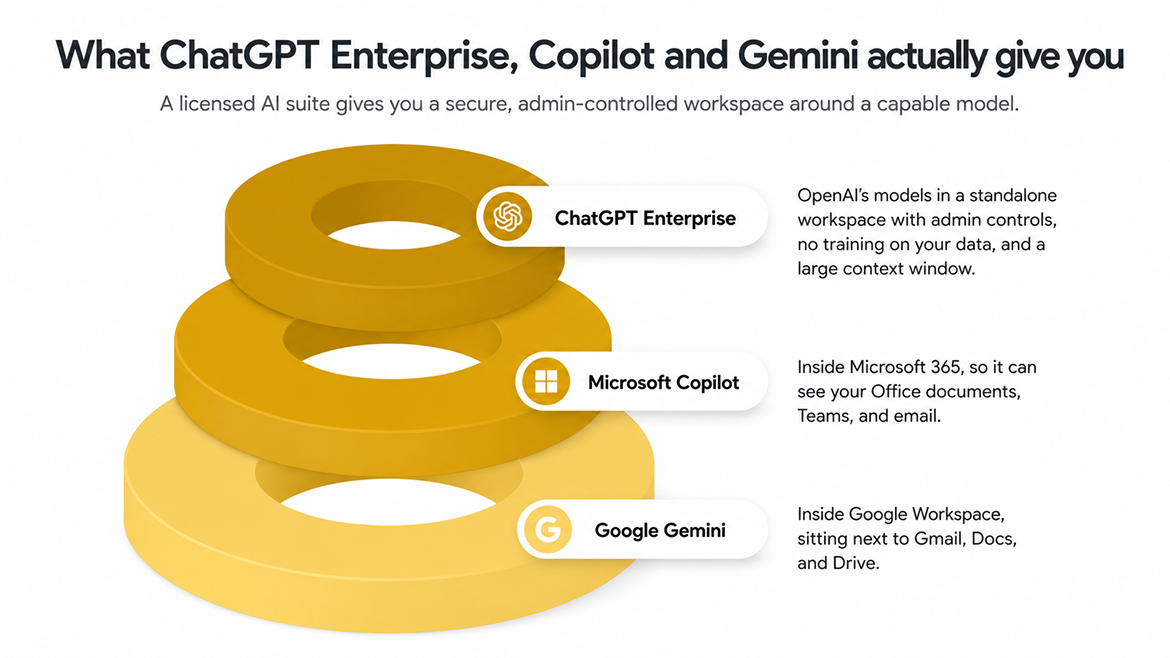
- ChatGPT Enterprise - OpenAI's models in a standalone workspace, with admin controls, no training on your data, and a large context window. A strong, general-purpose assistant.
- Microsoft Copilot - the same idea living inside Microsoft 365, so it can see your Office documents, Teams, and email. Its edge is proximity to where your work already happens.
- Google Gemini - the equivalent inside Google Workspace, sitting next to Gmail, Docs, and Drive.
What all three give you is the same shape: fast, safe, general help with writing, summarizing, searching, and coding, priced per user. What none of them give you is real knowledge of your business beyond the documents you hand them in a session. That single distinction is the whole article, and it is where the wall shows up.
Where off-the-shelf hits a wall
A suite hits a wall the moment your value depends on something it was never built to know or do - your proprietary data at scale, a workflow unique to you, an audit trail you must own, deep system integration, or a feature you want to sell. Below that wall, suites are excellent and you should use them. Above it, they simply cannot follow, no matter how good the underlying model gets.
- Your proprietary data. A suite can read a file you paste in. It cannot natively reason across years of your structured records, your pricing logic, or your case history the way a system built around that data can.
- Your specific workflow. Suites automate generic tasks. The multi-step process that is actually your business - how you underwrite, triage, quote, or reconcile - is not something a general assistant models.
- Audit trails and control. In regulated work you need to prove what the system did, why, and on what data, and to keep that record on your own terms. A vendor's suite gives you their logging, not yours.
- Anything you want to sell. This is the big one. You cannot build a product on top of a per-seat suite you do not control. If AI is going to be a feature customers pay you for, it has to be yours.
That last point is where I watch the most expensive mistakes get made. If your plan is to add an AI capability to the product you sell, a suite is a dead end, a case we lay out in our piece on adding AI to an existing SaaS product. You cannot resell someone else's seat license as your own feature, and you do not want your roadmap gated by a vendor's pricing page.
Build custom when you see these signals
Build custom when the value is specific to you and the suite cannot reach it. In delivery terms, I look for a few concrete signals before I recommend a build, because custom is the more expensive path and it should have to earn that cost. If none of these are true for you, do not build.
- The outcome depends on your proprietary data or logic, not general knowledge.
- There is one workflow you run thousands of times that a generic assistant cannot follow end to end.
- You need real integration - the system must read from and write to your internal tools, not just chat about them.
- You are in a regulated or high-stakes setting and need audit trails and control you own.
- The AI is meant to be a product or a competitive edge, something you sell or that sets you apart.
If two or more of these are true, custom is probably worth costing out. If only one is, look hard at whether a suite plus a light integration gets you most of the way first. When teams weigh a build against hiring or licensing, our breakdown of what custom AI development actually involves lays out the real scope, so the number does not surprise anyone halfway through.
A build-vs-buy decision table
Here is the table I actually use with clients. Find the row that matches your need and it usually points clearly at buy, build, or both. Read down your own priorities rather than across every row.
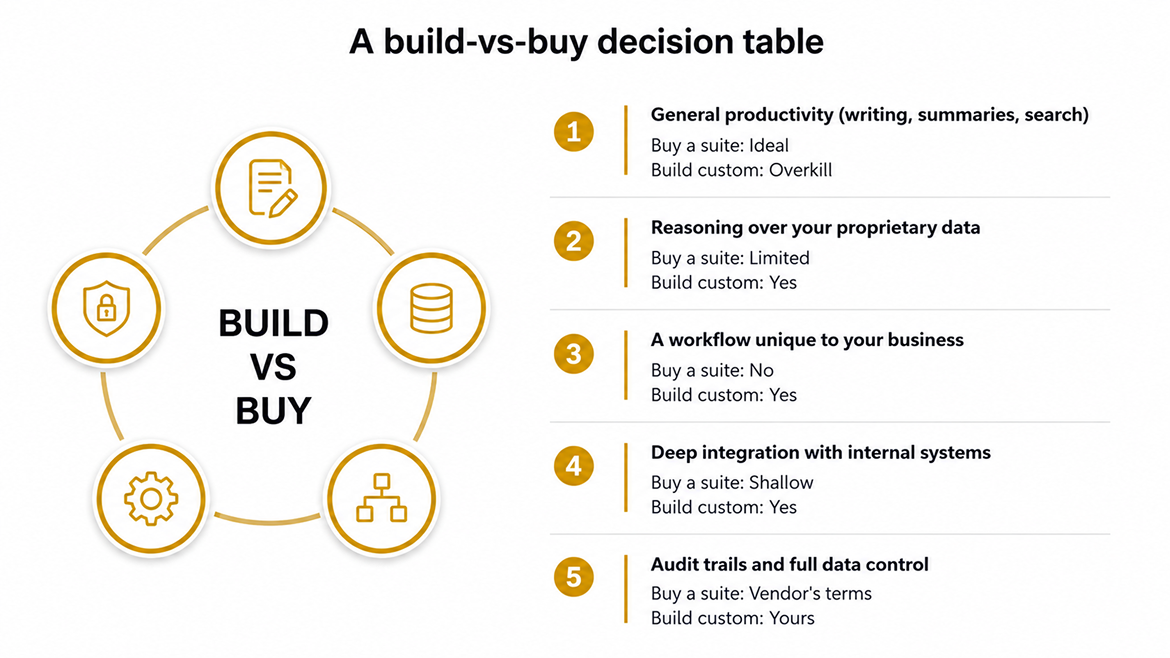
| Your need | Buy a suite | Build custom |
|---|---|---|
| General productivity (writing, summaries, search) | Ideal | Overkill |
| Reasoning over your proprietary data | Limited | Yes |
| A workflow unique to your business | No | Yes |
| Deep integration with internal systems | Shallow | Yes |
| Audit trails and full data control | Vendor's terms | Yours |
| An AI feature you sell to customers | Not possible | Yes |
| Predictable per-user budgeting | Yes | Build plus run cost |
| Time to first value | Days | Weeks to months |
Most companies land in more than one column, and that is the point. The honest answer is rarely all-buy or all-build, which is why the last section of this piece is about doing both on purpose.
The hidden costs of each path
Both paths cost more than the sticker. A suite's hidden cost is per-seat pricing that scales with your headcount whether or not each seat returns value. A custom build's hidden cost is running it - hosting, monitoring, and change management after launch. Neither is a trap, but both surprise teams that only budgeted the obvious number.
On the suite side, per-seat looks cheap until you multiply it across everyone and keep paying every month, forever, whether a given person uses it daily or twice a quarter. You also inherit the vendor's roadmap. Features change, prices change, and you get limited say in either. For broad productivity that trade is usually fine, because the value is broad too.
On the custom side, a build is not done at launch. It needs hosting, monitoring, evaluation, and someone to maintain it as your data and needs shift. The effort to write it is often smaller than the effort to run it well for three years. When our team takes on AI development work, we cost the run, not just the build, and we are upfront when that changes the math, because a build that no one maintains quietly stops being worth what you paid.
Can you do both? The hybrid path
Yes, and for most companies the hybrid is the right answer. Buy a suite for broad internal productivity, and build custom only for the one or two places that are genuinely your edge. You get cheap, immediate value everywhere, and you pay for a custom build only where it pays back. This is the split I recommend more than any other.
In practice it looks like this. ChatGPT Enterprise or Copilot goes to the whole team for drafting, research, and everyday help, while your engineering budget goes to the single workflow or product feature a suite will never touch. The suite handles the commodity; the custom build carries your differentiation. What goes wrong is forcing one tool to do both jobs - paying build-grade costs for email drafting, or trying to run a regulated, sellable product on a subscription seat that was never meant to carry it.
How we help teams decide
We start by drawing the line, not by picking a product. In a scoping session we map everything you want AI to do, sort each item into "any company could buy this" or "this is specific to us," and only then talk tools. Most teams leave with a hybrid plan: a suite to license this month, and a short list of custom work worth costing out properly.
That order matters. Buying a suite is reversible and cheap to trial, so start there and expand. A custom build is a real commitment, so reserve it for the work that genuinely moves your business. If you are staring at "buy or build" and cannot tell which side your need sits on, tell us what you want the AI to do and we will tell you straight - buy it, build it, or do both, and what each one actually takes.
Frequently Asked Questions
Should we buy ChatGPT Enterprise or build custom AI?
Buy the suite when you want broad productivity - drafting, summarizing, search - across your team. Build custom when the value depends on your proprietary data, a specific workflow no suite models, an audit trail you must control, or something you plan to sell as a product. Most teams end up doing both.
What is the difference between ChatGPT Enterprise, Copilot, and Gemini?
They are all licensed AI suites that wrap a strong model in a secure, admin-controlled workspace. ChatGPT Enterprise centers on OpenAI's models in a standalone workspace, Copilot lives inside Microsoft 365 and your Office data, and Gemini lives inside Google Workspace. The practical difference is which tools they sit next to, not raw capability.
When does an off-the-shelf AI suite hit a wall?
When you need it to reason over proprietary data it was never built to know, follow a workflow unique to your business, produce an audit trail you fully own, integrate deeply with internal systems, or become a feature you sell to customers. Suites are built for the average company, not your specific one.
Is building custom AI more expensive than buying a suite?
Up front, yes. A suite is a predictable per-seat subscription; custom is a build cost plus running costs. But per-seat pricing scales with headcount whether or not each seat delivers value, and custom scales with usage. Over a few years, for a core workflow, custom often costs less and returns more.
Can we use a suite and build custom at the same time?
Yes, and it is what we usually recommend. Buy ChatGPT Enterprise or Copilot for everyday productivity, and build custom only for the one or two places that are your edge - the proprietary workflow, the product feature, the regulated process. You pay suite prices for commodity work and build prices only where it pays back.
Have a project in mind? Let's scope it together.
You get a named team, written estimates, full code and IP ownership, and 48-hour response times. CMMI Level 5 certified. 700+ projects delivered across the UK, US, UAE, and Australia.