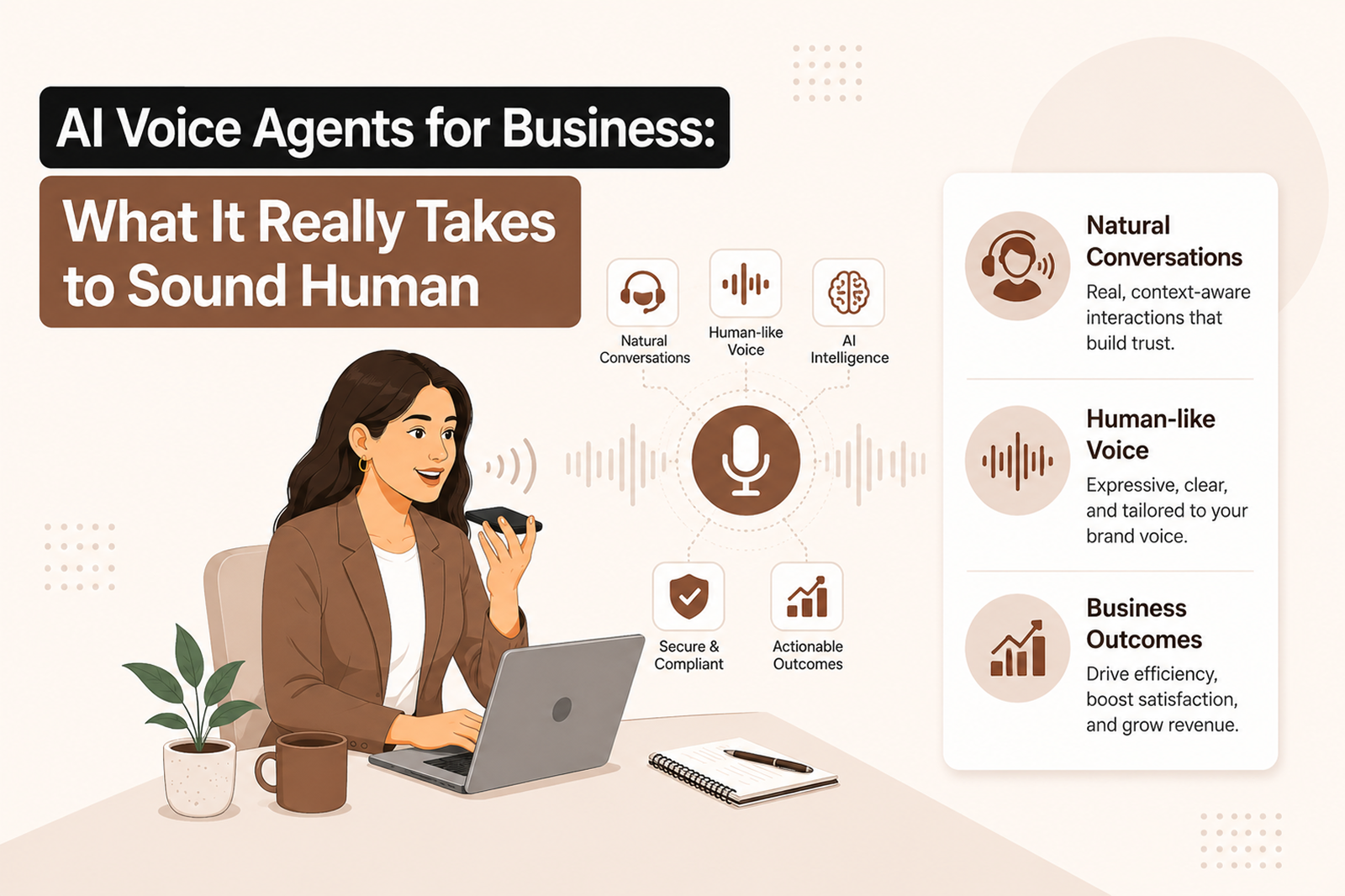
I have built a voice agent, so let me save you the first lesson: making it talk is the easy part. Text-to-speech has sounded good for years. The hard part is making it talk back fast enough that a person forgets they are on the phone with software, and teaching it when to stop talking. We built our own voice sales agent in-house as part of our AI development work, on a real-time stack, and most of what actually mattered was nowhere in the tutorials.
A voice agent lives or dies inside a window most people never think about - the gap between you finishing your sentence and the agent starting its reply. Get it right and callers relax. Get it wrong and they hang up, or start being rude to it. So we will spend our time on the engineering that closes that gap, and the handful of things that quietly break once real calls start coming in.
Projected 2033 voice-AI market, up from $2.54B in 2025 (~39% CAGR)
Growth in production voice AI deployments during 2025
Of Tier-1 enterprise calls handled by AI phone agents by mid-2026
What is an AI voice agent, and what makes one sound human?
An AI voice agent is software that holds a spoken conversation in real time - it listens, understands, decides, speaks back, and can take actions like booking a slot or pulling up an order. Unlike an old IVR menu, you just talk to it normally. What makes one feel human is not the voice. It is the timing.
This surprises people. Everyone obsesses over how natural the voice sounds, and the voice is basically solved - modern text-to-speech is excellent. What separates an agent people trust from one they fight with is rhythm: replying in the beat a human would, not talking over them, recovering when it mishears. A slightly robotic voice with perfect timing beats a gorgeous voice with a two-second delay every time. Callers do not forgive lag.
The latency budget: why 250 to 800ms decides everything
In natural conversation the gap between one person finishing and the next starting is about 200 milliseconds. That is the target a voice agent is quietly measured against. Land in the 250 to 800ms range and it feels like a conversation. Under half a second feels sharp and attentive. Push past about a second and it reads as lag, dead air creeps in, and people start talking over the agent.
The catch is that this budget is not one number you optimise once. It is a chain, and every link spends part of it:
- End-of-turn detection. Deciding the caller has actually finished, not just paused for breath. Wait too long and you get dead air; cut too early and you interrupt. This ate more of my time than anything else on the build.
- Speech-to-text. Streaming transcription that finalises the last words fast.
- The model. Time to the first token of the reply, not the whole reply.
- Text-to-speech. Time to the first chunk of audio, not the whole sentence.
- Network and playout. Every hop between the caller and your servers adds tens of milliseconds.
The trick that makes it fit is streaming. You do not need the full response quickly, only the first audio - so text-to-speech starts speaking the first sentence while the model is still writing the second. A well-placed filler line, "let me pull that up," covers a slow tool call and sounds more human than robotic precision anyway. The model you pick sets a big slice of this budget, which is why our guide on how to choose an LLM in 2026 weighs latency against capability - the smartest model is useless here if it thinks for two seconds.
The voice stack in plain terms
A voice agent is three moving parts in a loop. Speech-to-text turns the caller's words into text. An LLM decides what to say or do. Text-to-speech turns the reply back into audio. There is a fourth part people underestimate - the orchestration layer that handles turn-taking, interruptions, and the phone connection - and it is where most of the real engineering lives.
You have two broad architectures to choose between, and it is a genuine trade-off:
- The cascade. Separate speech-to-text, LLM, and text-to-speech wired in a pipeline. More parts to coordinate, but you control each one, swap them freely, and tool use and grounding stay straightforward. Most business agents that take actions should use this today.
- Speech-to-speech. A single realtime model that hears audio and speaks audio directly. It collapses the chain, so latency and prosody are lovely, but you trade away some control over tools, grounding, and cost.
We built ours on LiveKit for the real-time media transport and orchestration, with a realtime voice model doing the heavy lifting. The framework matters more than beginners expect - it shuttles audio both ways with low latency, detects when the caller starts speaking, and cancels the agent's speech the instant it must. You can build that yourself, but you will spend weeks rebuilding what these frameworks already solved.
What breaks in production
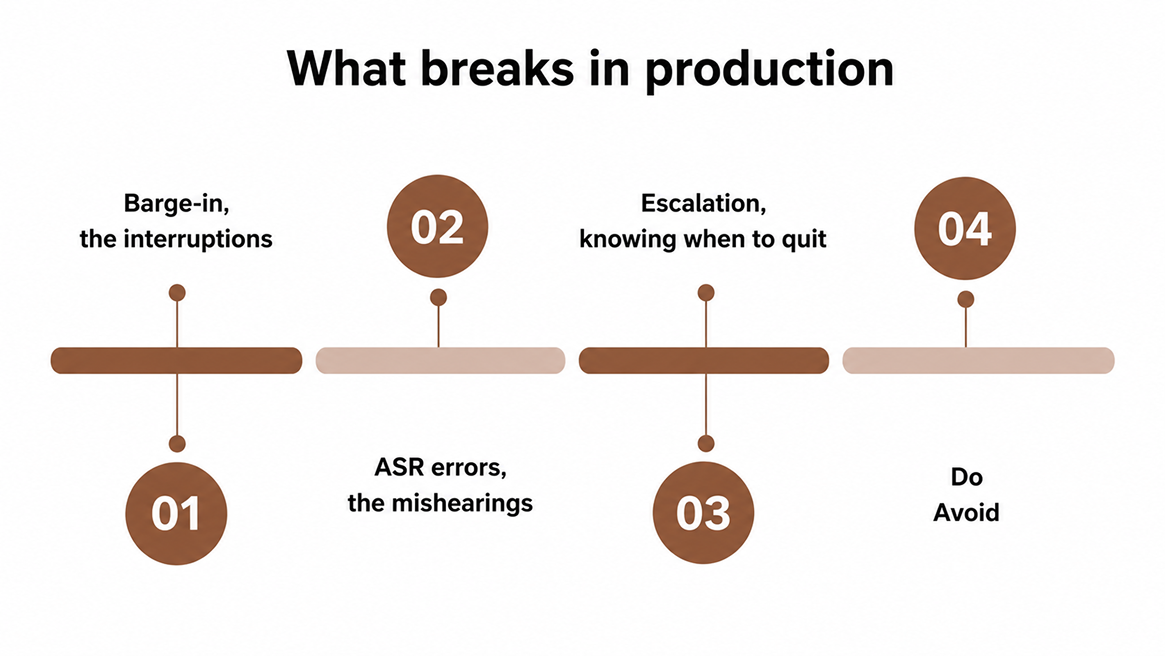
Three things break voice agents in the wild, and a demo exposes none of them, because a demo is one clean turn in a quiet room. Real calls are messy - people interrupt, mumble numbers, call from a moving car, and get annoyed.
Barge-in, the interruptions. A real caller cuts the agent off mid-sentence. It has to stop talking instantly, listen, and pick up the new thread - which means full-duplex audio and killing the text-to-speech playback the moment a real interruption starts. An agent that plows through your interruption feels deaf, and people hang up on deaf.
ASR errors, the mishearings. Speech-to-text is strong on ordinary sentences and weak exactly where it hurts: names, emails, order numbers, postcodes, accents, background noise. "Fifteen" versus "fifty" is the classic. You cannot just trust the transcript, so you build read-back and confirmation for anything that matters and treat alphanumerics with special care.
Escalation, knowing when to quit. The worst voice experiences are the ones that will not let you reach a human. The agent has to notice when it is out of its depth - repeated low confidence, an angry caller, an out-of-scope request - and hand off cleanly before frustration boils over.
Where voice agents pay off, and where they just annoy people
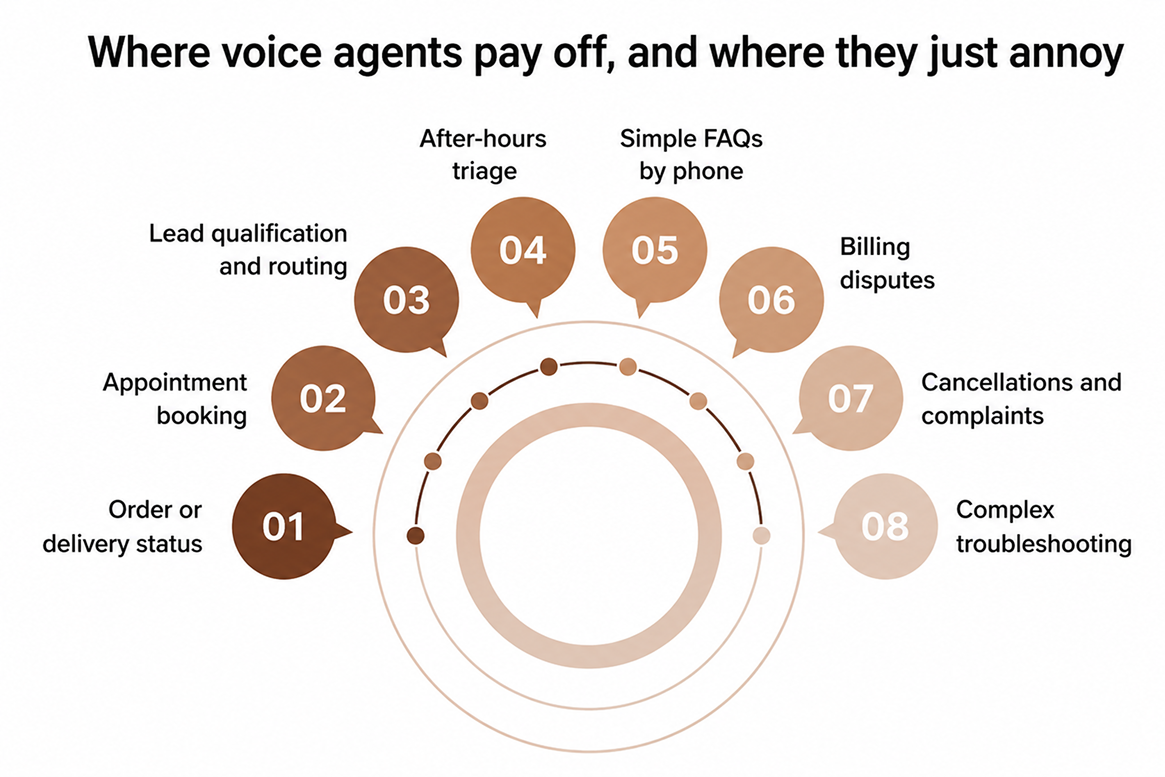
Voice agents pay off when the call is high-volume, predictable, and the caller mainly wants speed - order status, booking, simple qualification, after-hours triage. They annoy people when the situation is emotional, complex, or already broken, like a billing dispute, where the caller wanted a human three seconds ago. Here is the split we use to decide:
| Situation | Fit for a voice agent | Verdict |
|---|---|---|
| Order or delivery status | Instant, 24/7, no hold music | Strong win |
| Appointment booking | Checks the calendar, books, confirms | Strong win |
| Lead qualification and routing | Asks a few questions, routes the call | Win |
| After-hours triage | Catches the call, escalates the urgent ones | Win |
| Simple FAQs by phone | Answers on the spot | Win, though a chatbot is cheaper |
| Billing disputes | Caller is already frustrated | Send to a human |
| Cancellations and complaints | Emotional, high stakes | Send to a human |
| Complex troubleshooting | Many branches, needs context | Triage, then hand off |
One honest note: if the interaction is not time-sensitive, voice may be the wrong channel entirely. A text conversation over an AI chatbot is calmer, cheaper to run, and easier for the customer to do while distracted. Voice earns its cost only when the phone is genuinely the right place for the conversation.
Build vs buy for voice
Buy a platform to validate quickly; build your own when voice is core to the business, volume is high, or you need deep integration and control over your data and latency. For a first pilot, buying is almost always right - you can be live on a hosted platform in days and prove callers even accept an agent before you invest.
The reasons to build show up later. Hosted platforms bill per minute, and at real call volume that adds up fast. They also cap how far you can tune latency, how deeply you integrate with your systems, and where your call data lives - which matters a lot in regulated industries. An open stack like LiveKit or Pipecat hands you that control and your data back, at the cost of engineering. Buy to learn, build when voice becomes infrastructure you cannot afford to rent. Our write-up on custom AI development covers how we size that call before writing code.
Keeping a human in the loop
The best voice deployments are not fully autonomous, and they are not trying to be. They handle the routine majority of calls and hand the rest to a person, with the transcript and context attached, before the caller gets annoyed. The escalation path is a feature you design on purpose, not an embarrassing admission that the agent failed.
In practice that means confidence thresholds that trigger a warm transfer, humans reviewing transcripts to catch where the agent stumbles, and hard limits on what it may do on its own. That last point matters because a voice agent is an agent - it takes real actions, a different risk profile from a bot that only answers. If that distinction is fuzzy, our piece on the difference between an AI chatbot and an AI agent is worth ten minutes: a thing that can book, charge, or cancel needs guardrails a thing that only talks never will.
What we learned building our own
A few things surprised us, and they are the notes I would give anyone starting now:
- Latency is a system property, not a component. We kept hunting for the one slow part to fix. There wasn't one. Streaming the whole chain end to end did more than any single optimisation.
- Endpointing is the real boss fight. Deciding when the caller has finished speaking, across fast talkers, slow talkers, and thinkers who pause mid-sentence, took more tuning than the model did.
- The voice mattered least. We fussed over voice selection early. Callers cared far more about not being interrupted and not being misheard.
- Test on real phone lines. Everything is perfect on localhost. Add a cellular connection, a noisy room, and an accent, and you find your actual bugs.
- A good filler line beats 50ms. "Let me check that for you" buys more perceived speed than a week of shaving milliseconds, because humans do the same thing.
None of this is meant to talk you out of it. Voice agents are ready for the right jobs, and the numbers up top reflect a real shift in what businesses are putting on their phone lines this year. Just go in knowing the work is in the timing and the failure modes, not the talking. If you want a straight read on whether your use case is a strong win or a caller-annoyer, tell us what the call looks like and we will tell you honestly, including when you would be better off skipping voice altogether.
Frequently Asked Questions
What is an AI voice agent for business?
It is software that holds a real spoken conversation over a phone line or app - it listens, understands, decides, speaks back, and can take actions like booking an appointment or checking an order. Unlike an old IVR menu, you talk to it normally. The point is to handle routine calls at speed without a person on every one.
How fast does an AI voice agent need to respond to feel natural?
In human conversation the gap between turns is about 200 milliseconds, so a voice agent has to land in roughly the 250 to 800ms range to feel like a conversation. Under half a second feels sharp; past about a second it reads as lag and callers start talking over it. Hitting that window is the whole engineering challenge.
Are AI voice agents good enough to replace call center staff?
For the right calls, yes - high-volume, predictable ones like order status, booking, and after-hours triage. For emotional or complex calls, no, and forcing it there costs you customers. The realistic model is an agent that handles the routine majority and hands the rest to a person with full context.
Should we build or buy an AI voice agent?
Buy a hosted platform to validate quickly; build your own when voice is core to the business, call volume is high, or you need deep integration and control over your data and latency. Most companies should buy for the first pilot and only build once voice becomes infrastructure they cannot afford to rent per minute.
What is the hardest part of building a voice agent?
Not the voice - modern text-to-speech is excellent. The hard parts are latency (hitting that sub-second window), endpointing (knowing when the caller actually finished), barge-in (stopping instantly when interrupted), and mishearings on names and numbers. Handle those four and you have something people will actually talk to.
Have a project in mind? Let's scope it together.
You get a named team, written estimates, full code and IP ownership, and 48-hour response times. CMMI Level 5 certified. 700+ projects delivered across the UK, US, UAE, and Australia.