Every carrier I talk to wants the same two things from AI: faster claims and sharper underwriting. The demos deliver both. A model reads the first notice of loss, triages the claim, flags a fraud signal, and drafts the underwriting summary in seconds, and the room is sold. Then someone from compliance asks the question that ends the meeting: can it pass a state exam? That gap, between a model that works and one a regulator will accept, is where most insurance AI stalls, and closing it is the whole point of our AI consulting work with insurers.
Here is the uncomfortable part. In a regulated line of business, accuracy is table stakes and explainability is the product. A claims-triage or underwriting model that cannot show why it reached a decision, log that decision for an examiner, and prove it does not discriminate is not a compliance risk you manage later. It is a system you cannot ship. The carriers getting real value in 2026 are the ones who wired the governance in from the first sprint, not the ones bolting it on after a demo went well.
of insurers plan to scale AI claims agents in 2026
faster claim resolution with AI-assisted triage
US states that adopted the NAIC Model Bulletin on AI by mid-2026
Where AI actually fits in claims and underwriting
The short answer: AI belongs on the volume and the busywork, not on the decisions that carry legal weight. With 65 percent of insurers planning to scale AI claims agents in 2026, the live question is no longer whether to automate but where to point it. In claims, the safe surface is intake, document extraction from the loss notice and supporting files, severity triage, fraud and subrogation signals, and straight-through processing of clean, low-value claims. In underwriting, it is gathering and summarizing risk data, filling the submission, and flagging the cases a human should scrutinize.
That is not a small role. Triage and intake are where the hours disappear, and AI-assisted triage is reporting roughly 75 percent faster claim resolution on the routine work it touches. But notice what is missing from that list: the model does not deny the claim, set the final reserve, or decline the risk on its own. Those are the moments a regulator cares about, and they are exactly where you keep a human in the loop. Get the split right and you capture most of the speed with almost none of the exam risk. Get it wrong and you have automated your way into a liability.
The state-audit problem nobody demos
Insurance AI is harder than most enterprise AI for one reason: a regulator can knock on the door and ask to see how a decision was made. The framework driving this is the NAIC Model Bulletin on the Use of Artificial Intelligence Systems by Insurers, adopted by 24 states by mid-2026. It does not create a new law. It says the unfair-trade-practice and anti-discrimination statutes you already answer to apply fully to decisions your AI makes or informs, and it expects you to prove compliance on request.
In practice an examiner probes three things. Explainability: can you show why the model produced a given claim or underwriting outcome, in terms a person can follow? Documentation: do you have a written AI governance program and records you can hand over during a market conduct exam? And discrimination testing: can you demonstrate the model does not produce unfair bias against protected classes, even indirectly through proxies? The bulletin also makes you responsible for AI you bought, not just AI you built, so a vendor's black box is still your problem in the exam room. If your build cannot answer those questions on demand, it will not survive a regulator, however accurate it looks.
Explainable-by-design claims triage
Explainable by design means every decision ships with a reason a person can read, generated at the same moment as the decision and grounded in the actual inputs. It is the opposite of a black-box score you reverse-engineer after a complaint. When our triage model routes a claim to fast-track or to an adjuster, it also emits the why: the factors that drove the routing, the policy clauses and data points it relied on, and a confidence score that tells the adjuster how far to trust it.
The engineering choice that makes this possible is grounding. Instead of letting the model free-associate about coverage, we retrieve the relevant policy language and claim data and require the model to cite what it used. A routing note that reads "flagged for review: reported value exceeds the sublimit in clause 4.2, photos inconclusive" is something an adjuster and an examiner can both follow. That does two jobs at once. It produces the explanation the NAIC bulletin expects, and it keeps the model from inventing facts, because an answer that has to point to a source clause cannot wander far from it. Explainability and accuracy turn out to be the same discipline approached from two directions.
Audit logs and per-decision explanations
An audit log is a timestamped, tamper-evident record of every decision the AI touched: the inputs it saw, the model version that ran, the output it produced, the explanation it generated, and the human who reviewed, approved, or overrode it. This is the artifact you hand a market conduct examiner, and it is the single most common thing missing from the insurance AI pilots I review. The model performs well; nobody can reconstruct what it did last quarter.
Logging has to be built in, not added later, because you cannot recreate a decision you never captured. That means versioning your models and prompts so you know exactly which logic produced a given outcome, storing the retrieved context alongside the result, and keeping the records for as long as your state requires. The payoff is not only compliance. When a claim gets disputed, an audit trail showing a grounded, human-reviewed decision is your strongest defense, and when a model drifts, the logs are how you catch it early. A decision you can replay is a decision you can defend.
Bias testing before you ship, not after a complaint
Bias testing is measuring whether your model produces different outcomes across protected classes, before it goes live and on a schedule afterward. The trap in insurance is proxy discrimination: you never feed the model a protected trait, but zip code, occupation, or a credit-adjacent feature quietly stands in for one, and the outcome is disparate all the same. Regulators know this pattern well, and the NAIC bulletin expects you to test for it rather than wait for a complaint to surface it.
Concretely, that means running your triage or underwriting model against held-out data, measuring outcome rates across groups, documenting both the result and what you changed to close any gap, and then repeating the test on a cadence because models drift as data shifts. This is the same discipline we apply in a formal AI bias audit for compliance, and the mechanics carry straight over from hiring to insurance. Done before launch, it is an engineering task. Done after a regulator asks, it is a legal problem with your name on it.
The liability every carrier is quietly afraid of
Ask a claims executive what keeps them up about AI and it is rarely efficiency. It is a hallucinated coverage call: the model confidently misreads a policy, denies a valid claim, and turns a software error into a bad-faith lawsuit. In most industries a wrong AI answer is an embarrassment. In insurance, a wrongful denial can breach the duty of good faith, invite extra-contractual damages, and become a class action if the same flawed logic ran across thousands of claims. That is the failure mode that makes carriers cautious, and they are right to be.
This is why high-stakes, regulated domains punish sloppy AI far harder than a marketing chatbot ever could, a pattern we dug into in why AI projects die faster in fintech and healthtech. The defense is structural, not hopeful. Coverage statements stay grounded in cited policy language, and anything ambiguous gets escalated instead of guessed.
What to automate first, and what to keep human
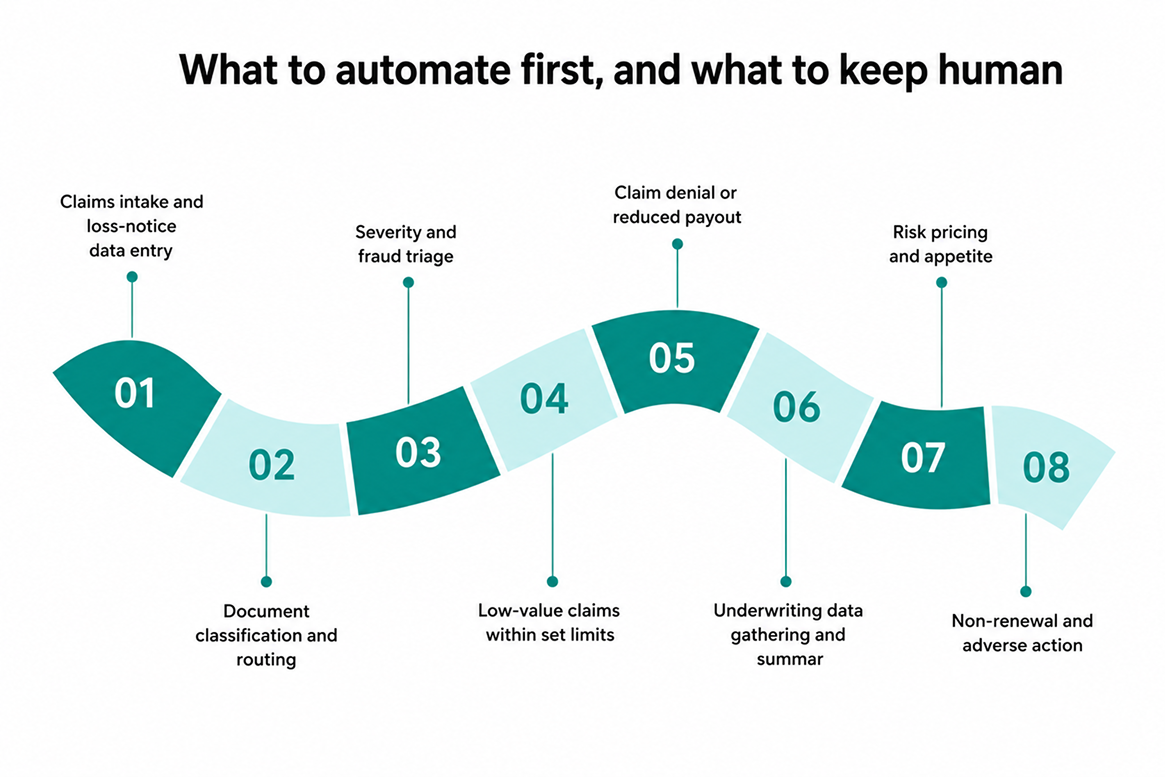
The rule we give carriers is simple: automate the tasks that are high-volume, low-legal-weight, and reversible, and keep a human on anything adverse, ambiguous, high-value, or litigable. The first bucket buys you speed and cost savings with little downside if the model is occasionally wrong. The second bucket is where a wrong call costs a lawsuit or a regulatory finding, so a person owns it. Here is how that split usually lands in a claims and underwriting operation.
| Task | Automate (AI-led) | Keep human (AI-assist only) |
|---|---|---|
| Claims intake and loss-notice data entry | Yes, extract and structure automatically | Exceptions only |
| Document classification and routing | Yes, with confidence scoring | Low-confidence items to a person |
| Severity and fraud triage | Yes, as a score and flag | Final fraud call and SIU referral |
| Low-value claims within set limits | Yes, straight-through | Anything above the threshold |
| Claim denial or reduced payout | No | Human decides and signs off |
| Underwriting data gathering and summary | Yes, retrieve and summarize | Exceptions only |
| Risk pricing and appetite | No, model can recommend only | Underwriter owns the decision |
| Non-renewal and adverse action | No | Human review, explainable reason |
The line moves as your governance matures. The model earns more autonomy on the reversible work as you build evidence that it is safe, but it never gets the last word on a decision a policyholder could take to court or a regulator could question in an exam.
How we build audit-ready insurance AI
We build backward from the exam. Before we pick a model, we map the decisions the system will touch, which of them are adverse or litigable, what an examiner will ask to see, and what has to be logged, explained, and tested to answer them. Then we build the model to feed that governance, rather than shipping a model and scrambling to wrap controls around it afterward. In a regulated line, that order is the difference between a pilot that goes live and one that dies in legal review.
This is the same grounded, evidence-first approach we bring to all of our custom AI development. We are a CMMI Level 5 team of 80-plus engineers who have delivered for 700-plus companies, and a focused claims-triage or underwriting-assist build usually stands up in weeks, not quarters. If you want an insurance AI build that survives a state audit rather than just impressing a demo room, tell us what you are trying to automate and we will show you exactly what it takes to make it exam-ready.
Frequently Asked Questions
Can AI legally process insurance claims in the US?
Yes, with guardrails. No federal ban exists, but the NAIC Model Bulletin on AI, now adopted by 24 states, holds insurers accountable for how their AI makes or informs decisions. You can automate triage and underwriting assist, but adverse decisions need documentation, testing for unfair discrimination, and a human who can explain and override the call.
What is the NAIC Model Bulletin on AI?
It is guidance the NAIC adopted in December 2023 telling insurers that existing unfair-trade-practice laws apply to AI decisions. It expects a written AI governance program, risk controls, bias testing, vendor oversight, and documentation a regulator can request during a market conduct exam. It is not a new law; it is how regulators will read the old ones.
Will AI replace insurance underwriters and claims adjusters?
Not for the decisions that carry legal weight. In our work, AI handles the volume: intake, triage, straight-through low-risk claims, and first-pass underwriting signals. Adjusters and underwriters keep the judgment calls, the adverse decisions, and the edge cases. The model speeds the routine work so people spend their time where a wrong call is expensive.
How do you stop an insurance AI from hallucinating a coverage decision?
You do not let the model interpret the policy on its own. Ground every coverage statement in the actual policy language through retrieval, restrict it to citing clauses it can point to, and route anything ambiguous to a human. A hallucinated coverage call that denies a valid claim is a bad-faith lawsuit waiting to happen, so that path stays closed by design.
How long does it take to build audit-ready insurance AI?
A focused claims-triage or underwriting-assist pilot with explanations and audit logging usually takes a few weeks to stand up, not months. We are a CMMI Level 5 team and build the governance in from the first sprint rather than bolting it on later, because retrofitting explainability and bias testing after the fact is the slow, expensive path.
Have a project in mind? Let's scope it together.
You get a named team, written estimates, full code and IP ownership, and 48-hour response times. CMMI Level 5 certified. 700+ projects delivered across the UK, US, UAE, and Australia.