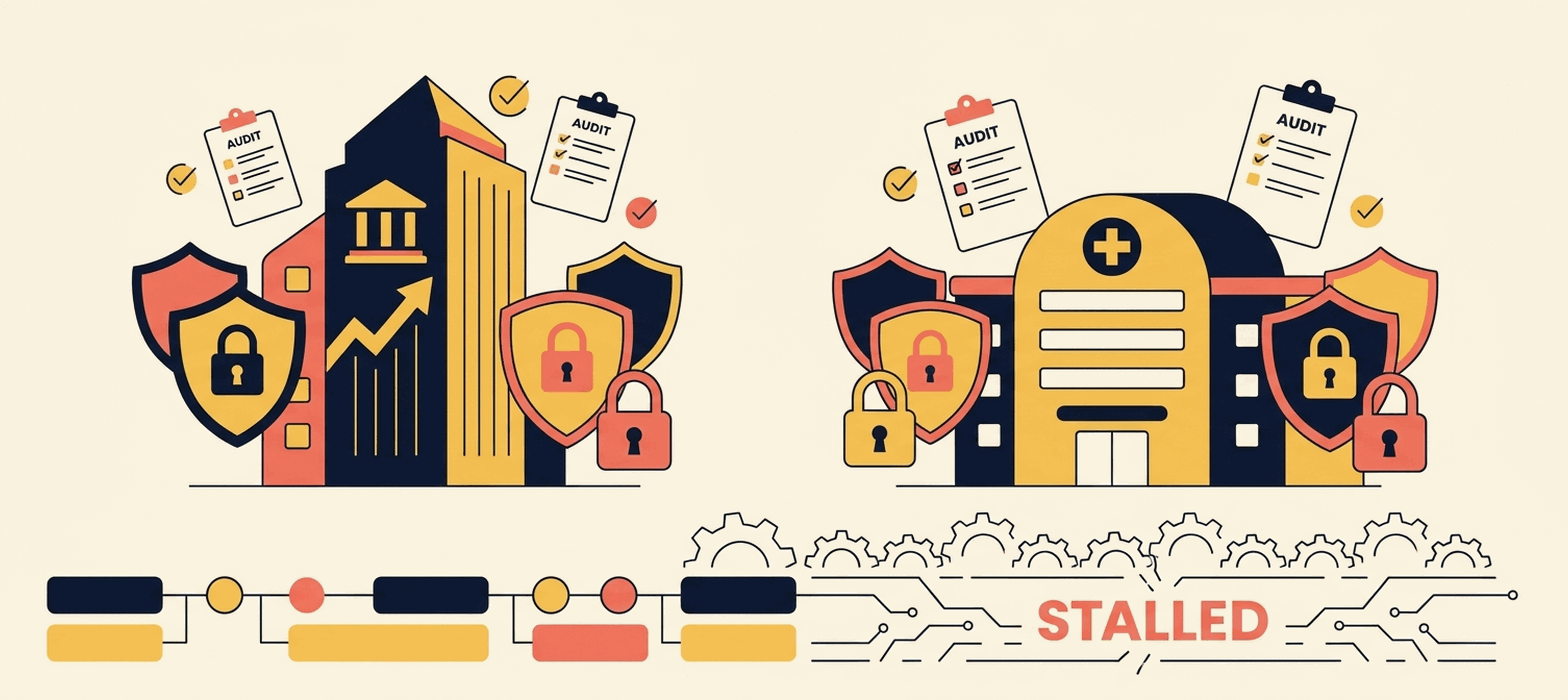
The AI demo that wins the room in a fintech or healthtech boardroom is, more often than not, the one that never ships. Not because the technology failed. Because nobody in the room had answered a quieter, harder question: who is liable when this is wrong about someone's money or someone's health?
We build AI for regulated industries — lending platforms, health and clinical tools, financial back-office systems — and we've watched a clear pattern emerge across these projects. AI initiatives in fintech and healthtech don't usually die from a lack of capability. They die in the gap between a working model and a compliant, accountable system that a regulator, an auditor, and a risk officer will all sign off on. That gap is where budgets quietly drain and timelines quietly slip until someone pulls the plug.
This isn't a vertical statistic — it's what we see in the work. And if you're a founder or operator in a regulated space, understanding it is the difference between an AI project that launches and one that becomes an expensive lesson.
Of agentic AI projects Gartner expects cancelled by 2027 — the pressure is higher where stakes are
Share of AI project failures RAND attributes to organizational, not technical, causes
In regulated work, the model is rarely the hard part — the system around it is
It's Almost Never a Capability Problem

Here's the uncomfortable truth we've learned delivering AI into regulated industries: the model is usually the easy 20%. A modern model can read a loan application, summarise a clinical note, flag an anomalous transaction, or draft a patient communication impressively well in a prototype. The demo is genuinely good. That's exactly why it's so seductive — and so dangerous.
The hard 80% is everything the demo doesn't show. Can you prove, months later, why the model made a specific decision about a specific person? Is every action logged in a way an auditor will accept? Who reviews the edge cases before they reach a customer? What happens to the data, and does that satisfy the regulation that governs it? Can you demonstrate the system is fair across protected groups? In a consumer app, a wrong answer is an annoyance. In lending or healthcare, a wrong answer is a complaint to a regulator, a denied claim, a clinical risk, or a headline. The bar isn't "does it work" — it's "can you defend it."
This is consistent with what the broader research shows about why AI projects fail at all. RAND's analysis found that the large majority of AI project failures — on the order of 84% — stem from organizational and human factors rather than the technology itself. In regulated industries, those organizational factors are simply louder and more expensive, because the organization includes a compliance function, a risk function, and an external regulator who all get a vote.
Where Regulated AI Projects Actually Die
From our delivery experience, the failures cluster in a handful of predictable places. None of them is "the AI wasn't smart enough." All of them are foreseeable — which means all of them are avoidable if you design for them from day one instead of discovering them at launch.
1. The audit-trail afterthought
A team builds the model, it works, and only then does someone ask: "can we show a regulator exactly what it did and why, for any given case, two years from now?" Retrofitting explainability and immutable logging into a system that wasn't designed for it is painful, sometimes impossible. Projects stall here while the team rebuilds foundations they should have poured first.
2. The data-governance wall
In healthtech, that's patient data under strict privacy regimes. In fintech, it's financial and personal data with its own rules about residency, retention, consent, and sharing. A model that quietly needs to send sensitive data somewhere it legally cannot go is dead on arrival — and teams routinely discover this late, after the architecture is already built around the assumption.
3. The "no human in the loop" trap
Full autonomy is tempting because it promises the biggest savings. But a system that auto-approves a loan or acts on a clinical signal with no human checkpoint is a regulatory and reputational liability. The projects that survive build the human oversight in deliberately — and accept that "agent proposes, accountable human disposes" is the right design for high-stakes decisions, not a failure of ambition.
4. The fairness and bias blind spot
A model trained on historical data can quietly encode historical bias — and in lending or healthcare, a biased outcome isn't just unethical, it's often unlawful. If you can't demonstrate the system treats protected groups fairly, you can't ship it. Teams that don't test for this early get stopped late, by their own legal counsel.
5. The accountability vacuum
When something goes wrong — and at scale, something will — who owns it? If the answer is "the AI did it," the project has failed a basic governance test. Regulated industries require a named, accountable human and a clear escalation path. Vendors who can't speak to this are a red flag we see clients (rightly) walk away from.
| Stage | Consumer app | Fintech / HealthTech |
|---|---|---|
| A wrong answer | An annoyance; user retries | A regulatory complaint, denied claim, or clinical risk |
| Explainability | Nice to have | Mandatory — you must defend each decision |
| Audit logging | Optional | Required, immutable, years-retained |
| Data handling | Standard privacy practice | Strict residency, consent, retention rules |
| Autonomy | Often fine | Human-in-the-loop on high-stakes decisions |
| What kills the project | Weak product-market fit | The compliance gap, discovered late |
How the Projects That Ship Are Built
The good news: regulated AI is entirely shippable. We do it. The teams that succeed simply invert the usual order — they treat compliance, explainability, and governance as design inputs from day one, not as a gate to clear at the end. Whether the work is a machine learning model for risk or prediction or a generative AI tool for documents and communication, the discipline is the same.
- Map the regulatory requirements before a single line of model code — they are constraints, not paperwork
- Design for explainability up front: every decision must be reconstructable for any case, for years
- Build immutable audit logging into the foundation, not bolted on at the end
- Confirm where sensitive data can and cannot go, and architect around that reality
- Put a human checkpoint on every high-stakes decision by design
- Test for fairness across protected groups early, and document it
- Name an accountable owner and an escalation path before launch, not after the first incident
Capability Is Table Stakes. Defensibility Wins.
If you're building AI in fintech or healthtech, the most important thing to internalise is this: your project will almost certainly not fail because the AI can't do the task. It will fail — if it fails — in the space between a working model and a system you can prove, log, defend, and stand behind. That space is where the budget goes when nobody planned for it, and it's exactly where a partner who has shipped regulated AI before earns their fee.
We've built AI into lending platforms, financial operations, and health and clinical workflows, and we design for the compliance reality from the first conversation — because in these industries, a system you can't defend isn't an asset, it's a liability waiting to surface. If you're planning AI in a regulated space and want a partner who treats explainability and governance as the starting point, tell us what you're building. You can also explore our approach to AI development and the regulated work in our portfolio.
A Tale of Two Regulated Projects
To make this concrete, here's the pattern we see, drawn as a composite of real projects rather than any single client. Two teams set out to build broadly the same thing: an AI system to speed up a decision in a regulated workflow — think a first-pass assessment in lending, or a triage aid in a clinical setting.
The first team did what feels natural. They built the model, it performed beautifully in testing, and they got excited. The compliance and audit questions were parked as "we'll handle that before launch." When launch approached, the questions arrived all at once: the risk team wanted to know why the model made each call, the data team flagged that a piece of the pipeline sent sensitive data somewhere it shouldn't, and legal asked for evidence the system was fair across protected groups. None of it had been designed in. The team spent months re-architecting foundations under pressure, the cost ballooned past the original budget, momentum evaporated, and leadership — looking at a project that was now late, over budget, and still not approved — quietly cancelled it. The model was never the problem. It worked the whole time.
The second team started somewhere less exciting. Before writing model code, they mapped the regulatory requirements and treated them as design constraints. They built immutable logging into the foundation. They confirmed where data could and couldn't travel and architected around it. They scoped the first release to a single, narrow decision with a human checkpoint on every consequential case, and they tested for fairness early and documented it. Their demo was less flashy — the model was the same calibre — but when launch approached, there was no wall. The risk team's questions already had answers. The system shipped, on a steadier timeline, and expanded from there.
Same technology. Same talent. Opposite outcomes — decided entirely by the order in which the hard questions were asked. That's the lesson regulated AI keeps teaching, and it's why we front-load the unglamorous 80% on every engagement.
Frequently Asked Questions
Building AI in a Regulated Industry? Start With What You Can Defend.
We build AI into fintech and healthtech systems where explainability, audit trails, data governance, and human oversight aren't optional. We design for the compliance reality from the first conversation — so your project ships instead of stalling. CMMI Level 5, 700+ projects.