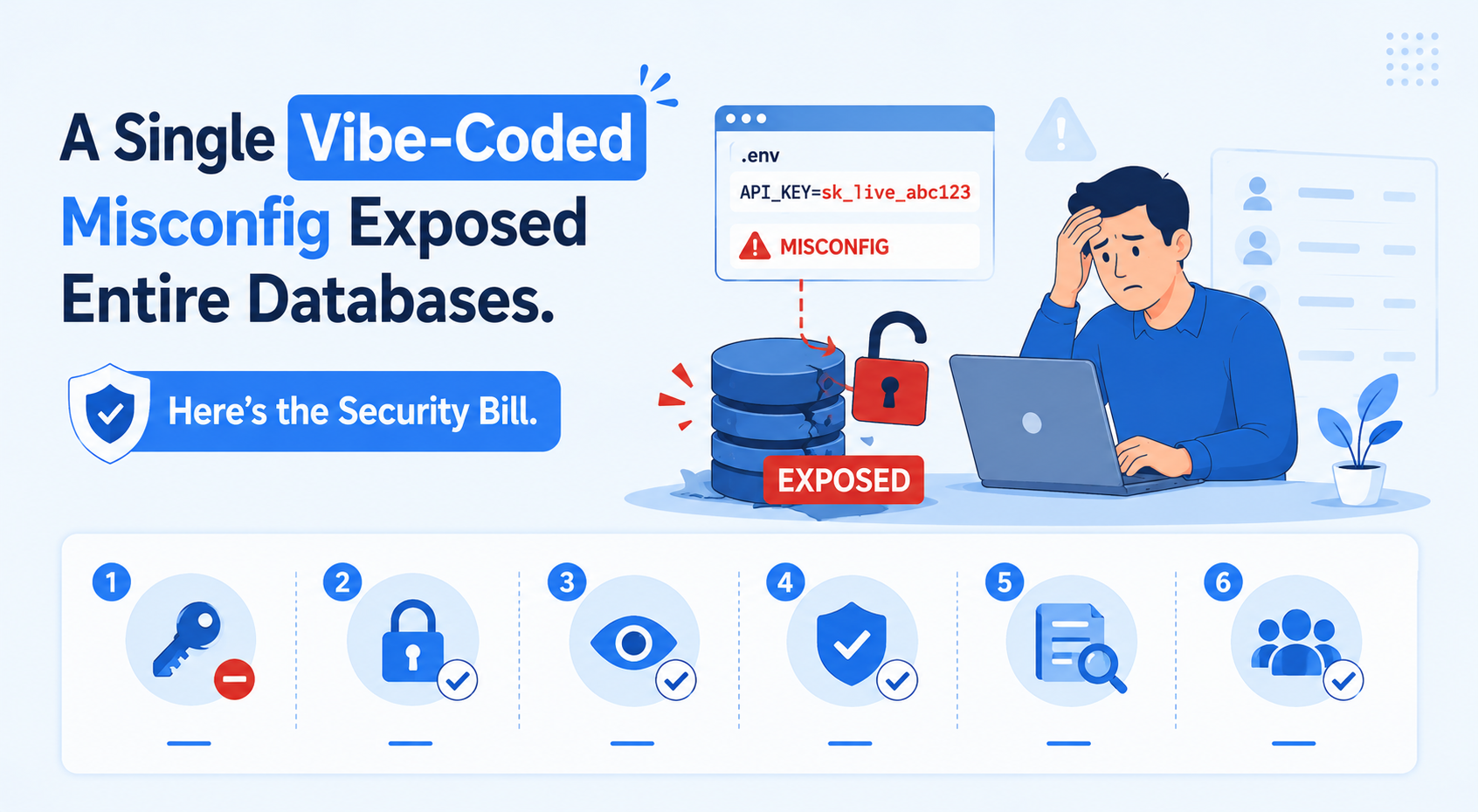
In 2025, security researchers found a single misconfiguration pattern - the kind a coding assistant will happily generate for you in seconds - that left the databases of more than a hundred applications wide open to anyone who knew where to look. No password cracking. No clever exploit chain. Just a publishable API key doing exactly what it was told, on apps that had been shipped fast and reviewed lightly. The flaw was catalogued as CVE-2025-48757 and rated CVSS 9.3 - critical.
That is the security bill of "vibe coding" - shipping code you describe in plain English and accept without fully reading - arriving all at once. And it is worth understanding in plain terms, because the same speed that makes AI-assisted development feel like a superpower is exactly what lets a single bad default get copied across hundreds of products before anyone notices.
This is not an anti-AI article. AI-assisted coding is genuinely transformative, and we use it. It is an article about the one thing the demos never show you: what happens between "the AI wrote it" and "it is safe to ship" - and the short, cheap review that closes that gap.
What Actually Happened: One Misconfig, Many Exposed Apps
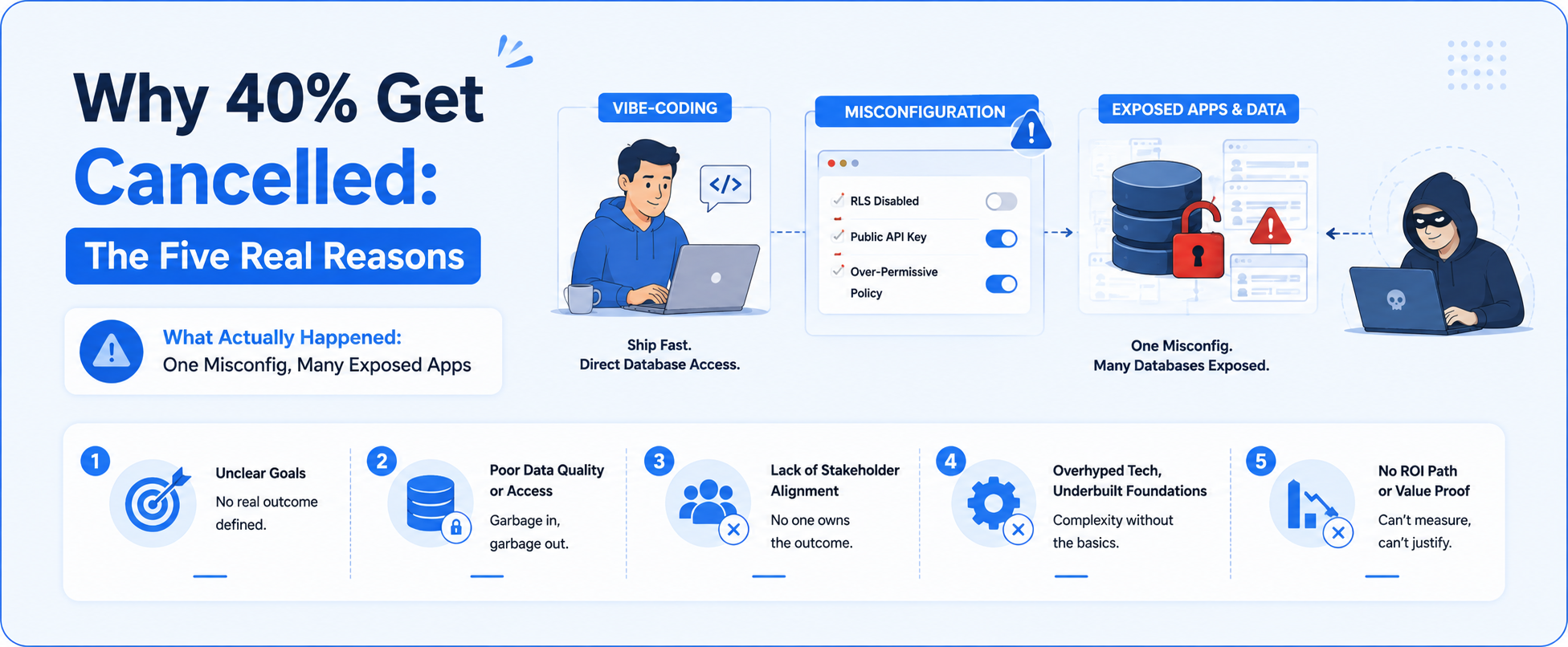
Modern app-building tools make a tempting trade. They give your frontend a direct line to your database so you can ship a working product in an afternoon, with security enforced by rules you configure rather than a traditional backend you write. The catch is that the safety now depends entirely on getting those rules right - and "getting the rules right" is precisely the boring, security-critical step a fast, AI-assisted, lightly-reviewed workflow tends to skip.
CVE-2025-48757 is what that skipped step looks like at scale. The vulnerability, disclosed in 2025, came down to missing or misconfigured row-level access rules on apps built this way. The crucial detail - and the one that makes this a teaching moment rather than a horror story - is that attackers did not need stolen admin credentials. They used the application's public client key, the so-called anonymous key that is meant to ship in the frontend and be visible to everyone by design. That key is safe only when the database's access rules are correct. When they were not, the public key that was supposed to grant near-nothing instead granted read - and sometimes write - access to other users' private data.
In other words: the lock was installed, the key was handed out to the public exactly as intended, and the door was never actually wired to the lock. The breach was not a sophisticated intrusion. It was a default that nobody reviewed, repeated across many applications that all leaned on the same fast-build pattern.
This Is Not a One-Off: The Scale of the Problem
It would be comforting to write this off as a single unlucky platform. The broader picture says otherwise. In a large 2025 study, the security firm Escape.tech scanned roughly 5,600 publicly deployed applications and surfaced more than 2,000 vulnerabilities - a hit rate that should make anyone shipping AI-assisted code at speed pause. The specific products vary; the pattern does not. Fast generation plus thin review produces a predictable class of mistakes, over and over.
And the mistakes are not exotic. They cluster around a handful of unglamorous defaults that a coding assistant will produce because they make the code work, not because they make it safe:
- Secrets in the frontend. API keys, tokens, and connection strings that end up in client-side code or a public bundle, where anyone can read them with browser dev tools.
- Access rules that are absent or too permissive. The database trusts the request because nobody told it which rows each user is actually allowed to see.
- Endpoints with no authorization check. The code confirms who you are but never checks whether you are allowed to do the thing you just asked for.
- Inputs trusted blindly. User-supplied values flow straight into queries, file paths, or commands without validation - the oldest class of web vulnerability, reborn at AI speed.
- Verbose errors that leak internals. Stack traces, table names, and config details handed to the attacker as a free map of your system.
None of these require a genius to find. Automated scanners and opportunistic attackers look for exactly this. The reason they keep working is not that they are hard to fix - it is that fast, AI-assisted code often ships before anyone looks for them.
Why AI-Assisted Code Is Especially Prone to This
It helps to understand why the speed and the risk are linked, because then the fix becomes obvious. A coding assistant is optimised to produce code that works and satisfies the request in front of it. "Make the signup form save to the database" gets you a signup form that saves to the database. It does not, unprompted, get you the row-level access rule that stops user A from reading user B's records - because that was not what you asked, and security is an absence (the bad thing that should not be possible), not a feature you can see working in a demo.
Three forces compound this:
- Plausibility outruns correctness. AI-generated code reads as confident and clean, which makes it feel trustworthy and lowers the instinct to scrutinise it. Insecure code and secure code look equally tidy.
- Defaults get copied at scale. When thousands of developers prompt similar things, they get similar code - including the same insecure default - propagated across products faster than any single team could review.
- Speed removes the natural pause. The traditional friction of writing a backend by hand created moments to think about authorization and data exposure. Generate-and-ship removes that friction, and the security thinking with it - unless you put it back deliberately.
The 6-Point Pre-Ship Security Review
Here is the practical payoff. Almost every vulnerability in the patterns above is caught by a short, repeatable review before code goes live. This is not a six-month security programme. It is a checklist a competent engineer can run on a feature in well under an hour, and it would have caught CVE-2025-48757 on the first item.
- ☐ No secrets in the frontend. Grep the client bundle for keys, tokens, and connection strings. Anything sensitive lives server-side or in a secrets manager - never in code the browser can read.
- ☐ Access rules exist and are tested. For every table the client can reach, confirm row-level rules are on and actually enforce them - then test as a second, unprivileged user that you genuinely cannot see their data. Do not trust that the default is locked.
- ☐ Every endpoint checks authorization, not just authentication. Confirm the code verifies the user is allowed to perform each action, not merely that they are logged in.
- ☐ All user input is validated and parameterised. No raw user values concatenated into queries, file paths, or shell commands. Validate type, range, and format at the boundary.
- ☐ Errors are quiet in production. No stack traces, table names, or config leaked to users. Generic messages out; full detail to your logs only.
- ☐ Dependencies and config are scanned. Run an automated vulnerability scan on packages and a check for known misconfigurations as part of every deploy, so a bad default fails the build instead of reaching production.
That is the whole bill, and it is small. The cost of running this review is a fraction of the cost of one exposed database, one breach-notification email to your customers, or one CVE with your product's name on it.
What This Means For You
If your team is shipping AI-assisted code - and almost every team is now - the lesson of CVE-2025-48757 is not "slow down" or "stop using AI." It is "move your attention." The hard part of software was never typing it. The hard part is making sure it does only what it is supposed to do, especially when the writing got ten times faster and the reviewing did not.
The teams that get burned over the next two years will be the ones that treated AI-generated code as finished the moment it ran. The teams that win will treat "it runs" and "it is safe to ship" as two different milestones, with a short, disciplined security review in between. That review is cheap, it is repeatable, and it is the difference between shipping fast and shipping a 9.3.
Ship Fast Without Shipping a CVE
We run security-reviewed delivery on every build - AI-accelerated where it helps, human-verified where it matters. Send us an app you shipped quickly and we will run the 6-point review above, tell you exactly what is exposed, and give you a fixed written estimate to close it. No scare tactics - just the findings.
Frequently Asked Questions
What is "vibe coding," and is it inherently insecure?
Vibe coding is describing what you want in plain language, letting an AI assistant generate the code, and shipping it with light review. It is not inherently insecure - the code itself is often fine - but it removes the natural pauses where developers used to think about authorization, data exposure, and secrets. The insecurity comes from skipping the review, not from using AI.
What was CVE-2025-48757?
A critical vulnerability (CVSS 9.3) disclosed in 2025, affecting applications built on a popular fast-build database pattern with missing or misconfigured row-level access rules. Attackers did not need admin credentials - they used the application's public, frontend-shipped anonymous key, which exposed other users' data because the database's access rules were never correctly configured.
How could a public API key expose private data?
That public "anonymous" key is meant to ship in the frontend and is safe only when the database enforces correct row-level access rules. When those rules are absent or too permissive, the public key - which should grant almost nothing - instead grants read or write access to data it was never meant to reach. The key was not the flaw; the missing access rules were.
How do I know if my AI-assisted app has these problems?
Run the 6-point review: check for secrets in the frontend bundle, confirm and test row-level access rules as a second unprivileged user, verify every endpoint checks authorization, validate and parameterise all user input, silence production errors, and run automated dependency and config scans on every deploy. The first check alone catches the CVE-2025-48757 class of issue.
Does this mean we should stop using AI coding tools?
No. AI coding tools deliver real speed and we use them. The fix is to recognise that faster writing makes reviewing more important, not less, and to put a short, disciplined security review between "it runs" and "we ship it." That review is inexpensive and repeatable - far cheaper than one exposed database.