If you are a SaaS founder, you have probably had the same gut-drop moment a lot of us have had over the past year. OpenAI ships "ChatGPT for Personal Finance." Anthropic launches "Claude for Legal." Google embeds Gemini across Workspace. And suddenly the billion-dollar category you spent a decade and a small fortune building inside of has a generic, deep-pocketed competitor that arrived in weeks, already holding a hundred million users and zero cold-start problem. The question writes itself: is the moat you spent $50M on customer acquisition to build about to evaporate?
It is a fair fear, and pretending otherwise would be dishonest. The platform providers — the companies that build the AI engines themselves — genuinely can ship a vertical product faster than you can run a single board meeting. But "they can ship fast" and "they can win your niche" are two very different statements. The giants are formidable at breadth and weak in exactly the places a focused vertical company is strong: proprietary data, deep workflow integration, and earned trust in a high-stakes domain.
This guide is a strategic playbook for defending a niche when the model giants come for it. We will walk through why they can move so fast, where they are structurally weak, how the API-first unbundling shift actually plays to your advantage, how to build a defensible data moat, and when it makes more sense to partner than to build. The throughline: a custom, integrated, data-moated product is the defense — and it is more buildable than the headlines suggest.
At a Glance
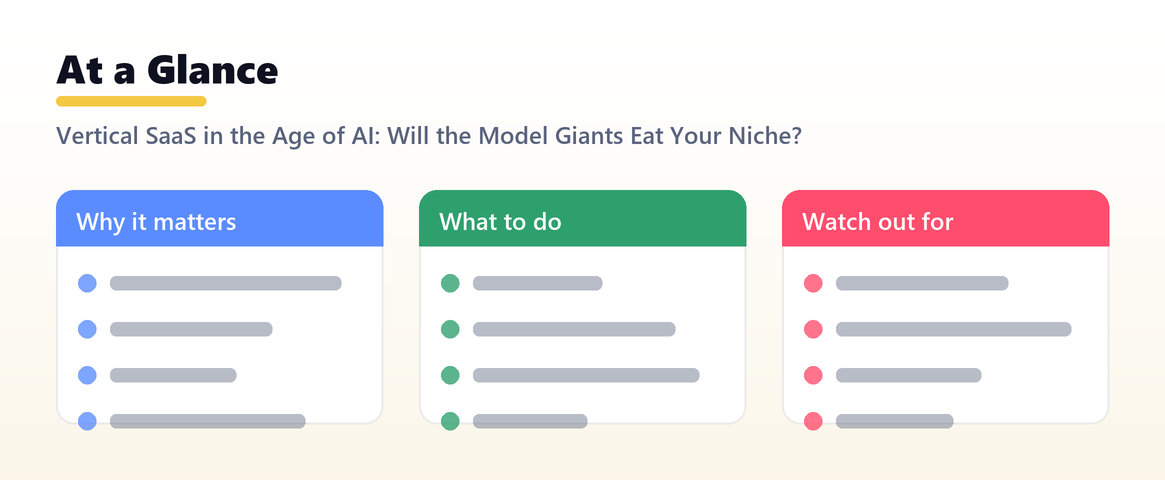
| The worry | The reality | Your move |
|---|---|---|
| Giants can ship my vertical in weeks. | True — they skip the cold-start problem and already own the users. | Out-move them on depth before the generic version matures. |
| Their generic product will beat mine. | Generic gets ~70% of the way. The last 30% — your data, your workflows — is where you win. | Train on YOUR data; own the workflow integration. |
| The all-in-one bundle era protects me. | It's ending. Agents mix and match best-of-breed services, not bundles. | Expose your capability as a clean API an agent can call. |
| I can't compete on compute or model quality. | You don't have to. Your moat is data and trust, not raw model horsepower. | Build a data moat and a workflow lock-in, not a better LLM. |
| Should I build my own AI layer or partner? | Depends on whether the capability is your differentiator or a commodity. | Build the moat; partner for the commodity infrastructure. |
Why Giants Can Ship Verticals Fast
To defend against the giants, respect what they are actually good at. Their advantage is real and worth naming precisely, because it tells you exactly which fights to avoid.
They skip the cold-start problem
The hardest part of building vertical SaaS was never the software — it was the cold start. Acquiring the first thousand users, earning the first reference logos, building the dataset. A platform provider with a hundred million existing users skips all of it. When OpenAI ships a personal-finance product, it ships to an enormous installed base on day one. That is a structural advantage you cannot match head-on, and you should stop trying to.
They ship in weeks, not years
Because the underlying model already exists, wrapping it in a vertical interface is a weeks-long effort, not a multi-year build. The categories that took a decade to establish — fintech, legaltech, productivity — can now have a generic challenger overnight. The window between "they could build this" and "they have built this" is roughly 12 to 18 months for any category they have not hit yet. That is your planning horizon.
What this actually means for you
It does not mean the niche is lost. It means the clock is running, and the worst response is to freeze. The founders who lose are the ones who assume their decade-old moat will hold and do nothing. The founders who win move faster than the platform can on the one dimension the platform is weakest: depth. Which brings us to where the giants are not strong at all.
Where They're Weak (Data, Integration, Trust)
The giants are generalists. In any domain with real stakes — health, law, finance, logistics, dental operations — the specialist wins. Here is the structural breakdown of where a focused vertical company beats a frontier platform, and why.
| Dimension | The giants' position | Where a vertical company wins |
|---|---|---|
| Proprietary data | Trained on the open web; generic by design. Gets ~70% of a domain task right. | Trained on your customer tickets, deal notes, SOPs, and case data — the last 30% that differentiates. |
| Workflow integration | A standalone chat product that lives outside your customer's real tools. | An agent that lives inside the systems your users already run all day. |
| Trust & compliance | Generic terms, generic data handling, generic accountability. | Domain-specific compliance, auditability, and a name your customer can call. |
| Domain accuracy | Jack-of-all-trades; "close enough" answers. | Specialist-grade results where "close enough" doesn't cut it. |
| Switching cost | Easy to try, easy to leave — no embedded workflow. | Deep integration and accumulated data make leaving painful. |
The 70/30 rule that decides who wins
A generic prompt to a frontier model will get a user roughly 70% of the way to a useful answer in most domains. The last 30% — the part that actually saves serious time, unlocks revenue, or carries legal and clinical weight — requires training on data the giants do not have: your customers' tickets, your deal notes, your standard operating procedures, your proprietary workflows. Vertical models trained on real domain data consistently outperform general LLMs on domain tasks. That 30% is your entire business. Protect it, deepen it, and the giant's generic version stays stuck at 70%.
Specialists eat generalists in high-stakes domains
This is not theoretical. Harvey trained on case law and contracts and is used by top law firms. BloombergGPT owns financial analysis because it learned on decades of market data, not Wikipedia. The pattern repeats in every domain with real consequences: the specialist that knows the field, the data, and the workflow beats the generalist that knows a little about everything. Our AI development and machine learning teams build exactly these vertical models and the RAG systems that feed them your private data.
Unbundling and the API-First Advantage
There is a second shift happening at the same time as the frontier-model invasion, and it works in your favor if you position for it correctly: the all-in-one software era is ending, and AI agents are the reason.
Why the all-in-one bundle is breaking
For a decade, SaaS companies raced to bolt on features. Your CRM grew a marketing suite; your project tool grew a CRM; everyone built everything. The pitch was "one login, one bill, no integrations." That model breaks the moment AI agents enter the picture. Agents do not care about your feature roadmap — they care about assembling the best tool for each micro-task. Book the meeting in one service, pull the lead from another, draft the follow-up in a third, log it in a fourth. The bundle becomes a liability; the building block becomes the asset.
The simple, brutal test: can an agent call it?
The companies winning right now sell composable building blocks, not bundles. WorkOS gives you enterprise SSO as a clean API a developer or an agent can plug in within an afternoon. Stripe owns payments the same way — clean endpoints, zero bloat, works with anything. The legacy all-in-one platforms fail one test: if your product cannot be called via an API or a command-line tool, an agent cannot use it, which means your users will route around you to a competitor that exposed the same capability as a composable service.
How API-first defends your niche
Here is the strategic insight founders miss: being API-first is not just hygiene — it is a moat against the giants. When your vertical capability is exposed as a clean, agent-callable endpoint, you become a building block in your customers' agent-orchestrated workflows. The giant's standalone chat product is not in that workflow; your service is, embedded where the actual work happens. The question to ask about your own product is no longer "does it have every feature?" It is "can an agent call it, and is it the best block for this job?" Our custom software development team helps SaaS companies decompose monolithic workflows into the agent-friendly, API-first pieces that survive the unbundling.
Building a Defensible Moat
You cannot out-compute the giants, and you do not need to. Compute and raw model quality are their moat, not yours. Your moat is data, integration, and trust. Use this checklist to build one that holds.
- Own proprietary data the giants can't scrape. Your customers' tickets, deal notes, SOPs, transaction history, and domain corpus are the foundation. The more of it you accumulate and the cleaner it is, the wider the gap between your 100% and their 70%.
- Train or fine-tune on that data. A vertical model or a RAG system grounded in your private data delivers specialist-grade results a general LLM structurally cannot. The lift is smaller than most founders assume.
- Embed in the customer's real workflow. Build agents that live inside the systems your users run all day, not a separate destination they have to remember to visit. Embedded beats standalone every time.
- Expose everything as a clean API. Make your core capability agent-callable so you become a building block in their orchestrated stack — not a bundle they route around.
- Win on trust and compliance. In high-stakes domains, domain-specific compliance, auditability, and a vendor someone can actually call are moats the giants' generic terms cannot match.
- Move inside the 12–18 month window. If the platforms have not hit your category yet, ship the agent layer and lock in users before the generic version arrives. Speed on depth is the defense.
- Control your unit economics. Map your highest-volume AI calls and own the compute stack for the ones that justify it — a fine-tuned model on reserved capacity can cut per-request cost 70–80% and let you own your SLA.
- Keep your IP and source. Whatever you build, retain full ownership of the model, the code, and the data pipeline. Your moat should never live inside someone else's black box.
When to Partner vs Build
Not everything deserves a custom build, and over-building is how startups die slowly. The decision rule is simple: build your differentiator, partner for the commodity.
Build when it's your moat
If a capability is your competitive edge — the vertical model trained on your data, the workflow integration that locks users in, the agent layer that defines your product category — build it and own it. This is where custom development pays for itself, because a bought or rented version cannot carry your proprietary data or your workflow depth.
Partner for the commodity layer
For the undifferentiated infrastructure — base model inference, auth, payments, hosting — partner. Use WorkOS-style APIs for SSO, Stripe for payments, and managed inference providers for raw model calls. There is no moat in re-building SSO, and every hour spent on it is an hour not spent widening your data advantage.
The compute nuance
There is one place the build/partner line gets interesting: high-volume inference. If you are calling a frontier API and paying three to five cents per complex request, that works at ten thousand users and bleeds you at a hundred thousand. The move is to map your highest-volume, lowest-margin AI calls and build a dedicated fine-tuned model for those narrow tasks on reserved capacity. You cut per-request cost dramatically and own your uptime — partnering for the platform, building for the hot path. Our team has done exactly this migration for SaaS clients, taking a lead-scoring agent from frontier-API pricing down to a fraction of the cost on a fine-tuned instance.
Final Checklist for Defending Your Niche
- You know which categories the platforms have already entered — and which window you still have (12–18 months).
- You have identified the proprietary data the giants cannot scrape and are actively accumulating more of it.
- You are training or fine-tuning on that data, not relying on generic prompts.
- Your core capability is exposed as a clean, agent-callable API — not locked inside a bundle.
- Your product lives inside your customer's real workflow, not as a standalone destination.
- You compete on data, integration, and trust — not on raw compute or model quality.
- You build your differentiator and partner for the commodity infrastructure.
- You have a plan to own the compute stack for your highest-volume, lowest-margin calls.
- You retain full ownership of your models, source code, and data pipeline.
- You are moving now — before the generic version of your product ships.
If two or more of these boxes are empty, your niche is more exposed than it feels. The giants are fast, but they are generic. Depth, data, and integration are how you stay ahead of them.
Frequently Asked Questions
Can a frontier model really replace my vertical SaaS product?
It can replace the generic 70% of what you do — the part any general model handles. It cannot replace the last 30% that requires your proprietary data, your workflow integration, and your domain trust. That 30% is your business. Deepen it and the generic version stays a generic version.
How fast can the platform giants actually ship into my category?
Weeks, not years, because the underlying model already exists. The realistic window between "they could build this" and "they have built this" is roughly 12 to 18 months for any category they have not yet entered. Treat that as your planning horizon and move on depth now.
What is the single most important moat for a vertical SaaS company today?
Proprietary data the giants cannot scrape, paired with deep workflow integration. Raw model quality and compute belong to the platforms; data and integration belong to you. A vertical model or RAG system trained on your private data is the most durable edge available.
Why does being API-first matter so much now?
Because AI agents assemble best-of-breed building blocks rather than using bundles. If your product cannot be called via an API, an agent cannot use it, and your users will route around you to a competitor that exposed the same capability cleanly. API-first makes you part of the agent-orchestrated workflow instead of a casualty of it.
Should I build my own model or just call an API?
Both, in the right places. Build a fine-tuned vertical model where it is your differentiator and where you have proprietary data. Call managed APIs for commodity inference and infrastructure. For your highest-volume, lowest-margin calls, owning a fine-tuned model on reserved capacity can cut cost 70–80% and give you control of your SLA.
I'm not a deep-AI company. Is this even realistic for my team?
Yes. The lift to fine-tune a vertical model or stand up a RAG system over your private data is smaller than the headlines suggest, and you do not need to become an AI research lab to do it. You need clear data, a defined differentiator, and a build partner who can scope it as a fixed-price engagement and hand you full ownership.
Defend Your Niche — Book a Free 20-Min Call
If the model giants are circling your category, let's map your defense. We will show you which parts of your workflow are ready to become agent-callable building blocks, where your data moat is strongest, and what it takes to build the vertical layer before the generic version ships. You get a named senior engineer, a written fixed-scope estimate, and full ownership of everything we build.
Explore more: AI Development · Machine Learning · Custom Software Development · View Our Work