You don't need to understand machine learning to hire the right AI development company. But you do need to ask the right questions — because the wrong hire will cost you months of wasted time and tens of thousands of dollars with nothing to show for it.
This guide is written for business owners and founders who are not engineers. No jargon. No technical theory. Just 10 honest questions that separate serious AI vendors from expensive disappointments — plus a pre-contract checklist you can use before you sign.
Plain-English questions every buyer should ask before hiring an AI company
Typical timeline for a well-scoped AI project from contract to launch
Projects delivered by Shanti Infosoft across the UK, US, UAE, and Australia
Why Non-Technical Buyers Need a Different Checklist
Most guides on how to choose an AI development company are written by engineers for engineers. They cover model architecture, training pipelines, and API latency. That is not what you need.
What you need to know is simpler: Will this company solve my actual business problem? Will it cost what they say? Will it still work in six months? And what happens when something goes wrong? Those are business questions, not technical ones. Any vendor worth hiring should answer every one of them in plain English — without making you feel like you should have studied computer science first.
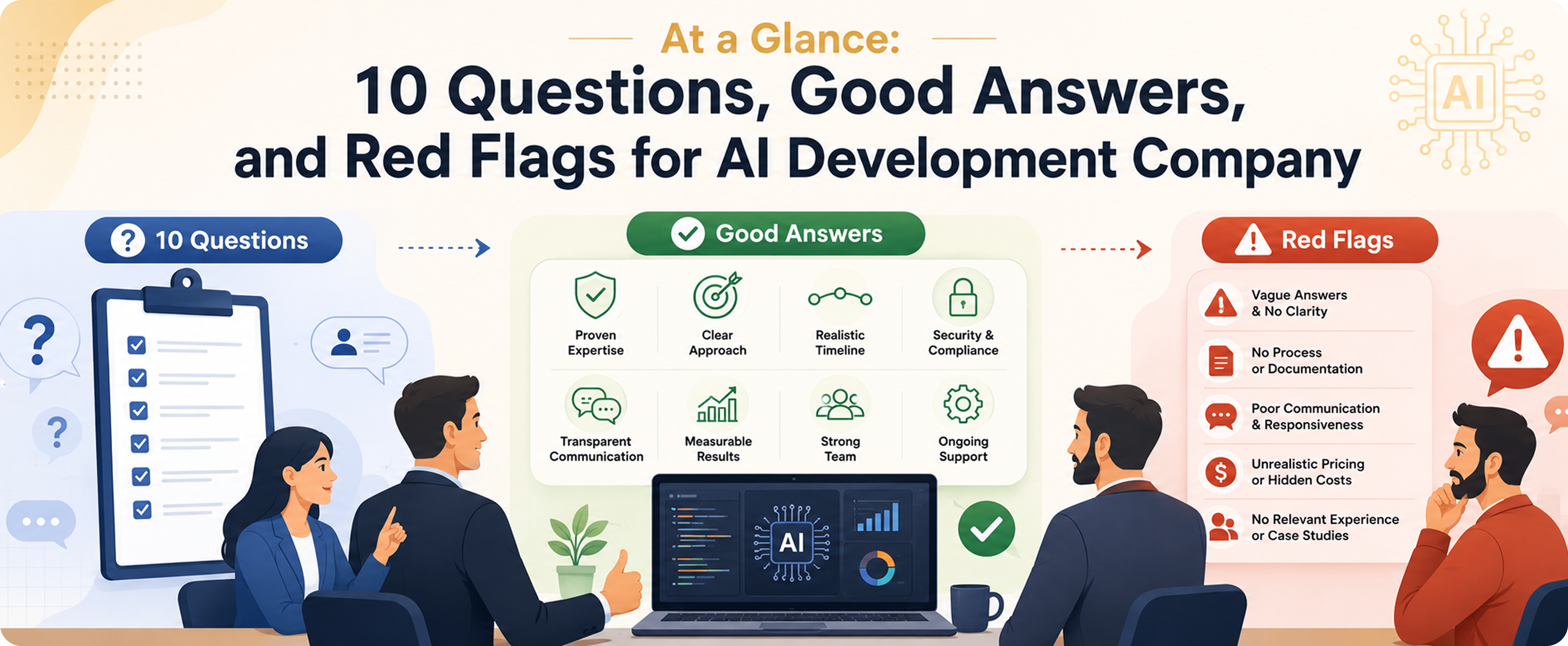
At a Glance: 10 Questions, Good Answers, and Red Flags
| # | Question | Good Answer | Walk Away If |
|---|---|---|---|
| 1 | Can you show me a live system? | Live product, real client, offer a reference call | Demos only, NDAs without alternatives |
| 2 | What business problem will this solve? | Specific outcome with measurable impact | Technology talk with no outcome |
| 3 | How will you measure success? | Named metrics agreed in writing | Vague goals like "improve efficiency" |
| 4 | Who owns the data and system? | Full ownership transfers to you | "Runs on our proprietary platform" |
| 5 | What happens after launch? | Defined support, monitoring, and update plan | Launch is treated as the finish line |
| 6 | How do you handle mistakes? | Escalation process, feedback loop, clear liability | "Our system rarely makes mistakes." |
| 7 | What will this cost now and later? | Full breakdown including ongoing fees | Project price only, nothing beyond |
| 8 | Who will work on my project? | Named team, offer to meet before signing | "Our experienced team of engineers" |
| 9 | Can you explain the process? | Clear milestones, weekly updates, your approval required | "We're agile and flexible." |
| 10 | What similar work have you done? | Specific results, verifiable client references | Wide portfolio, no depth on any project |
Question 1
Can You Show Me a Live System?
Any AI company can build a polished demo. Demos are designed to impress — controlled environments where every input is clean and every output looks perfect. Real business systems are noisier, messier, and far less predictable.
Ask to see a live product running for a real client right now. Better yet, ask to speak directly with that client.
Question 2
What Business Problem Will This Solve?
Before discussing technology, discuss outcomes. Ask the vendor to describe in specific language what your business will be able to do after the project that it cannot do today. Not "leverage AI-powered automation" — something concrete: what problem disappears, what task gets faster, what cost drops, and by roughly how much.
Whether you're exploring generative AI for content or customer service, or custom machine learning for data prediction — any serious vendor should be able to translate their technology into a specific business outcome for your situation.
Question 3
How Will You Measure Success?
If neither you nor the vendor can define what "done" looks like, the project will never feel finished — and you will keep paying for it. Push for specific, measurable success criteria before work begins, agreed in writing and tied to your contract.
Question 4
Who Owns the Data and System?
This question protects you from a trap more common than it should be: the project ends and you discover the vendor owns the model, the training data, or the infrastructure. You are now locked into paying them indefinitely just to keep using what you already paid to build.
Ask directly: after we pay you, who owns the model weights, the training data, and the code? Can we take this system elsewhere if we switch vendors? This applies equally to standard machine learning development and to generative AI pipelines where fine-tuned models and vector databases represent significant proprietary value.
Question 5
What Happens After Launch?
Most AI projects don't fail during development. They fail six months after launch, when the world changes and nobody updates the system. Models drift over time. Customer language changes. Your products change. Regulations change. A system that isn't maintained gradually becomes less accurate and eventually works against your business.
Question 6
How Do You Handle Mistakes?
Every AI system makes mistakes. The difference between a strong and a weak AI development company is not whether their system is perfect — it won't be. It is whether they have a clear plan for when it goes wrong. This is especially important for generative AI systems, where hallucinations and unexpected outputs are a well-documented limitation at production scale.
Ask: what happens when the AI gives a wrong answer? How does it flag uncertain responses? Who is liable when an error affects my customers?
Question 7
What Will This Cost Now and Later?
The initial project price is only part of what you will spend. AI systems carry ongoing costs — cloud hosting, API fees, data storage, maintenance, future updates — that many vendors underquote or skip during the sales conversation entirely.
Ask for a full breakdown upfront. Then ask: what happens to the cost if our usage doubles?
Question 8
Who Will Work on My Project?
The team you meet during the sales process is almost never the team that builds your system. This is one of the most consistent complaints from business owners who have been through a difficult AI development project.
Ask: who specifically will be on this project? Are they employees or contractors? Can I meet them before we sign? At our AI development company, every client meets the actual project team — named engineers, their backgrounds, and their prior work — before a contract is signed.
Question 9
Can You Explain the Process?
You don't need to understand the technology. You do need to understand how the project runs — how work gets done, how you stay informed, and how problems get escalated before they become expensive.
Ask: what do the first 30 days look like? How often do we meet? What am I approving at each milestone?
Question 10
What Similar Work Have You Done?
Experience in AI is not the same as experience in your industry. A company that has built machine learning systems for hospitals is not automatically equipped to build one for a retail business. Ask for examples close to what you actually need.
Ask: can you show me two or three projects similar to mine — same industry, similar problem, similar scale? What was the business result? You can review similar work we've delivered across industries in our client portfolio.
Final Checklist Before You Sign
Use this before committing to any AI development company. If two or more boxes remain empty, slow down before you sign.
- They showed you a live, working system — not a controlled demo
- They described your business outcome in specific, measurable terms
- Success metrics are defined and confirmed in writing
- Data, code, and model ownership is clearly stated in your contract
- Post-launch support and monitoring is agreed and costed
- You have met the actual project team by name
- You understand the milestones, the process, and your approval rights at each stage
- Total cost including ongoing fees is estimated in writing
- You spoke to at least one reference from a similar project
- Nothing felt rushed and no question was avoided or deflected
Frequently Asked Questions
Do I need to understand AI to hire an AI development company?
No. You need to understand your business problem clearly, ask the right questions, and insist on plain-English answers. That is enough to make a sound decision. If a vendor makes you feel foolish for asking basic questions, that tells you everything about how they will communicate throughout the project.
How much does an AI development project cost?
Costs vary based on complexity. For a well-scoped custom project, budget for development, integration, testing, and at least six months of post-launch support. Be cautious of quotes that seem unusually low — they almost always omit ongoing costs that make up the majority of what you spend in year one. Contact us for a written estimate with no obligation.
What is the most common mistake when hiring an AI company?
Focusing on the technology instead of the outcome. The question is never "what model will you use?" It is always "what will my business be able to do that it cannot do today, and how will we measure it?" Vendors who lead with technical capability and skip business outcomes are a consistent red flag.
How long does an AI development project take?
A well-scoped project — a customer service chatbot, a document processing tool, an internal search system — typically takes 2 to 5 months from signed contract to launch. Be skeptical of timelines under 6 weeks for anything genuinely custom, and equally skeptical of open-ended timelines with no defined milestones.
What questions should I ask about data security when hiring an AI company?
Ask how your data will be stored, who has access to it, whether it will be used to train models beyond your project, and what happens to it if you end the contract. Ask specifically for a Data Processing Agreement (DPA) — required under GDPR if they process personal data. Vague answers here are not just a business risk — they are a legal one.
Talk to an AI Development Team That Answers Every Question
We work with business owners and founders who are not technical. You get a named team, written cost estimates, full IP ownership, and 48-hour response times. CMMI Level 5 certified. 700+ projects delivered.